

By Marco Elian Ruiz | Updated on April, 2026 | 🕓 12 minutes
Key Highlights
- Why do so many freelancer retainers still lead to unstable income?
- How can “stable monthly clients” quietly reduce your effective hourly rate?
- What is the difference between a healthy retainer and disguised hourly labor?
- Why is client “pause flexibility” often more dangerous than project uncertainty?
- How can freelancers prevent scope creep inside retainer agreements?
- What contract clauses protect freelancers from sudden cancellations and hidden overtime?
- How do successful freelancers balance retainers, projects, and passive income streams?
In the fall of 2022, I rented a small apartment in the Alfama district of Lisbon, with sunsets over the Tagus River outside my window. At the time, I had just signed two $3,000-per-month retainer contracts—one with a SaaS startup in Berlin and another with an ecommerce brand in London. I thought I had finally escaped the classic freelancer feast-or-famine cycle.
Three months later, the Berlin client hit the “pause” button because of “Q4 budget adjustments.” The London client turned “small monthly tweaks” into fifteen hours of urgent weekly requests. My effective hourly rate dropped from $75 to $28—lower than what I had earned charging per project. Worse, I had stopped actively looking for new clients because, after all, I had “stable income,” right?
This is not an isolated story. According to Millo’s 2025 freelancer survey, freelancers with retainer clients earn an average of 35% more annually. But almost nobody tells you the other side of the story: nearly half lose at least one retainer client within the first year, and on average, 20–30% of retainer hours get silently overextended. In an Upwork survey, 63% of freelancers identified income instability as their biggest source of stress, while 43% experienced at least one month with zero income.
Most freelance retainers are essentially just “project work billed monthly.” You are still selling time—the uncertainty merely shifts from “Will I have projects this month?” to “Will this client pause, overload, or refuse to renew this month?”
A real retainer should function as a risk-transfer mechanism: converting the client’s uncertainty costs into a predictable long-term partnership. To achieve that, you first need to recognize the structural problems that turn retainers into traps.
Part One: Why Are You Still Broke Even After Signing Retainers? Five Hidden Traps
Ninety percent of retainer advice online only talks about the benefits while ignoring the structural dangers. The following five patterns repeatedly appear across global freelance communities.
Trap #1: The All-You-Can-Eat Trap
Carlo signed a $2,000/month retainer with a Singapore ecommerce company that included 40 hours of “maintenance and support.” Three months later, the client started treating new feature development, third-party API integrations, and even customer-service training as part of “support.” Carlo’s actual workload ballooned to 65 hours per month, and his effective hourly rate fell from $50 to $31.
Hourly retainers are essentially wholesale time sales. Clients are naturally incentivized to “use every hour,” while your profit ceiling becomes fixed. According to ClearTimeline research, 72% of freelance projects suffer from scope creep, with affected projects losing an average of more than £1,500.
Trap #2: The Pause Button Trap
Sophie signed a $4,000/month retainer with a marketing agency in New York City. Her contract stated that the “client may pause with 30 days notice.” In month six, the agency lost a major customer and hit pause. Sophie instantly lost 40% of her monthly income, and because she had already turned down two new projects during the previous months due to her “stable income,” she had no backup pipeline.
A “pause anytime” clause transforms your stable income into stable uncertainty. During the 2023 economic downturn, Kim Hobson lost two anchor retainer clients she had worked with for over two years—one because the company internalized the work, and the other because of cost-cutting measures. The risk becomes amplified in retainer models because freelancers often stop actively prospecting.
Trap #3: The Scope Creep Retainer
Diana’s contract simply said “monthly marketing support.” The client interpreted that as “unlimited marketing assistance.” In the first month alone, the client requested four blog posts, eight social media posts, one white paper outline, and three “quick brainstorming meetings.” Diana delivered approximately $6,000 worth of output while only receiving a $2,500 retainer fee.
As one service business owner explained:
“Clients sign the retainer agreement in the morning and start asking for clearly out-of-scope work in the afternoon. The contract says ‘monthly marketing support’; they hear ‘unlimited marketing help.’ Nobody is wrong. The contract is wrong.”
Trap #4: The Single-Client Dependency Trap
Ana had one retainer client accounting for 55% of her total income. When the U.S. startup cut 30% of its staff in 2024, her contract was “amicably terminated.” It took Ana four months to recover the income gap, during which she had to accept below-market-rate projects just to survive.
When one retainer accounts for more than 50% of your income, losing it becomes a form of structural unemployment. This is even more dangerous than project-based freelancing because you stop prospecting and gradually lose bargaining power. According to Freelancers Union data, 66% of freelancers struggle to find stable work.
Trap #5: The Nomad-Specific Tax
Mark, a Canadian digital nomad based primarily in Bali, provided technical consulting services to a German company. His contract was denominated in euros, while most of his living expenses were in Indonesian rupiah and U.S. dollars. In 2024, euro-to-rupiah exchange rate fluctuations reached 12%, meaning his real purchasing power shrank without any reduction in workload.
The legal side became even worse. When a contractual dispute emerged, the agreement required disputes to be handled under German law. For someone living in Bali, pursuing litigation in Germany was practically impossible.
Cross-time-zone communication costs, currency fluctuations, and unclear legal jurisdiction are all hidden taxes unique to global freelancers. According to Canadian legal publications, digital nomads face four major legal issues: determining applicable jurisdiction, consumer protection rules, where lawsuits must be filed, and where contracts are legally formed.
Part Two: Building Anti-Fragile Retainer Structures
Forget the simplistic “hourly vs deliverable-based” debate. Below are three retainer models that actually work.
2.1 Three Anti-Fragile Retainer Models
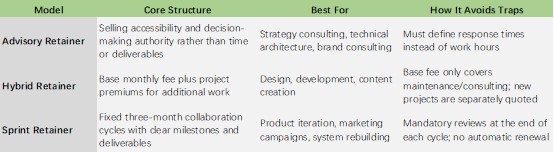
Advisory Retainer Example
Thabo, a business consultant in Johannesburg, provides “strategic advisory accessibility” services to a Nigerian fintech company. His agreement states:
- $3,500 per month
- Strategic questions answered within 24 hours
- One 90-minute deep consultation per month
- No execution work included
When the client says, “Can you quickly review this marketing campaign?” Thabo can confidently respond:
“That falls under execution work. I’d be happy to provide a separate quote for it.”
Hybrid Retainer Example
Nok, a web developer based in Chiang Mai, works with an Australian ecommerce company using a hybrid retainer structure.
- Base fee: $1,500/month
- Includes maintenance, security updates, and up to five hours of minor changes
- Any new page design, feature additions, or third-party integrations are quoted separately
This keeps Nok’s monthly income stable between $3,000 and $5,000 rather than locking her into a flat $1,500 ceiling.
2.2 Five “Life-Saving” Contract Clauses
The following clauses are based on seven years of trial and error, as well as best practices shared throughout global freelance communities.
Clause #1: Minimum Commitment Clause
Not “cancel anytime,” but “minimum three-month commitment, with early termination requiring payment of 50% of the remaining contract value.”
Why It Matters
You reserved capacity for this client and declined other opportunities. This is not a punishment—it is compensation for opportunity cost.
Real Example
Luiza, a social media manager in São Paulo, added a three-month minimum commitment clause to her contract. When the client attempted to pause the contract during month two, Luiza politely but firmly referenced the agreement. Instead of paying the $1,500 early termination fee, the client continued the collaboration. Three months later, they saw the value of consistent operations and renewed for an entire year.
Clause #2: Scope Fence
Clearly defining what is not included matters more than defining what is included.
Sample Clause
“This retainer does not include emergency requests requiring less than 24-hour turnaround, third-party vendor coordination, technical development beyond agreed platforms, or services listed under ‘Excluded Services’ in Appendix B. Any out-of-scope work will be billed at 1.5x the standard rate.”
Why It Matters
Vague scope definitions are the root cause of scope creep. According to BeanCount analysis, unclear retainer agreements are the leading cause of scope creep, revenue leakage, and deteriorating client relationships.
Clause #3: Value Reassessment Trigger
Reassess pricing every 90 days based on the ROI generated for the client.
Sample Clause
“Both parties agree to review the commercial value of this agreement quarterly. If the client’s measurable gains from the consultant’s services—including revenue growth or cost savings—exceed five times the retainer fee, the consultant may propose a fee adjustment of up to 30%.”
Why It Matters
This prevents “low-price lock-in.” Many freelancers help clients generate tens of thousands of dollars while continuing to charge the same outdated monthly fee.
Clause #4: Communication Budget
Include a fixed monthly limit for meetings, calls, emails, or Slack communication. Extra communication becomes billable.
Sample Clause
“This retainer includes up to three hours of synchronous communication per month, including meetings, phone calls, and video calls, along with reasonable asynchronous communication via email or messaging. Additional synchronous communication beyond three hours will be billed at $200/hour.”
Why It Matters
It protects your deep-work time. One creative professional interviewed by Digiday explained:
“Those ‘just five-minute’ requests are the most dangerous. If it really only takes five minutes, the client could probably do it themselves. Even if it’s quick, it doesn’t mean I budgeted the mental energy for it.”
Clause #5: Pause Penalty
Clients may pause, but must continue paying 30% of the monthly fee as a capacity-retention fee.
Sample Clause
“The client may request a temporary service pause for a minimum of 30 days. During the pause period, the client shall continue paying 30% of the monthly retainer as a reservation fee. If the pause exceeds 60 days, this agreement terminates automatically, and reactivation will require signing a new agreement under current rates.”
Why It Matters
Otherwise, you are forced to replace lost income within weeks, often pushing you into accepting underpriced work.
2.3 Special Clauses for Digital Nomads
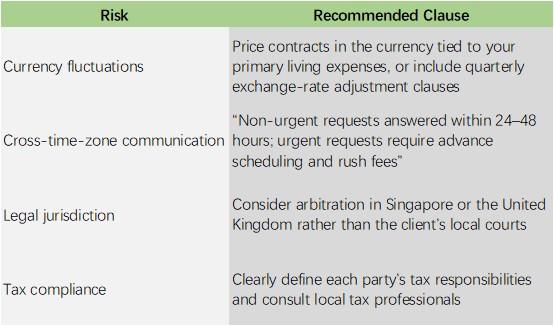
On Legal Jurisdiction
Canadian legal experts note that one of the biggest issues for digital nomads is determining which jurisdiction governs a dispute. The Singapore International Arbitration Centre (SIAC) and the London Court of International Arbitration (LCIA) are considered among the most freelancer-friendly options because of their efficiency, transparent procedures, and remote accessibility.
Part Three: From “Order-Taker” to External Partner — The Psychology of Retainer Negotiation
3.1 Don’t Sell a Retainer — Sell Opportunity Cost
Show clients the hidden cost of not having you available.
“Based on the past three months of collaboration, I’ve noticed your team consistently needs around 15–20 hours of ongoing website maintenance, content updates, and urgent fixes every month. Right now, those requests are spread across multiple vendors, which creates two-to-three-day coordination delays each time. With a monthly partnership, I can guarantee 48-hour response times instead of scheduling work two weeks out. What you save isn’t just my fee—it’s the time and operational friction your team currently loses waiting.”
3.2 Transitioning Clients from Projects to Retainers
Do not tell existing clients, “I want a retainer.”
Instead, say:
“Looking at the last three months, your team has recurring needs involving maintenance, updates, and emergency fixes. Under the current project-based model, every request requires new scheduling and quoting, which adds an average delay of five to seven days. I’d suggest testing a 90-day sprint retainer with clearly defined scope and response times. That allows you to stabilize this portion of your budget while giving your requests scheduling priority.”
3.3 Which Clients Are Bad Fits for Retainers?
- Clients with unstable budgets that constantly require “approval”
- Organizations with excessively long decision-making chains
- Clients who treat freelancers like employees by demanding fixed hours, daily reporting, or attendance at internal meetings
The ability to say no is the foundation of a healthy retainer strategy. As Studio Fellow advises, when clients push for discounts, confidently say:
“I sincerely appreciate the opportunity, but I’m unable to negotiate my rates.”
Then immediately shift the discussion toward outcomes and profitability.
Part Four: Retainer Portfolio Management — Building Anti-Fragile Cash Flow
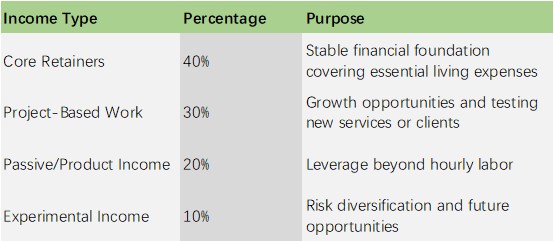
4.1 The Income Portfolio Formula
According to the 2026 Freelance Benchmark Report, the most successful freelancers use the following structure:
4.2 The Retainer Ladder Strategy
- 1 premium advisory retainer: 30–40% of income, low time investment, high strategic value
- 2 mid-tier hybrid retainers: 15–20% each, stable recurring cash flow
- 1 low-tier maintenance retainer: roughly 10%, nearly passive income while maintaining relationships
Example: Valentina in Medellín
Valentina, a digital marketing consultant based in Medellín, structured her income as follows:
- One SaaS advisory retainer from a U.S. company: $4,000/month (around 15 hours/month)
- Two hybrid retainers for Latin American ecommerce brands: $2,000/month each (about 25 hours/month each)
- One maintenance retainer for a local restaurant: $500/month (around five hours/month)
Total monthly income: $8,500.
Nearly half of that income comes from low-time-investment advisory work, giving her the freedom to build online courses and additional passive income streams.
4.3 Quarterly ROE Evaluation (Return on Energy)
Do not evaluate retainers solely by money earned.
Measure:
Net financial return per unit of emotional and cognitive energy invested.
Evaluation Criteria
1. Income stability
Do clients pay on time, or do you constantly chase invoices?
2. Time boundaries
Do they respect the agreed scope and communication limits?
3. Professional respect
Are you treated as an expert or disposable outsourced labor?
4. Growth potential
Does the work help you develop new skills or opportunities?
5. Exit cost
If the relationship ends, how difficult is the income replacement process?
Every quarter, eliminate the retainer client with the lowest ROE score and replace it with stronger opportunities.
Part Five: Practical Toolkit
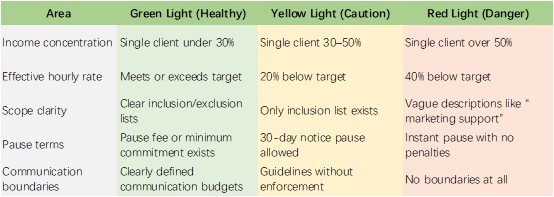
5.1 Retainer Health Checklist
5.2 Retainer Contract Checklist
Essential Clauses (10 Items)
〇 Detailed scope of services, including exclusions
〇 Monthly fee and payment timing (ideally prepaid at the beginning of the month)
〇 Minimum commitment period (recommended: three months)
〇 Termination notice period (recommended: 30–60 days)
〇 Pause terms and fees
〇 Rates for out-of-scope work
〇 Communication time budget
〇 Revision and feedback limits
〇 Legal jurisdiction and dispute resolution process
〇 Intellectual property ownership and transfer timing
Red-Flag Clauses (5 Items)
〇 “Unlimited revisions” or “until satisfaction”
〇 “Pause anytime without fees”
〇 Vague “fully responsible for everything” descriptions
〇 Fixed office hours or mandatory daily reports
〇 Equity-only or stock-only compensation unless you are effectively a cofounder
5.3 Pricing Anchor Formula
Base Retainer Fee Formula
Base Fee = (Last Month’s Similar Project Revenue × 0.8) + Response Premium
Why This Works
This is not discounting—it is value restructuring.
Under project-based work, approximately 20% of your time disappears into proposals, onboarding, communication, and waiting for approvals. In retainer relationships, much of that friction disappears, which is why you can use 80% of previous project revenue as the foundation and then add a premium for priority access.
Example
- Last month’s related project revenue: $3,000
- Actual production time: 30 hours
- Proposal/communication/waiting time: 10 hours
- Retainer base fee: $3,000 × 0.8 = $2,400
- Priority response premium: $600
Recommended Retainer Fee
$3,000/month
The income remains identical to project-based billing, but your actual working time decreases by roughly 25% while your revenue becomes significantly more predictable.
“The best retainer isn’t the one that traps you in golden handcuffs—it’s the one that pays you to say no to bad opportunities.”
FAQs
1. What is the biggest mistake freelancers make with retainers?
The most common mistake is treating retainers as guaranteed income instead of risk-managed business relationships. Many freelancers stop prospecting for new clients after landing a retainer, which increases financial vulnerability if the contract is paused or terminated.
2. Are hourly retainers always a bad idea?
Not necessarily, but they are often vulnerable to overuse and scope creep. If freelancers use hourly retainers, they should include strict scope definitions, communication limits, and overage billing terms to prevent unpaid labor expansion.
3. How many retainer clients should a freelancer ideally have?
Most experienced freelancers aim for multiple income sources instead of relying on one large client. A common strategy is maintaining two to four retainers while keeping project-based or passive income streams active.
4. What is a healthy percentage for one client’s share of income?
Financially safer freelance businesses usually keep a single client below 30% of total income. Once one client exceeds 50%, losing that contract can create serious financial instability.
5. Can freelancers include “pause fees” in contracts?
Yes. Pause fees or reservation fees are increasingly common in professional freelance agreements because freelancers reserve time and capacity for clients. These clauses help compensate for lost opportunities during inactive periods.
6. What is the safest retainer model for digital nomads?
Advisory or hybrid retainers are often safer because they emphasize strategic value rather than constant execution work. They also provide more flexibility across time zones and travel schedules.
References
1. BeanCount. (2024). Why vague retainer agreements create scope creep and revenue leakage. Retrieved from https://www.beancount.com
2. ClearTimeline. (2025). The true cost of scope creep in freelance and agency projects. Retrieved from https://www.cleartimeline.com
3. Digiday. (2024). Creative freelancers discuss hidden labor and communication overload. Retrieved from https://www.digiday.com
4. Freelancers Union. (2025). Freelance economic stability and client dependency report. Retrieved from https://www.freelancersunion.org
5. Millo. (2025). Freelancer retainer income survey. Retrieved from https://www.millo.co
6. Studio Fellow. (2024). Pricing boundaries and freelancer negotiation psychology. Retrieved from https://www.studiofellow.com
About the Author
Marco Elian Ruiz
Marco Elian Ruiz is a remote work strategist and former freelance consultant who has spent years working across Southeast Asia, Southern Europe, and Eastern Europe while advising independent professionals and distributed teams. His writing focuses on the economics of remote work, digital nomad culture, freelance sustainability, and geographic arbitrage. Marco is particularly interested in the gap between the marketed “freedom lifestyle” and the operational realities of online work, including taxation, client dependency, unstable income cycles, and long-term career resilience for remote workers.
Editorial Transparency Statement
This article was created through a combination of firsthand freelance industry experience, independent analysis, and publicly available reports from freelance platforms, business publications, and professional communities. The goal is to provide educational and practical insights for freelancers evaluating retainer-based business models.
Examples and scenarios in the article may be adapted from aggregated real-world experiences shared within freelance communities to protect individual privacy while preserving the underlying business lessons.
No sponsor, software company, freelance platform, or financial institution influenced the editorial direction of this content.
Disclaimer
This content is provided for informational and educational purposes only and should not be interpreted as legal, tax, accounting, financial, or investment advice. Contract laws, tax obligations, labor classifications, and dispute resolution procedures vary significantly by jurisdiction.
Readers should consult qualified legal, tax, or financial professionals before signing agreements, restructuring business models, or making major financial decisions related to freelance retainers or international remote work arrangements.
The author and publisher assume no liability for actions taken based on the information presented in this article.