

By Marco Elian Ruiz | Updated on February, 2026 | 🕓 14 minutes
Key Highlights
- Who actually profits most from the digital nomad industry?
- Are expensive nomad courses really necessary to get remote work?
- What free or low-cost alternatives exist for learning remote work skills?
- How can you verify whether a remote-work opportunity or certification is legitimate?
- What does sustainable geographic freedom actually look like beyond social media aesthetics?
I. A $12,000 Wake-Up Call
In the spring of 2023, I was sitting in a café in Lisbon, Portugal, across from an Australian entrepreneur. We started talking about our experiences as “digital nomads.”
“I’ve spent around $12,000 on courses and retreats,” he said. There was no anger in his voice—just a kind of exhausted clarity. “Eventually I realized that the people making the most stable money in this space aren’t software developers or marketers. They’re the people teaching others how to become digital nomads.”
That was the moment I understood we weren’t just looking at a lifestyle trend. We were looking at an industrial complex—an entire commercial ecosystem built around courses, retreats, certification programs, coworking spaces, and social-media storytelling.
This is not an argument against remote work or geographic freedom. On the contrary, I’ve personally benefited from remote work. What I want to unpack is this:
When you buy “freedom,” where does your money actually go? What are the incentives behind this industry? And how can you avoid being monetized while still achieving the life you want?
II. Anatomy of an Industry: Who Makes Up the “Complex”?
2.1 The Upstream Layer: Dream Merchants and Narrative Factories
Open Instagram or TikTok and you’ll see the same visual template repeated endlessly: a MacBook on a wooden table overlooking the ocean in Bali, captioned:
“Monday morning, 9 a.m. — my office.”
Many of the people posting this content are not actually making most of their income from the remote jobs they showcase. They make money from showcasing the lifestyle itself.
According to MBO Partners’ 2024 research, there are now 18.1 million self-identified digital nomads in the United States alone, representing 11% of the workforce and marking more than 147% growth since 2019.
But one statistic matters more than the headline:
- 17% of digital nomads earn less than $25,000 annually.
- 46% earn more than $75,000 annually.
In other words, income distribution is extremely polarized—and social media overwhelmingly shows you the stories from the top 46%.
Even more revealing is the actual revenue structure behind many “$10K/month nomad” creators:
- Affiliate marketing income (credit cards, VPNs, travel insurance)
- Course sales (“How I did it”)
- Brand partnerships (tourism boards, coworking spaces)
- A relatively small percentage from the “main career” they claim to have
One blogger based in Estonia pointed this out bluntly back in 2020:
“Most people selling these courses aren’t real digital nomads anymore. They traveled for a year or two, and now they’re trying to monetize the story. Their business is teaching people how to become digital nomads.”
Practical Tip: How to Spot “Income Flexing” vs. “Lifestyle Marketing”
- Look for income transparency reports, if they exist. How much comes from courses and affiliate sales?
- Search:
- “[Creator Name] + course review”
- “[Creator Name] + refund”
- Pay attention to timelines. If someone started teaching very shortly after they started “doing,” be cautious.
2.2 The Middle Layer: Courses and Certification Factories
This is the most hidden—and often the most profitable—part of the industrial complex.
Case 1: The $575 “All-in-One Bundle”
One blogger exposed a €575 “Digital Nomad School Bundle” filled with courses that were, in their words, “mostly fluff”—information that could either be found free online or purchased for a few dollars on platforms like Coursera.
Case 2: The $3,000–$5,000 “Premium Program”
More expensive programs usually include promises such as:
- “Guaranteed remote job placement”
- “Exclusive private community”
- “1-on-1 mentorship”
- “Certification upon completion”
But the real question is:
How valuable are these certificates to actual employers?
In 2024, a job seeker in the UK named Rachel spent £4,950 on a “Certified Cybersecurity Specialist” program that promised guaranteed interviews and salaries starting at £45,000+. What she ultimately received were outdated public materials, a certificate not recognized by any legitimate industry body, and “career support” that amounted to links to free job boards.
The U.S. Federal Trade Commission (FTC) has repeatedly warned consumers that fake work-from-home opportunities often promise high pay with little effort, then require upfront payments for training materials, background checks, or “special certifications.”
The core rule is simple: legitimate employers do not charge you money to get a job.
Practical Tip: Five Reverse Indicators for Evaluating Course Quality
1. It emphasizes speed
- “Go from zero to full-time remote worker in 6 weeks.”
- Real skill acquisition rarely works that way.
2. It avoids concrete skills
- Endless talk about “mindset” and “community,” but little discussion of SQL, Python, project management, design systems, or other practical competencies.
3. It guarantees income
- Any course promising specific earnings should raise skepticism.
4. It uses high-pressure sales tactics
- “Only 3 spots left.”
- “Price goes up tonight.”
- These are classic scarcity techniques.
5. The instructors’ backgrounds are difficult to verify
- Check LinkedIn. Do they have an ongoing professional career outside of selling courses?
2.3 The Downstream Layer: Retreats and Coworking Spaces — The “Retreat Economy”
This is the most experience-driven part of the industry—and often one of the highest-margin businesses within it.
Breaking Down the Economics of Retreats
Take a typical “Digital Nomad Transformation Retreat” in Bali:
Revenue
- $3,000–$5,000 per person for one week
Estimated Costs
- Shared villa rental: $8,000/week
- Food (15 people × 7 days): $3,675
- “Mentor” fees: $3,000
- Materials and marketing: $2,000
- Transportation and activities: $1,500
Total Estimated Cost
- Approximately $18,175
Revenue from 15 Participants
- Approximately $52,500
Estimated Profit
- Approximately $34,325
- Profit margin: roughly 65%
That far exceeds the normal retreat industry benchmark, where healthy profit margins often fall between 20% and 40%.
The “Nomad Tax” of Coworking Spaces
In Bali’s Canggu district, monthly coworking memberships typically range from IDR 2,000,000 to 4,500,000 (roughly $125–$280).
Meanwhile, many local cafés allow customers to work all day after buying a single $3 coffee.
One digital nomad in Chiang Mai compared common work options:
- Punspace monthly membership: 3,500 baht (~$98)
- Code Space monthly membership: 3,500 baht (~$98)
- Heartwork café:
- Drink + daily fee = around $45/month for 20 days
- Standard cafés:
- One coffee per day = roughly $34/month for 20 days
The Real Meaning of the “Nomad Tax”
You are not paying for Wi-Fi or chairs.
You are paying for social confirmation—the feeling of being surrounded by people making the same lifestyle choices as you, which reinforces the belief that you’ve made the “right” decision.

III. The Psychology: Why Smart People Keep Paying
This industry does not survive because people are unintelligent.
It survives because it targets deep psychological needs with remarkable precision.
3.1 Monetizing Identity Anxiety
“I’m not buying a course. I’m buying an identity.”
The transition from “office worker” to “digital nomad” offers the illusion of an identity upgrade.
You are not merely purchasing information. You are purchasing an answer to the question:
“Who am I?”
The industrial complex understands this perfectly. It packages “freedom” as a purchasable product—and your anxiety becomes its inventory.
3.2 Industrialized Echo Chambers
Paid communities often share one defining characteristic:
They filter out failure stories.
Inside these groups, you constantly hear stories like:
“I doubled my income after joining this program.”
What you rarely hear are the stories from people who spent $5,000 and saw no meaningful change—but remain silent because of embarrassment or sunk costs.
One blogger described the structure as:
“Almost pyramid-scheme-like.”
Why? Because the system relies heavily on existing customers becoming affiliates and evangelists who recruit more paying members while insisting:
“No, this isn’t a scam.”
3.3 The Sunk Cost Trap
“I already spent $5,000. If I spend another $3,000, maybe this time it’ll work.”
This is a classic behavioral economics trap.
The industry activates it by designing layered product ladders:
- Beginner course
- Advanced course
- Private coaching
- Retreats
- Mastermind groups
Each step deepens your emotional and financial commitment, making it harder to walk away.
IV. Global Case Studies: Same Script, Different Countries
This industrial complex is not unique to one region. The pattern repeats globally.
Lisbon, Portugal: The Visa Funnel
Portugal’s D8 Digital Nomad Visa requires a monthly income of at least €3,680 (roughly $4,000), while the visa fee itself is relatively modest at €90–€120.
But the real cost is housing.
A one-bedroom apartment in central Lisbon now averages around €1,300 per month, with annual rent increases often ranging from 15% to 25%.
As a result, “digital nomad visa consulting” businesses have exploded, charging anywhere from €500 to €2,000 to prepare paperwork—despite the fact that most of the information is freely available on Portuguese government websites.
Chiang Mai, Thailand: The Course Colony
Chiang Mai was once considered a digital nomad paradise.
Now it has also become a hotspot for dropshipping and affiliate-marketing gurus.
One observer summarized the problem sharply:
“These people charge $5,000 to teach you how to sell avocado slicers on Amazon. But the people really making money in dropshipping are the ones selling dropshipping courses.”
Canggu, Bali: Coworking as Performance
A long-term observer of Bali’s coworking culture listed seven “unspoken truths” about the experience:
- “Community” often means forced networking
- Productivity crashes after 3 p.m.
- $8 matcha lattes become normal
- Every second conversation turns into a Web3 startup pitch
The coworking space becomes less about work and more about performing the identity of a digital nomad.
V. The Anti-Hype Practical Guide: Low-Cost Alternatives That Actually Work
5.1 Skill Building: Low-Cost or Free Paths
Don’t:
Spend $3,000 on a “remote work certification.”
Do:
- Google Data Analytics Certificate
- About $39/month
- Recognized by many employers
- IBM Data Analytics Foundations
- Available to audit on Coursera
- freeCodeCamp
- Completely free
- Widely respected by developers
- Harvard/edX “Remote Work Revolution”
- Free to audit
- LinkedIn Learning
- About $30/month
- Extensive practical skill courses
The Core Principle
Employers care far more about:
- Verifiable skills
- Real-world projects
- Demonstrated outcomes
…than about how much money you spent on a certificate.
As one hiring expert put it:
“A portfolio and measurable project results beat a long résumé every time.”
5.2 Building Community Without Paying Thousands
Don’t:
Spend $2,000 joining an “exclusive nomad network.”
Do:
- Meetup.com
- Search “remote work” or “[city] digital nomads”
- Facebook Groups
- Example:
- “Chiang Mai Digital Nomads”
- Tens of thousands of members
- r/digitalnomad
- r/remotework
- r/freelance
- Free—and importantly, filled with both success stories and failure stories
- Coworker.com
- Compare coworking spaces and read reviews
5.3 Choosing Destinations with Anti-Marketing Thinking
Don’t:
Automatically follow Instagram trends toward places like Canggu or Lisbon.
Do:
- Use Numbeo for realistic cost-of-living research
- Search:
- “[City] + cost of living + local vs expat”
- Use the free tier of Nomad List
- Ask local Facebook groups:
- “What does a realistic monthly budget look like for locals?”
Underrated Destinations (Based on 2024–2025 Data)
- Tbilisi, Georgia
- Roughly $1,000–$1,400/month
- Da Nang, Vietnam
- Quieter and cheaper than Bali’s Canggu
- Udon Thani, Thailand
- Far from Chiang Mai’s nomad bubble
- Extremely low living costs
5.4 Verifying Income Claims: A More Practical Framework
Don’t:
Trust screenshots claiming “$10K/month.”
Do:
- Reverse-research companies on Glassdoor
- Search LinkedIn for current remote employees
- Ask detailed operational questions:
- “How often does your team meet on video calls?”
- “What are the timezone expectations?”
- Build a six-month emergency fund before transitioning into freelancing
A truly remote-friendly employer can answer these questions clearly.
VI. A Less Romantic—but More Sustainable—Definition of a Digital Nomad
After years of observation and personal experience, my definition of a “digital nomad” has completely changed.
It is not:
- Working on a beach in Bali with a MacBook
- Posting Instagram Stories every day
It is:
Having location-independent earning power.
That means if you returned to your hometown tomorrow, your work quality and income would remain intact.
This definition strips away the fantasy, the geographic arbitrage, and the lifestyle branding. It forces us to focus on one core question:
Are your skills strong enough that location becomes a preference rather than a requirement?
The Australian entrepreneur I met in Lisbon eventually stopped chasing the next hotspot.
He didn’t move back to Sydney. He didn’t continue the endless nomad circuit either.
Instead, he relocated to Mexico City, rented a normal apartment, joined a free local programming community, and started taking on stable remote development contracts.
His Instagram hasn’t been updated in six months.
“I stopped buying lifestyle products,” he told me.
“Now I only invest in things that directly improve my skills. Freedom isn’t purchased. It’s earned.”
VII. A Five-Question Self-Check Before Paying for Anything
1. What is the actual deliverable?
- Concrete skills?
- Or vague promises about mindset and community?
2. Without the marketing, what is this information truly worth?
- Could you learn it through books, YouTube, libraries, or low-cost courses?
3. What is the seller’s real income source?
- Their actual profession?
- Or teaching people how to enter that profession?
4. What is the refund policy?
- Is there a genuine no-questions-asked refund window?
- Many expensive programs have extremely restrictive refund clauses.
5. One year from now, what do you want to be remembered for?
- Attending a retreat?
- Or mastering a valuable skill?
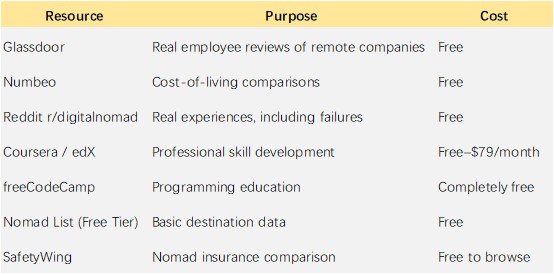
VIII. Actually Useful Free Resources
Conclusion: Are You Paying for Freedom—or Paying to Look Free?
This industrial complex will not disappear, because the underlying desire is real.
People genuinely want more freedom, more flexibility, and more meaningful ways of living and working.
But the problem begins when “freedom” itself becomes a commercial product.
At that point, the act of purchasing freedom can become another form of dependency.
My advice is not:
“Never buy anything.”
It is:
Learn to recognize the incentive structure behind the industry before spending money.
Ask yourself:
- Is this purchase moving me closer to my goals?
- Or moving someone else closer to their sales targets?
Ultimately, real geographic freedom comes from three things:
- Irreplaceable skills
- Sustainable income sources
- Rational financial planning
No retreat can sell you those things.
No course can build them for you.
At some point, you have to build them yourself.
FAQs
1. Are all digital nomad courses scams?
No. Some courses provide structured learning, mentorship, accountability, or technical skills that can genuinely help people. However, many overpriced programs primarily sell motivation, branding, and lifestyle aspirations rather than employer-recognized competencies. The key difference is whether the course delivers measurable, transferable skills and transparent outcomes.
2. Do employers care about digital nomad certifications?
In most industries, employers prioritize practical experience, portfolios, problem-solving ability, and verified technical skills over niche “digital nomad” certificates. Certifications tied to established institutions or technology vendors may carry weight, but generic remote-work certificates often have little hiring value.
3. Is it possible to become location-independent without joining paid communities?
Yes. Many successful remote workers build careers through low-cost or free resources, including open-source communities, professional networking platforms, online portfolios, local meetups, and skill-based education platforms. Consistent skill development and networking often matter more than paid memberships.
4. Are coworking spaces necessary for productivity?
Not necessarily. Some people benefit from structured environments and networking opportunities, while others work effectively from cafés, libraries, or home offices at far lower cost. The value depends on work style, profession, and personal preferences rather than branding.
5. What are the biggest hidden costs of the digital nomad lifestyle?
Frequent relocation, unstable housing, healthcare, visa renewals, tax complexity, inconsistent income, burnout, loneliness, and currency fluctuations are often underestimated. Social media content rarely reflects these ongoing pressures.
6. Is geographic freedom realistic for average workers?
It can be, but usually through gradual skill-building and career adaptation rather than overnight transformation. Sustainable remote careers are typically built over years through expertise, professional relationships, and financial discipline.
7. What is the healthiest mindset toward the “laptop lifestyle”?
Treat geographic flexibility as a byproduct of valuable skills and stable income—not as a personality brand or consumer identity. Long-term freedom is usually more practical and less glamorous than social media portrays.
References
1. Federal Trade Commission. (2025). Job scams. Retrieved from https://consumer.ftc.gov/articles/job-scams
2. MBO Partners. (2024). Digital Nomads Report 2024. Retrieved from https://www.mbopartners.com/state-of-independence/digital-nomads/
3. Coursera. (2025). Google Data Analytics Professional Certificate. Retrieved from https://www.coursera.org/professional-certificates/google-data-analytics
4. edX. (2025). Remote Work Revolution for Everyone. Retrieved from https://www.edx.org/
5. freeCodeCamp. (2025). Learn to Code — For Free. Retrieved from https://www.freecodecamp.org/
6. Numbeo. (2025). Cost of Living Index by City. Retrieved from https://www.numbeo.com/cost-of-living/
7. Glassdoor. (2025). Remote company reviews and salary insights. Retrieved from https://www.glassdoor.com/
8. SafetyWing. (2025). Nomad insurance resources and pricing. Retrieved from https://www.safetywing.com/
About the Author
Marco Elian Ruiz
Marco Elian Ruiz is a remote work strategist and former freelance consultant who has spent years working across Southeast Asia, Southern Europe, and Eastern Europe while advising independent professionals and distributed teams. His writing focuses on the economics of remote work, digital nomad culture, freelance sustainability, and geographic arbitrage. Marco is particularly interested in the gap between the marketed “freedom lifestyle” and the operational realities of online work, including taxation, client dependency, unstable income cycles, and long-term career resilience for remote workers.
Editorial Transparency Statement
This article is intended for educational and informational purposes only. It reflects a combination of publicly available research, industry reports, firsthand observations, and commentary on trends within the digital nomad and remote-work economy.
The article does not receive sponsorship from coworking brands, retreat operators, visa consultancies, online-course providers, or affiliate partnerships related to the products and services discussed. Any examples mentioned are used solely for analysis, commentary, or educational context.
While every effort has been made to ensure factual accuracy at the time of publication, pricing, regulations, visa requirements, and market conditions may change over time. Readers are encouraged to verify financial, legal, immigration, and employment information through official sources before making decisions.
Disclaimer
The content in this article does not constitute legal, immigration, financial, tax, investment, employment, or psychological advice. Readers should consult qualified professionals before making major financial commitments, relocating internationally, purchasing educational programs, or changing career paths.
Experiences within the digital nomad and remote-work economy vary widely depending on industry, skill level, citizenship, financial resources, visa eligibility, and personal circumstances. References to income levels, business models, or lifestyle outcomes are illustrative examples and should not be interpreted as guarantees of future results.
Any mention of third-party companies, platforms, communities, or services does not constitute endorsement or recommendation.