

By Nikolai Mercer | Updated on May, 2026 | 🕓 13 minutes
Key Highlights
- Why are remote workers more vulnerable to AI-driven bureaucracy?
- How does automation create more hidden administrative work?
- What is “digital Taylorism” in the AI era?
- Why do productivity gains often lead to higher expectations instead of more free time?
- What kinds of tasks should never be delegated to AI?
- Why do organizations struggle to absorb AI successfully?
British psychologist Lisanne Bainbridge wrote a paper in 1983 called Ironies of Automation. Four decades later, the phenomenon she described is replaying itself on the screens of remote workers using AI every single day.
I. The Discovery of the Paradox: From Personal Invoices to Global Data
In 2024, freelance platform Upwork commissioned a survey covering 2,500 workers worldwide. The result was not “AI makes work easier,” but something far more uncomfortable: 77% of respondents said their workload had actually increased after using AI; 71% reported burnout; and 47% admitted they had no idea how to use AI in ways that met their employer’s performance expectations.
More specifically, 39% of workers said they now spend more time reviewing AI-generated content, 23% were forced to teach themselves how to use new tools, and 21% acknowledged that AI directly caused them to be assigned more work.
This was not just one platform’s bias. In early 2026, enterprise software company Workday released a survey covering 3,200 corporate employees across North America, Europe, and the Asia-Pacific region. These workers all came from companies with over $100 million in annual revenue and more than 150 employees, and all of them were active AI users.
Eighty-five percent said AI saved them between one and seven hours per week. Sounds good, right? But the next number changed the tone entirely: 37% of those “saved” hours were spent on rework — correcting, rewriting, and verifying AI-generated output. Only 14% of respondents said they consistently achieved a clearly positive net gain from AI.
Workday president Gerrit Kazmaier used the phrase “productivity paradox” directly in an interview with Axios. He said the people who used AI most heavily were also the ones spending the most time reviewing and correcting its outputs.
Researchers at University of California, Berkeley spent eight months in 2025 embedded inside a 200-person technology company conducting field research. After more than 40 in-depth interviews, they discovered a subtle but critical phenomenon: the company had not explicitly increased employee KPIs. AI tools had simply made “more tasks possible.” As a result, employees’ to-do lists naturally expanded, spilling into lunch breaks and evenings.
One engineer said the expectation that AI would “free up time” was quickly replaced by the reality of “the same amount of work — or more.” Even more ironically, another experiment showed that developers using AI believed they were 20% more productive, while in reality they took 19% longer to complete tasks. Overall, the actual time savings from AI amounted to roughly 3%, with no significant impact on income or working hours.
I did not invent these numbers. They come from different research institutions, different countries, and different industries. Yet they all point in the same direction: AI is not subtracting work. It is performing a strange kind of addition — removing certain manual tasks while inserting new burdens elsewhere in the system.
II. Global Cases: None of Them Are Simple Success or Failure Stories
American Healthcare: Bot Wars
The American healthcare system loses roughly $350 billion annually to administrative waste. That number alone tells you how broken the process infrastructure already is. Then AI arrived.
Hospitals began using AI to automatically generate insurance preauthorization requests. Insurance companies responded by using AI to automatically review and reject those requests. The result was something now referred to as “Bot Wars”: hospitals’ AI systems submitted more applications, insurers’ AI systems rejected them faster, and both sides escalated their algorithms while communication volume exploded, costs piled up, and patient wait times actually grew longer.
In a May 2026 report, the Peterson Health Technology Institute stated that “AI layered onto broken workflows only makes the brokenness more visible — and more expensive. It does not fix it.”
This does not mean AI has no value in healthcare. In certain diagnostic imaging fields, AI genuinely improved accuracy. But at the administrative level, AI became an accelerator — accelerating not efficiency, but the system’s existing friction.
The result: doctors and nurses did not spend less time filling out forms or communicating with insurers. In many cases, they spent more time correcting AI-generated documents because of incompatible formats, missing information, or validation problems.
The Dutch Government: How an AI System Brought Down a Cabinet
In 2021, the Dutch government collapsed because of an AI welfare fraud detection system. The system was used to flag families suspected of fraudulently receiving childcare benefits. Instead, it falsely accused thousands of families. Many were pushed into massive debt, and their lives were destroyed. Eventually, the cabinet led by Prime Minister Mark Rutte resigned collectively.
But the complexity of this story is important: the problem was not simply that “AI was evil.” Subsequent investigations revealed that the data quality behind the system was terrible, different departments used incompatible data formats, and the bureaucracy lacked the technical capacity to properly understand, monitor, or correct the AI’s decisions.
Researchers at Stanford Law School systematically evaluated AI governance implementation across the U.S. federal government in 2022. They found that of 456 AI governance legal requirements, fewer than 40% could be publicly verified as implemented. Of 23 requirements from an AI leadership executive order, only 39% were completed. Of 15 requirements from a trustworthy AI executive order, only 13% were completed. Roughly 88% of agencies that were supposed to submit AI plans had not submitted them at all.
This points toward a deeper problem: the speed of AI deployment is vastly outpacing institutions’ ability to absorb it. The Dutch tragedy was not a simple morality tale about “bad AI.” It was a story about the mismatch between bureaucratic maturity and technological ambition.
As Fast Company argued in a 2025 analysis, most government agencies remain in the first or second stage of AI maturity, while the AI projects they attempt require fourth- or fifth-stage maturity to succeed.
AES: When 14 Days Became 1 Hour — and Workloads Doubled
In March 2026, Fortune reported on energy company AES Corporation. The company used AI to reduce an audit process from 14 days to 1 hour.
Under normal logic, employees should have been able to go home earlier. Instead, the opposite happened: the task itself shrank from six hours to forty minutes, but employees’ total workloads expanded from eight-hour days to twenty-hour days. Why? Because once efficiency increased, the organization did not reduce task allocation. It simply filled the newly released capacity with more work.
This is a digital-age replay of the Jevons Paradox from economics. In the nineteenth century, improvements in steam engine efficiency did not reduce coal consumption; they increased it, because lower costs stimulated more demand.
AI works similarly. It is not merely a labor-saving technology. It is a demand-creation technology. Every minute you save is rapidly consumed by some new expectation.
The “Small Accidents” and the Burden of Verification
Some incidents sound ridiculous at first glance, but they reveal the same structural problem underneath.
A supermarket in New Zealand used an AI recipe planner that recommended recipes containing toxic ingredients. A chatbot deployed by the New York City Government incorrectly told users it was legal to fire employees for reporting sexual harassment. AI systems from Google suggested people should “eat rocks” or “put glue on pizza.”
These were not isolated technical glitches. They were extreme expressions of what might be called a “verification tax.” Once AI becomes embedded into everyday workflows, every output requires secondary human review.
Upwork’s data showed that 39% of workers now spend more time reviewing AI outputs. Harvard Business Review coined the term “workslop” in a 2025 survey — low-quality AI-generated content that forces employees to waste time correcting memos, reports, and emails.
Their survey of 1,150 American white-collar workers found that 40% had experienced AI slowing down their work within the previous month, with each incident costing an average of 1 hour and 56 minutes.
What do all these cases share in common?
Not that AI failed — but that there is a gap between what we expect AI to do and what it actually does. AI genuinely accelerates certain processes, but at the same time it creates new, often underestimated hidden costs. And in the world of remote work, nobody shares those costs for you.
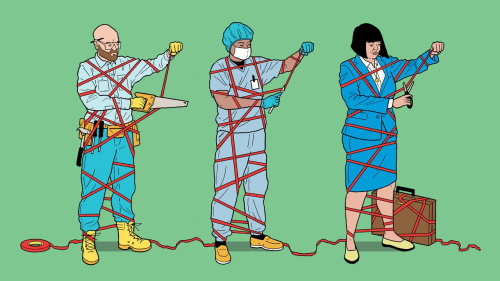
III. Four Hidden Mechanisms: How Bureaucracy Grows Out of Code
The first mechanism is verification and monitoring burden.
Research from Boston Consulting Group found that employees constantly monitoring multiple AI tools experienced a 12% increase in mental fatigue. This phenomenon has been called “AI Brain Fry.”
Remote workers have no support staff to catch mistakes for them. Every AI-generated client proposal, contract draft, or financial report ultimately becomes their personal responsibility. You are no longer just completing work — you are also completing the additional work of verifying whether AI completed the work correctly.
The second mechanism is the transfer of shadow work.
The analogy comes from self-checkout machines. Supermarkets did not eliminate cashier work; they transferred it onto customers.
The AI version of shadow work is more subtle. AI generates meeting summaries, but you spend twenty minutes “translating” them into something a client can actually understand. AI helps write code, but you spend an hour debugging hidden errors it introduced. AI drafts an email, but you spend fifteen minutes adjusting the tone so it sounds human.
Workday’s data suggested that for every ten hours saved through AI, organizations “pay back” four hours in rework. Yet none of that rework appears inside project management systems. It is invisible, unpaid, but absolutely real.
The third mechanism is tool stack expansion and cognitive tax.
Earlier, I mentioned subscribing to more than ten AI tools myself. Every additional tool introduces another layer of learning costs, switching costs, subscription management costs, and data silo problems.
Workday’s survey found that in 89% of organizations, fewer than half of all job roles had been updated to reflect AI capabilities. Employees were described as “using 2025 tools inside 2015 job structures.”
For remote workers, the problem is even worse. We have no IT department handling procurement, deployment, or training. You become your own AI systems administrator — and it is unpaid labor.
The fourth mechanism is global competition and expectation inflation.
Massachusetts Institute of Technology published research on the accounting industry in August 2025 showing that when automation replaces “simple tasks,” the remaining work demands higher skill levels and wages may rise. But when automation replaces “professional tasks,” barriers to entry fall, more competitors flood in, and pricing collapses.
For remote workers and freelancers, this means the time you save rarely becomes leisure. Instead, it becomes pressure to take on more lower-priced projects.
Employers’ expectations for AI-assisted workers are rising globally, while compensation is not increasing at the same pace.
Combined together, these four mechanisms create what I would call a new form of “digital Taylorism.”
Frederick Winslow Taylor used stopwatches to measure factory workers’ movements in order to maximize industrial efficiency. Today’s AI systems use algorithms to measure knowledge workers’ output in order to maximize throughput.
The only difference is that the “factory” is now distributed across bedrooms, cafés, and coworking spaces around the world.
IV. Why Remote Workers Are Especially Vulnerable
Why are remote workers and freelancers particularly exposed to this paradox?
I thought about this for a long time, and I believe there are three major reasons.
First, there is no organizational buffer.
When corporate employees become more efficient, companies may reduce labor allocation or at least redistribute workloads through HR structures. But remote workers are usually paid per project or per deliverable.
Clients do not reduce expectations because you use AI. On the contrary, they expect you to produce more within the same timeframe. Your efficiency gains become the client’s cost savings — not your free time.
Second, you are your own IT department.
Corporate employees have internal teams responsible for software procurement, security reviews, training, and troubleshooting. Remote workers absorb all of it personally.
When you spend three hours figuring out why a file exported from AI Tool A cannot be recognized by Tool B, those three hours are not “learning costs.” They are hours directly deducted from your billable work time.
Third, the consumption trap of productivity porn.
Buying AI tools is psychologically similar to buying Notion templates, online courses, or a seventh project management app. The essence of the tech consumer trap is replacing action itself with the act of purchasing optimization.
Every time you subscribe to another AI tool, you are consuming a fantasy about a “better version” of yourself. Maintaining that fantasy requires ongoing investment — learning, configuring, optimizing, migrating.
Those investments rarely appear inside “work cost” calculations. But they are absolutely costs.
V. My Experiment: A Remote Worker’s “Anti-Automation Audit”
I spent three days tracking every minute related to AI.
Not just “AI saved me two hours writing copy,” but everything: how many minutes went into prompt engineering? How much time was spent checking and correcting AI outputs? How many minutes disappeared switching between Tool A and Tool B? How much time went into learning new features or reading update logs?
The results made me uncomfortable.
AI genuinely saved time on certain tasks. But once I added back the time spent “managing AI,” the net time savings became negative.
Not “slightly smaller than expected.” Clearly negative.
That experiment led me to develop five practical principles. They are not a “best practices checklist.” They are messy, highly personal coping mechanisms I developed while navigating chaos. You do not have to adopt all of them, but they may still be useful.
Eventually, I divided my work into three zones.
The green zone is fully automated: data formatting, spell checking, scheduling.
The yellow zone is AI-assisted but requires human review: email drafts, first-pass meeting notes, code snippets.
The red zone belongs exclusively to humans: client pricing strategy, career direction decisions, and any communication involving trust and relationships.
Work in the red zone should never be “initially drafted” by AI — because drafting sets the tone, and tone shapes decisions.
I also set a weekly “AI management time limit.” My recommendation is that it should not exceed 10% of your total working time. Once you exceed that threshold, it signals that your tool stack is out of control and triggers an emergency audit.
The existence of that limit forces a decision: should you spend your time optimizing tools, or simply complete the task manually?
VI. Beyond the Worship of Efficiency
MIT’s research offers a balanced perspective: the direction of automation matters.
Automating the execution layer can free you to focus on the judgment layer. But if you outsource judgment itself to AI, you eventually become a servant to your own tools.
Your competitive advantage is not “using AI faster.” It is preserving human judgment in the AI era.
What makes this paradox so difficult to notice is that it is wrapped inside an optimistic narrative. Every AI product update promises to make you “more efficient.” Every tech media headline says “AI is changing the world.”
But very few people ask: changing it in what direction? Who absorbs the hidden costs? Where did the saved time actually go?
Maybe true liberation is not owning more tools, but having the courage to say, “I am not using AI for this task.”
Maybe true efficiency is not completing more tasks, but protecting the parts of life that algorithms cannot replace: judgment, creativity, trust, and human relationships.
I do not know the final answer. I am still experimenting.
But I do know this: when I canceled the auto-renewal on my tenth AI subscription last month in Ubud, my credit card bill became lighter — and my brain became slightly quieter too.
FAQs
1. What did Lisanne Bainbridge mean by “Ironies of Automation”?
In her 1983 paper Ironies of Automation, British psychologist Lisanne Bainbridge argued that automation often removes routine tasks while leaving humans responsible for more difficult supervision and error-handling tasks. Modern AI systems reflect many of the same problems.
2. Why are freelancers and remote workers especially affected?
Remote workers often lack organizational support systems such as IT teams, compliance staff, or training departments. They personally absorb the costs of troubleshooting tools, learning systems, managing subscriptions, and correcting AI outputs.
3. What is “digital Taylorism”?
The term refers to AI-driven measurement and optimization of knowledge work, similar to how Frederick Winslow Taylor scientifically measured factory labor during the industrial era. In modern digital work, algorithms increasingly track productivity, output, and workflow efficiency.
4. Should all important work avoid AI entirely?
Not necessarily. It's more advisable to categorize work into:
- Fully automatable tasks
- AI-assisted tasks requiring human review
- Human-exclusive judgment tasks
The key idea is that sensitive decisions involving trust, pricing, strategy, ethics, or relationships should remain human-led.
References
1. Bainbridge, L. (1983). Ironies of automation. Automatica, 19(6), 775–779.
2. Upwork. (2024). Research on AI productivity and burnout among knowledge workers.
3. Workday. (2026). Global AI productivity and workforce adaptation survey.
4. University of California, Berkeley. (2025). Field research on AI integration and workplace expansion effects.
5. Harvard Business Review. (2025). Workslop: How AI-generated content creates hidden productivity costs.
6. Massachusetts Institute of Technology. (2025). Automation, labor restructuring, and professional wage dynamics.
7. Peterson Health Technology Institute. (2026). AI and administrative inefficiencies in healthcare systems.
8. Stanford Law School. (2022). Assessment of federal AI governance implementation.
9. Organisation for Economic Co-operation and Development. (2025). AI adoption, labor markets, and productivity governance.
About the Author
Nikolai Mercer
Nikolai Mercer is a technology operations analyst and SaaS infrastructure researcher focused on enterprise software ecosystems, AI implementation strategies, and subscription-based technology economics. His work explores how organizations adopt AI tools, where automation initiatives fail, and why many modern SaaS products prioritize investor narratives over measurable operational improvements. Nikolai writes extensively about AI-related spending, hidden implementation costs, workflow inefficiencies, and the long-term sustainability challenges facing software-dependent businesses.
Editorial Transparency Statement
This article combines personal experience, public research, institutional reports, and media analysis to examine the unintended operational consequences of AI adoption in modern remote work environments.
The editorial goal is not to promote or reject AI tools categorically, but to critically evaluate their real-world impact on workload, administrative burden, and cognitive labor. The article intentionally includes both positive and negative findings related to automation and AI-assisted productivity.
This article is based on personal remote work experience and draws from publicly available research including studies and reports from Upwork (2024), Workday (2026), UC Berkeley (2025), Harvard Business Review (2025), MIT (2025), Peterson Health Technology Institute (2026), Stanford Law School (2022), and OECD (2025). All cases and statistics cited in this article are derived from verifiable public sources.
Disclaimer
This article is intended for informational and educational purposes only. It does not constitute legal, financial, psychological, employment, or professional technology advice.
Workflows, productivity outcomes, and AI implementation experiences may vary significantly depending on industry, technical skill level, organizational structure, and individual work habits.
Readers should independently evaluate any AI tools, automation systems, or workflow strategies before adopting them in professional environments.