

By Adrian Vale | Updated on April, 2026 | 🕓 15 minutes read
Key Highlights
- What are the hidden risks behind the "study → work → permanent residency" path?
- How do different countries use international students as temporary labor?
- Which policies and traps most affect your chances of staying after graduation?
- What practical strategies can help international students protect themselves?
- Are there alternative paths to building a global career without permanent residency?
1. A Carefully Packaged Promise
Open the social media account of any study-abroad agency, and you are likely to see messages like:
"Study in Canada, graduate and get a three-year work permit, high chance of immigration success!"
"Australia as a study destination = a stepping stone to immigration, just pick a program on the shortage occupation list!"
"UK PSW visa is back, stay two years after graduation and easily switch to permanent residency!"
These messages precisely hit the anxieties and expectations of countless families. For students and their families from Nigeria, India, Vietnam, Colombia, the Philippines, and other countries, the word "study abroad" often equates to "changing their destiny." They mortgage property, borrow money, and exhaust savings—all for the chance to "stay."
But the truth is: governments have designed a sophisticated screening system. On the surface, they welcome you as a student, but in reality, they treat you as a "manageable temporary workforce"—used when needed and discarded afterward, or forced to self-eliminate through long waiting periods.
This is not a conspiracy theory—it is a transparent policy logic. Canadian Immigration Minister Marc Miller bluntly stated in a 2023 press conference:
"There are jobs in every sector seeking cheap labor… why would we deny them (international students) the right to work? After all, they’ve paid so much money to study here."
The subtext is clear: international students are workers first, students second.
2. Core Mechanisms: How International Students Are Designed as "Manageable Temporary Labor"
2.1 The Time-Lag Trap: Every Step Is a Cutthroat Race
The "study permit → work permit → permanent residency" path in every country is essentially a marathon elimination race. At each step, some people are eliminated, and policymakers calculate the attrition rates precisely.
Canada: A sharp turn from “welcome” to “refusal”
Canada was once seen as the friendliest study-abroad and immigration destination, but the data tell a different story. In 2025, the study permit approval rate dropped to 35.7%, meaning nearly two-thirds of applications were rejected. For Indian applicants, the rejection rate approached 80%.
Even if you are admitted and graduate, the path to permanent residency narrows. In 2025, while the PR approval rate for applicants with prior study permits remained at 94%, the total number of approvals fell 17% year-on-year. More importantly, the Canadian government imposed a cap of 437,000 study permits and removed the Student Direct Stream (SDS), raising the financial proof requirement to nearly CAD 21,000.
The logic behind these numbers is clear: Canada wants students’ tuition and labor but not all of them to eventually stay.
United States: A lottery of luck
The U.S. path is even harsher. After graduation, students get 12–36 months of Optional Practical Training (OPT), but must then enter the H-1B lottery. For fiscal year 2026, over 780,000 people registered for 85,000 slots—an approval rate of about 11%. Absurdly, the Trump administration once proposed raising the H-1B application fee to $100,000, causing many employers to abandon sponsoring new graduates.
Even if lucky enough to win the H-1B lottery, applicants still face country-based green card backlog—for India and China, this could mean more than ten years of waiting.
United Kingdom: The gentle trap of the PSW visa
The UK Graduate Route (PSW) allows students to stay 2–3 years after graduation, which sounds appealing. But data from the Oxford University Immigration Observatory reveal a key fact: time spent on the PSW visa does not count toward the five-year permanent residency requirement. Students must find an employer willing to sponsor them to switch to a Skilled Worker visa before the permanent residency clock starts.
Ironically, in 2024, about 40% of students switching from student visas to skilled visas ended up in nursing, meaning many highly educated international students worked in low-paying jobs unrelated to their studies. In 2025, the UK government further shortened the PSW period from two years to 18 months.
2.2 The Manipulation of Occupation Lists
Every immigration country maintains a "shortage occupation list" (SOL/MLTSSL/TEER, etc.), which is packaged as an "opportunity list." But the real logic is: governments don’t need immigrants—they need willing, cheap, temporary labor for these jobs.
Australia: 84% of students cannot obtain PR
Australian data are particularly stark. According to the Australian Financial Review (AFR), 84% of international students ultimately fail to obtain permanent residency and return home. From 2018 to 2023, about 98,000 students applied for the Temporary Graduate visa (subclass 485), but only around 21,500 (22%) successfully transitioned to PR.
By February 2025, 214,714 people held 485 visas in Australia, while the total permanent migration quota for 2024–25 was only 185,000. Simple math shows: not all 485 holders can realistically convert to PR.
The government frequently adjusts the Medium and Long-term Strategic Skills List (MLTSSL). Many students’ programs are on the list when they enroll but removed by the time they graduate. This "list drift" shatters countless plans.
Canada: The NOC maze
Canada’s National Occupational Classification (NOC) system is highly complex. A "software developer" may correspond to NOC 21231 or 21230; selecting the wrong code can result in Express Entry applications being rejected at the initial review. In 2025, many candidates were eliminated before CRS scoring due to incorrect NOC classification.
2.3 Regional and Employer Lock-in Design
Remote area sponsorship: opportunity or exile?
Canada and Australia promote "regional nomination" policies, offering extra immigration points for studying or working in remote areas. Many don’t realize: this is essentially a labor market lock-in mechanism.
When you choose to study in Tasmania, Saskatchewan, or Canada’s Atlantic provinces, you gamble on the provincial nomination quotas. If policies change—like Quebec suspending the PEQ program in 2024 and closing it permanently in 2025—your entire plan can collapse instantly.
Employer sponsorship: the modern contract labor
Employer-sponsored visas (UK Skilled Worker, Canadian Employer Nomination, New Zealand AEWV) tie students to specific employers. Many employers exploit this to lower wages and extend working hours. A student in Brampton, Toronto, reported to Ontario’s labor department that her employer paid CAD 100 for a 12-hour workday in cash and withheld over CAD 18,000 in six months—well below minimum wage.
2.4 Income Thresholds and Age Discrimination: Precise Filtering
In technical immigration points systems, age and income are two of the most precise filters.
Age: In Canada’s CRS system, points drop each year after age 29, with a cliff at 35.
Income: The UK Skilled Worker visa has a minimum salary threshold (£38,700), which many graduates cannot reach immediately.
New Zealand: In 2024/25, only 1,470 first-time student visa holders successfully transitioned to resident status—3.1% of total student visas.
This means international students—usually young, inexperienced, and low-income—are naturally disadvantaged in points systems. Policymakers are well aware of this.
3. Comparative Reality Check: Who Tells the Truth, Who Just Offers Hopes?
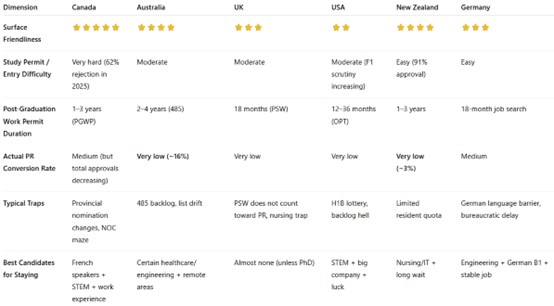
In-Depth Cases
New Zealand: The most underestimated harsh reality
New Zealand is often overlooked, but its data are shocking. According to official statistics, in 2024/25, of 47,354 first-time student visa holders, only 1,470 became residents—a conversion rate of 3.1%. Although study permit approval was 91%, this only shows New Zealand is happy to let you study and pay—staying is another matter.
Germany: The over-glorified "easy path"
Germany is often advertised as the "easiest country for PR in Europe," but the truth is more complex. Graduates have an 18-month job search period, and the EU Blue Card theoretically allows permanent residency in 21 months (B1 level) or 33 months (A1 level). But German language requirements and bureaucracy (difficulty booking appointments at local immigration offices, slow processing) are major obstacles. Many graduates cannot meet the Blue Card salary threshold (€43,800 in 2026) within 18 months and are forced to leave.
4. Why This Truth Rarely Gets Told
4.1 The Intermediary Profit Chain
Study applications → language training → immigration consulting form a full business chain. Every step relies on the "hope narrative." If agencies told the truth—"84% of Australian students don’t get PR"—their business would collapse.
4.2 Survivorship Bias
Successful students share their achievements on social media; those who fail quietly buy tickets home. What you see is the glittering tip of the pyramid, not the massive silent base.
4.3 Political Correctness and Image Management
Governments need to maintain an "open and inclusive" international image. Canada cuts study permits while claiming to welcome students; the UK shortens the PSW while claiming leadership in global education. This disconnect is a deliberately designed smokescreen.
4.4 Silence of Students
Many exploited students dare not speak out for fear of affecting their visa. The Brampton student who reported wage theft only dared come forward with media and advocacy support. Many others endure quietly.
5. Practical Guide: How to Protect Yourself Within the Rules
5.1 "Stress Test" Before Making Decisions
Before paying tuition, ask yourself three questions:
1. If I cannot obtain PR after graduation, is this degree still worth it?
- If "no," reconsider the true purpose of studying abroad.
- If "yes" (for academic growth, returning home, building a global network), your mindset will be healthier.
2. Can I bear the financial loss in the worst-case scenario?
- Calculate total costs: tuition + living + opportunity cost (years of reduced income).
- If this exhausts your family savings, the risk is too high.
3. What is my Plan B?
- If country A refuses you or policies change, do you have backup options (B or C countries)?
- If you must return home, how is your degree recognized locally?
5.2 Key Actions During Study
From day one, start building "local experience"
Grades are just the entry ticket; local work experience is the hard currency in immigration points systems. Regardless of origin, these actions are universally valuable:
Internships/Co-op: Prioritize paid internships; local work experience often earns extra immigration points.
Part-time jobs: Build local professional networks, staying compliant—avoid "cash jobs" that may jeopardize your visa.
Volunteering and community involvement: In Australia and Canada, community participation may affect provincial nomination points.
Build transferable skills
Don’t pick a major solely because it’s on a migration list. Lists change, but these skills are globally transferable:
- Programming and data analysis
- Nursing and healthcare
- Engineering (especially civil and electrical)
- Accounting and financial analysis
Language is survival, not just bonus points
In Germany, without B1 German, the Blue Card PR path extends from 21 to 33 months. In Canada, fluent French significantly boosts CRS points. In 2025, students from French-speaking countries (France, Morocco, Cameroon) saw PR approvals rise sharply—Morocco +80%, Cameroon +80%.
5.3 "Multithreaded" Strategy After Graduation
Don’t rely on a single country for PR
This is the most important practical advice. Prepare multiple immigration paths simultaneously:
- Canada: Keep Express Entry profile active, watch for provincial nomination invitations.
- Australia: Submit an Expression of Interest (EOI) while accumulating work experience to increase points.
- Germany: Use the 18-month job search visa while preparing for Blue Card or standard work visa.
- New Zealand: Though low conversion, it can serve as a backup.
Use remote work to maintain geographic flexibility
If you work in IT, design, consulting, or other remote-friendly jobs:
- Apply for digital nomad visas (Portugal, Spain, Estonia, Dubai, etc.) as a bridge.
- Work for global companies remotely, gaining international experience while waiting for immigration windows.
Watch for policy change signals
Signals often indicating tightening policies:
- Election cycles: Governments may restrict immigration to appeal to domestic voters.
- Economic recession or high unemployment: Local citizens struggle to find work—why grant PR to foreigners?
- Housing crises: Canada’s 2025 study permit reduction was directly linked to housing pressure.
- Temporary policy windows: Special pandemic-related routes are short-lived and competitive but can be leveraged strategically.
5.4 Recognize and Respond to Exploitation
Your rights checklist (general principles)
Anywhere you are:
- You are entitled to at least the statutory minimum wage.
- You have the right to refuse "cash jobs" or illegal work, even if the employer threatens to report you.
- You have the right to a written contract specifying wages, hours, and responsibilities.
- You have the right to report violations to labor authorities—many countries protect whistleblowing international students.
If faced with wage theft or exploitation:
1. Preserve all evidence (payslips, chat records, work hours).
2. Contact your international student office or labor rights organizations.
3. File a formal complaint with labor authorities—Ontario, Canada, treats international student complaints.
4. Seek legal aid—many universities provide free legal consultation.

6. Alternative Paths: If PR Isn’t the Only Goal
6.1 A "Nomadic" Career Approach
Instead of exhausting your youth chasing a PR card:
- Short-term stays in multiple countries: study in A, work in B, remote work in C.
- Accumulate global experience: in 5 years, you may be more competitive than those stuck in a single country chasing points.
- Global tax optimization: understand residency rules to reduce taxes legally.
6.2 Profit from Exchange Rates, Not Status
For students from developing countries (Nigeria, India, Philippines, Vietnam), a practical strategy:
- Work in developed countries for 3–5 years, accumulate savings and skills.
- Remit income home or invest in third-country assets.
- Ultimately choose a country with lower cost of living and higher quality of life—not necessarily the one you studied in.
6.3 Build a "Borderless" Professional Identity
True security does not come from a PR card but from:
- Globally recognized professional credentials (CPA, PMP, AWS certifications).
- International networks.
- Multilingual skills.
- Remote-deliverable expertise.
Conclusion: From "Selected Labor" to "People with Choices"
All policies are public, all data is traceable. Yet governments, educational institutions, and agencies jointly construct an information asymmetry ecosystem—they emphasize "possibility" and downplay "probability"; showcase "success stories" while hiding the silent majority.
Understanding the rules is not to complain, but to find your position within them. True "immigration success" is not the moment you receive a PR card—it is having the ability to choose to stay or leave, to say no, and to protect your time and labor value.
If reading this article makes you reconsider your study-abroad plans—it has already served its purpose.
If you decide to proceed with greater awareness and preparation—its value is even greater.
The power of choice ultimately lies in your hands.
References
1. Canadian Immigration and Citizenship (2025). Study permit and PR conversion statistics. Government of Canada. [https://www.canada.ca/en/immigration-refugees-citizenship/services/study-canada.html]
2. U.S. Citizenship and Immigration Services (2026). H-1B visa statistics and OPT program. [https://www.uscis.gov/]
3. Australian Government Department of Home Affairs (2025). Temporary Graduate visa (subclass 485) report. [https://immi.homeaffairs.gov.au/]
4. Oxford University Migration Observatory (2024). Graduate Route visa outcomes in the UK. [https://migrationobservatory.ox.ac.uk/]
5. New Zealand Immigration (2025). International student visa and resident transition statistics. [https://www.immigration.govt.nz/]
6. Australian Financial Review (AFR) (2023). International student PR success rates analysis.
About the Author
Adrian Vale
Adrian Vale is an independent researcher and former international admissions advisor who has worked with students applying to universities across Canada, the United Kingdom, Germany, and Australia. Over the past decade, he has studied how universities, education agencies, and migration policies shape the global study-abroad industry. His work focuses on international student recruitment systems, university rankings, visa approval trends, and the hidden commercial incentives behind cross-border education pathways. Adrian writes long-form analyses aimed at helping students and families make more informed decisions before committing to expensive international education plans.
Editorial Transparency Statement
This article is based on publicly available data, government statistics, and research from authoritative institutions. No promotional content or financial incentives influenced the content. The author’s analysis aims to provide practical guidance for international students considering study and work opportunities abroad.
Disclaimer
The information provided in this article is for general informational purposes only and does not constitute legal, financial, or immigration advice. Immigration policies are subject to change. Readers should consult licensed immigration professionals or legal advisors before making any major decisions regarding study, work, or permanent residency abroad.