

By Leonie Hartmann | Updated on: March, 2026 | 🕓 11 minutes read
Key Highlights
- What is the "hope tax" and how does it affect immigration applicants?
- How can a licensed immigration consultant still mislead clients?
- What are the global examples of consultants over-promising outcomes?
- How can applicants identify structural over-promises before signing a contract?
- What alternative strategies exist to reduce reliance on potentially biased advice?
- What steps can applicants take if they have already been misled by a consultant?
I. A 92,000 AED Lesson from a Dubai Businessman
In May 2023, an Arab businessman in Dubai signed a contract with an immigration services company, paying CAD 16,500 (approximately AED 92,886) to process his Canadian permanent residency. Six months later, he couldn’t even confirm whether his application had been submitted. The company initially promised a partial refund, then completely disappeared. In February 2026, the Dubai First Instance Court ruled that the company must provide a full refund and pay an additional AED 10,000 in compensation.
This is not a story about a "fraudulent consultant"—this company had a valid business license, a physical office, and even provided seemingly professional "immigration assessment reports." The problem was: they knew from the start that the client’s business background did not meet the hard requirements of Canada’s Provincial Nominee Program (PNP), yet they still collected the full service fee.
II. What Is the "Hope Tax"? Redefining Consultant Risk
Most anti-fraud guides focus on identifying "ghost consultants"—unlicensed agents who forge documents and promise 100% approval. In 2025, the CICC in Canada disciplined multiple violating consultants, revoking licenses and imposing fines; Ontario even issued a record CAD 66,000 fine against unlicensed consultants in October 2025.
But here, we focus on a subtler and more pervasive problem: licensed consultants who know the chances of success are extremely low, yet use language to make clients believe they have a strong chance.
2.1 The Three Layers of the "Hope Tax"
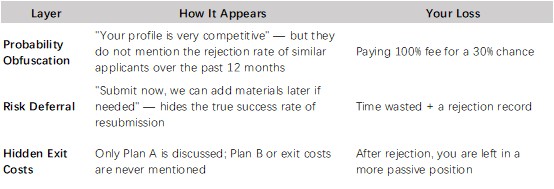
Key difference: This is not fraud, because the consultant does provide services (forms, translations, submissions); however, it is a misaligned incentive, since the consultant’s earnings are completely detached from your outcome.
III. Global Cases: When "Legal" Becomes "Unreasonable"
Case 1: Canada — Licensed Consultants Playing the "LMIA Game"
In 2025, the CICC disciplined several licensed consultants, including Rajesh Randev of Get Visa Immigration Inc. in Vancouver (permanently revoked) and Mala Sharma-Singh in Ramara, Ontario (temporarily suspended). A common pattern: consultants exploited clients’ reliance on Labor Market Impact Assessment (LMIA) to charge high fees for nonexistent employer sponsorships.
Neera Agnihotri, director of the nonprofit One Voice Canada, commented: "Many consultants continue working through family or friends’ licenses after being disciplined. The most common form of abuse involves LMIA—consultants charge huge fees to extend clients’ status, exploiting their vulnerability."
Case 2: Australia — Two Visitor Visa Rejections for a "Genuine Visitor"
A South Asian client with four children who were Australian citizens or permanent residents submitted a parent migration application. Despite such strong family ties, her visitor visa was rejected twice for "failure to meet the genuine temporary entrant standard," only overturned later through the Administrative Review Tribunal (ART).
Reflection: Had she consulted a migration consultant, she would likely have been told "strong family ties, high chance of approval." However, the immigration department’s internal risk assessment may have already listed her source country as "high risk," information the consultant would not voluntarily share.
Case 3: United Kingdom — The "Administrative Review" Trap
A South African client entered the UK as a visitor and applied for asylum. The consultant knew the asylum grounds were weak but did not fully explain the risk. The asylum was rejected, though discretionary leave was eventually granted for health reasons. The case revealed consultants often conceal alternative strategies.
UK visa authorities explicitly state: "Even with professional representation, visas may still be refused because no agent can influence the Home Office decision-maker."
Case 4: New Zealand — $18,000 for a "Ghost Employer"
In early 2026, a group of Chinese workers paid NZD 18,000 to New Zealand immigration consultants for "employer sponsorship," only to find the jobs did not exist. While an extreme case involving unlicensed consultants, it highlights a core industry issue: desperate applicants are willing to pay far beyond reasonable fees for mere possibility.
IV. Why Over-Promising Is Systemic
4.1 The Built-in Flaw of Fee Structures
Data comparing Canadian immigration lawyers and consultants reveal the core problem:
- Self-employed applicants: 19.3% rejection rate
- Applicants using consultants: 18% rejection rate
- Applicants using immigration lawyers: 10.4% rejection rate
Two points emerge: first, consultants do not significantly improve success rates over DIY; second, lawyers have a markedly higher success rate, but also charge more. This creates a perverse incentive—consultants are motivated to exaggerate approval chances rather than honestly disclose risks.
4.2 The Ghost Consultant Squeeze
An estimated 20% of Canadian applicants have encountered ghost consultants. Consequences:
1. Distorted price anchoring: Ghost consultants charge CAD 5,000–20,000 for "guaranteed approval," making licensed consultants’ CAD 1,500–3,000 fees appear "unprofessional."
2. Erosion of trust: Applicants cannot distinguish "cautious assessment" from "neglect," misinterpreting honest risk disclosure as incompetence.
4.3 Regulatory "Blind Spots"
CICC disciplinary actions mainly target "fraud" or "unlicensed practice," rarely addressing "overly optimistic assessments." The boundary between overly optimistic guidance and professional judgment is ambiguous, making regulatory intervention difficult.

V. Seven Signs of Structural Over-Promise
These signs apply globally where immigration consultants are regulated (Canada CICC, Australia MARA, UK OISC, US state bar associations, etc.):
Sign 1: Vague Probability Language
- Phrases: "High chance of success," "very competitive profile"
- Counter: Ask, "Does 'high' mean 80% or 51%? Can you provide approval/rejection rates for similar clients over the past 12 months?"
- Principle: Licensed consultants have data but may avoid sharing it. Industry averages in Canada are 65–70%; claims of "98% success" require verifiable methodology.
Sign 2: Refusal to Document Risks in Writing
- Action: Request email confirmation of "main risks: X, Y, Z"
- Benefit: Serves as evidence for disputes. UK IAA accepts complaints regarding "poor service, overcharging, or professional misconduct."
Sign 3: Full Prepayment Demands
- Strategy: Insist on phased payment—assessment fee, pre-submission, after RFE, final result
- Reference: US immigration lawyers commonly use fixed fees ($1,500–$15,000+), but fixed fee ≠ full prepayment.
Sign 4: Only Discuss Plan A, Avoid Plan B
- Must Ask: "If this path is rejected, what is the backup plan and extra cost?"
- Example: In the UK case, discussing health-based discretionary leave as Plan B allows more rational decision-making.
Sign 5: Using "Inside Channels" Language
- Red flag: Claims of "special connections" or "fast-tracking"—terminate cooperation immediately, licensed or not.
Sign 6: Creating False Urgency
- Phrases: "Limited quotas," "policy tightening soon"
- Counter: Request official policy links. Canada IRCC, Australia Home Affairs, UK Home Office all publish policy timelines.
Sign 7: Contract "Liability Black Holes"
- Check: Contracts stating "consultant not responsible for results" yet promising "high success"
- Logical contradiction: If results are independent, why charge a high fee?
VI. Global Self-Protection Checklist: Due Diligence Before Signing
6.1 Verify Credentials (30 Seconds)
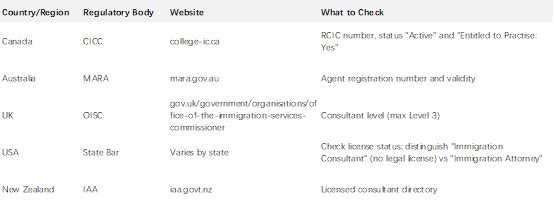
6.2 Reputation Checks – A Counterintuitive Approach
- Ignore Google 5-star reviews (easilymanipulated); focus on specific complaints in 3–4 star reviews
- Cross-platform search: Reddit/Quora/local forums: "consultant name + denied/refund/problem"
- Key test: Ask, "Can you provide a recent client who was rejected?" A legitimate consultant won’t violate privacy, but attitude reveals integrity (avoidance vs candid discussion).
6.3 Three Must-Have Contract Clauses
1. Precise Scope: Specify forms (e.g., "only I-485 form preparation, excludes RFE response")
2. Refund Trigger: Define refund ratio if consultant assessment leads to rejection
3. Exit Rights: 7–14 day unconditional cancellation with refund ("cooling-off period")
VII. Three Alternative Strategies to Reduce the "Hope Tax"
Strategy 1: "Second Opinion" Rule
- Spend $100–$300 on 1–2 consultations without revealing the first consultant’s plan
- If opinions vary widely on "success probability," someone is over-promising
Strategy 2: DIY + On-Demand Services
- Simple cases (green card renewal, work permit extension) fully DIY
- Complex cases (asylum, waivers, deportation defense) purchase only document review, not full representation
Strategy 3: Prioritize Official Free Resources
- Canada: IRCC self-assessment tools—more conservative, but honest
- USA: USCIS case status check and processing time estimates
- UK: Gov.uk visa check tools
- Australia: Home Affairs Visa Finder
VIII. If You Have Already Been "Over-Promised": Remediation Roadmap
Stage 1: Document All Communication
- Save emails, chats, and contract copies
- Key: Compare verbal promises to written contract
Stage 2: File Complaints with Regulators
- Canada: CICC for "professional conduct" issues
- UK: IAA complaints for "poor service or overcharging"
- USA: State bar for lawyers; FTC for fraud complaints
Stage 3: Legal Remedies
- Small Claims Court: Often cheaper than continuing with consultant
- Breach of Contract: As in the Dubai case, courts may order refund + compensation
Stage 4: Case Remediation
- When seeking a new consultant, disclose previous misguidance
- This may constitute "ineffective assistance of counsel" and in some jurisdictions can be grounds to overturn adverse decisions
IX. Conclusion: The "Antifragile" Mindset in Immigration Decisions
Immigration consultants are neither enemies nor friends—they are service providers, and you are the one bearing the consequences.
The costliest part of immigration is not the consultant fee but time loss and immigration record damage caused by poor advice. One rejection can affect all your visa applications for the next 5–10 years.
FAQs
1. Are licensed immigration consultants always trustworthy?
Not necessarily. Licensed consultants are regulated and must follow professional standards, but some may still exaggerate your chances of approval or omit key risks. Trustworthiness varies between individuals; always verify credentials, request written risk assessments, and check past client experiences.
2. How much does hiring a consultant actually increase my chances of approval?
Data from Canada shows that the success rate for applications handled by licensed consultants is only slightly higher than self-filed applications (18% rejection for consultants vs 19.3% DIY). Hiring a licensed immigration lawyer often provides a higher success rate (10.4% rejection), but consultants mainly help with paperwork and process guidance rather than guaranteeing approval.
3. What is the difference between a consultant and an immigration lawyer?
- Immigration Consultant: Trained and licensed to provide immigration advice and handle paperwork. Cannot represent you in court or provide full legal advocacy in complex cases.
- Immigration Lawyer: Licensed attorney with full legal rights to represent clients in immigration court, appeals, or complex legal challenges. Lawyers generally achieve higher approval rates in complicated cases.
4. Can I legally recover fees if a consultant over-promises but delivers services?
It depends on your jurisdiction. If you can show that the consultant misrepresented your chances or acted negligently, you may recover part or all of the fees through small claims court, contract disputes, or regulatory complaints. Courts may require documentation of communications and contracts.
5. Which countries provide official resources to verify consultants’ credentials?
- Canada: CICC (college-ic.ca) – check RCIC license status and entitlement to practice
- Australia: MARA (mara.gov.au) – verify registered migration agents
- UK: OISC (gov.uk/government/organisations/office-of-the-immigration-services-commissioner) – verify consultant level
- USA: State Bar Associations – check immigration attorney licenses; distinguish licensed attorneys from unlicensed consultants
- New Zealand: IAA (iaa.govt.nz) – licensed immigration advisors
6. How can I avoid "ghost consultants" and over-promising practices?
- Verify licensing and registration before signing a contract
- Ask for written assessments of risks and probabilities
- Avoid consultants who demand full upfront payment
- Watch for vague language like "high success rate" or claims of "inside channels"
- Cross-check reviews on multiple platforms rather than relying on paid ratings
7. Should I always consider a second opinion before submitting my application?
Yes. A second opinion helps identify inconsistent advice and potential over-promising. Consulting one or two additional licensed professionals or lawyers can clarify realistic chances, alternative strategies, and potential risks before committing large fees.
References
1. College of Immigration and Citizenship Consultants (CICC). (2025). Disciplinary actions and professional standards. Retrieved from [https://college-ic.ca]
2. One Voice Canada. (2025). Consultant misuse of LMIA for vulnerable applicants. Retrieved from [https://www.onevoicecanada.org]
3. MARA (Migration Agents Registration Authority). (2025). Registration verification and regulatory guidelines. Retrieved from [https://www.mara.gov.au]
4. UK Office of the Immigration Services Commissioner (OISC). (2025). Professional conduct standards and complaint guidance. Retrieved from [https://www.gov.uk/government/organisations/office-of-the-immigration-services-commissioner]
5. USCIS. (2025). Case status and processing times. Retrieved from [https://www.uscis.gov]
6. Australian Home Affairs. (2025). Visa Finder & official self-assessment tools. Retrieved from [https://www.homeaffairs.gov.au]
About the Author
Leonie Hartmann
Leonie Hartmann is a migration policy writer and cross-border labor researcher specializing in temporary migration systems, international labor mobility, and visa-driven employment markets. Her research explores how governments, employers, and private consulting industries influence migration pathways for students, skilled workers, and digital nomads. Leonie frequently writes about immigration consulting practices, labor shortages, visa sponsorship structures, and the economic realities behind modern migration narratives. Her work combines policy analysis with practical insights for globally mobile professionals.
Editorial Transparency Statement
This article was independently researched and written by the author based on publicly available regulatory records, real-world case studies, and professional experience. The author has no financial affiliations with any immigration consultancy firm mentioned in this article.
Disclaimer
The content provided in this article is for informational purposes only and does not constitute legal advice. Immigration laws and regulations vary by country and are subject to change. Readers should consult official government sources or licensed immigration professionals for advice specific to their circumstances.