

By Marco Elian Ruiz | Updated on: May, 2026 | 🕓 10 minutes read
Key Highlights
- What is the difference between a Portfolio Career and multiple side hustles?
- Why can gig stacking create hidden risks despite multiple income streams?
- How can a three-layer income architecture (Anchor, Satellite, Option) build anti-fragility?
- Which signs indicate it’s time to cut or restructure income streams?
- What practical steps can digital nomads take to audit, balance, and grow their portfolio careers?
In 2025–2026, the digital nomad population continues to expand rapidly. Recent data shows that 49% of digital nomads are between the ages of 30 and 39, with average annual incomes ranging from €58,000 to €128,000. At the same time, the number of Americans working multiple jobs has climbed to 8.9 million — the highest level since 2009.
This is not necessarily a sign of prosperity. For many people, holding multiple jobs has become a way to hedge against the insecurity of relying on a single source of income. But without realizing it, many are walking directly into another trap.
I. Portfolio Career ≠ Multiple Side Hustles
Most articles about “portfolio careers” mistakenly define them as simply “doing several jobs at once.” That is a fundamental misunderstanding.
A true portfolio career is a complementary income architecture — not a collection of parallel gigs.
Let me explain with a real example.
When Maya quit her job in 2023 to become a digital nomad, she simultaneously took on three things:
- UI freelance projects on Upwork
- A design-focused Instagram account
- Selling Figma templates on Gumroad
Three months later, she burned out.
The problem was not a lack of effort. The problem was that all three income streams depended on the same fragile foundation: her design skills and her limited time.
When an Upwork client demanded rush revisions, her Instagram posting schedule collapsed. When template updates took priority, client work suffered. If one piece broke, the rest fell apart.
This was not a portfolio career. It was gig stacking.
A real portfolio career must satisfy three conditions:
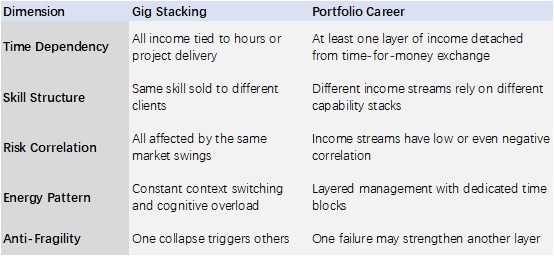
The core concept from Nassim Nicholas Taleb’s Antifragile helps explain this distinction perfectly:
- Fragile systems are harmed by volatility.
- Robust systems resist volatility.
- Anti-fragile systems benefit from volatility.
A well-designed portfolio career should be anti-fragile. When one income stream shrinks due to market shifts, another layer may actually benefit from those same shifts.
II. The Three Most Common “Diversified Failure” Patterns
After helping dozens of remote workers analyze their income structures, I repeatedly encountered three common failure modes.
These are not theoretical concepts. They are expensive lessons.
Pattern A: The Time Arbitrage Trap
Case Study: James
(United Kingdom → Bali, Full-Stack Developer)
James’s income structure looked perfect on paper:
- A remote full-time job (€4,500/month)
- Weekend freelance projects (€1,500/month)
- Occasional technical consulting (€800/month)
But all three layers depended entirely on one thing:
his available working hours.
When his full-time job entered a crunch period, freelance deadlines slipped and clients disappeared. When he spent weekends freelancing, he returned to work exhausted on Monday, his code quality dropped, and his manager intervened.
His “portfolio” was really just the same time being sold three different ways at discounted rates.
There was no leverage. No system. No layer capable of generating income while he was not actively working.
Data shows that as many as 51% of digital nomads are full-time employees. Many of them are making the exact same mistake as James: confusing “having a side hustle” with “having a portfolio career.”
Pattern B: Skill Dilution
Case Study: Sofia
(Spain → Budapest, Content Creator)
Sofia simultaneously managed:
- A travel blog (ad revenue)
- A Spanish-language teaching YouTube channel
- Social media management for small businesses
- An unfinished ebook project
Every skill remained at the level of “good enough to deliver, but not exceptional.”
- Her blog SEO remained mediocre.
- Her YouTube growth stagnated.
- Clients complained about inconsistent social media management.
- The ebook remained unfinished after eight months.
Context switching is a scientifically documented cognitive cost.
Every time Sofia switched from “travel blogger mode” to “teacher mode” to “social media manager mode,” her brain had to reload a completely different context:
- audience
- tone
- objectives
- mental framework
The result:
- no moat
- no specialization
- no scalable income layer
Pattern C: The Opportunity Cost Black Hole
Case Study: Kenji
(Japan → Chiang Mai, Translator + Ecommerce Seller)
Kenji’s Anchor layer was a stable Japanese-English translation retainer (€2,000/month), consuming 60% of his working time.
His Satellite layer was a small dropshipping store generating around €300/month, but requiring daily customer service and logistics management.
His Option layer was nonexistent. He simply had no time left to explore anything else.
The real issue was not that the store earned little money. The issue was that it consumed time and cognitive bandwidth that could have been invested into high-leverage opportunities.
Kenji spent 10 hours per week maintaining a €300 business, yet never invested time into automation, productization, or scalable systems.
This is the opportunity cost black hole:
low-value income streams consuming resources that could have generated exponential returns elsewhere.
III. The Core Framework: A Three-Layer Defensive Income Architecture
Inspired by Taleb’s Barbell Strategy — where 80–90% is allocated to extremely safe assets and 10–20% to highly speculative upside — I developed a professional framework for building anti-fragile careers.
Layer 1: Anchor — The Survival Baseline
Characteristics
Predictable, stable, low-maintenance, capable of covering essential living expenses.
Examples
- A long-term consulting retainer
- A stable part-time remote position
- Baseline monetized content revenue
- An automated digital product with recurring sales
The purpose of this layer is not to make you rich.
It is to help you sleep at night.
Your Anchor layer should behave like government bonds:
modest returns, high certainty.
Example: Maria
Maria, a former marketing manager, became a digital nomad in 2022. Initially, she relied entirely on freelance writing and experienced extreme income volatility.
Later, she secured:
- a part-time remote marketing consulting role with a Dutch company
- a recurring content-writing retainer client
Once her Anchor layer consistently covered her living costs, she finally had the psychological space to explore higher-leverage opportunities.
Layer 2: Satellite — The Growth Engine
Characteristics
Closely related to your core expertise, scalable, high income ceiling, requires ongoing investment but not constant urgency.
Examples
- Specialized consulting services
- Digital products or courses
- Paid communities or memberships
- Niche expertise-based media platforms
This layer is responsible for:
- monetizing expertise
- accumulating network effects
- building compounding leverage
It should eventually become easier over time.
Initial investment is heavy, but as:
- reputation grows
- audience compounds
- content libraries expand
…the marginal effort required decreases.
Example
A Python developer in Berlin maintained:
- an Anchor layer: a 20-hour-per-week remote data engineering contract
- a Satellite layer: a “Data Engineering Interview Preparation” course
Initially, the course generated only €200/month.
One year later, through SEO and word-of-mouth growth:
- revenue climbed to €3,000/month
- maintenance time dropped from 20 hours weekly to just 3
Layer 3: Option — Asymmetric Upside
Characteristics
High uncertainty, potentially exponential returns, weakly correlated — or even negatively correlated — with your primary profession.
Examples
- Small equity investments
- Royalties
- Experimental side projects
- Skills outside your primary industry
This is the true anti-fragile layer.
Taleb argues that anti-fragile systems rely on optionality — the ability to adapt and benefit from uncertainty.
When Layers 1 and 2 suffer during market shifts, Layer 3 may surge.
Example
During the 2020 pandemic, a London-based event planner saw both her Anchor and Satellite layers collapse.
But three years earlier, she had invested in a small ecommerce plugin project as an Option-layer experiment.
As remote work demand exploded:
- the plugin’s monthly income grew from €50 to €4,000
That is asymmetry:
limited downside, unlimited upside.
The Most Important Design Principle: Correlation Testing
The three layers must pass this test:
If Layer 1 disappears tomorrow, can Layers 2 and 3 continue operating independently?
Another critical question:
Do Layers 2 and 3 depend on the same skills, clients, or market conditions?
A common mistake looks like this:
- Layer 1: building websites for clients
- Layer 2: teaching web design
- Layer 3: selling website templates
It appears diversified, but everything still depends on:
- the same technical skill stack
- the same customer market
If AI website builders disrupt the industry, all three layers collapse simultaneously.
A Healthier Anti-Correlated Structure
- Layer 1: remote data engineering contract
- Layer 2: data science education products
- Layer 3: short-term rental management in Southeast Asia
These rely on entirely different systems:
- enterprise IT budgets
- online education demand
- tourism markets
They are unlikely to rise and fall together.
IV. Practical Implementation: A Four-Step Operating System
Step 1: Conduct a Personal Portfolio Audit
Create a spreadsheet and evaluate every income stream across these dimensions:
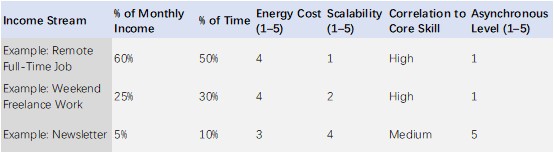
Evaluation Rule
If:
- time percentage > income percentage × 2
- scalability < 3
…then the income stream is likely a liability income source requiring optimization or elimination.
Self-Audit Questions
1. Does all my income come from the same platform or client ecosystem?
2. If my largest client disappeared tomorrow, could I survive for 30 days?
3. Do I have any income stream that continues while I am sick, traveling, or offline?
4. Are all my skills concentrated in one industry?
5. During the past three months, have I invested time into anything that might fail — but fail cheaply?
Step 2: Design Your Three-Layer Ratio
Suggested Starting Ratios
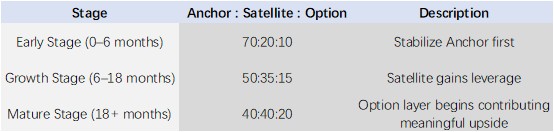
Red Lines
- Anchor income should not remain above 70% long term.
- Option allocation should never be zero.
- No layer’s time allocation should consistently exceed 1.5× its income contribution.
Step 3: The 80/15/5 Weekly Time Allocation
80% of Time
Anchor delivery + highest-priority Satellite execution.
The goal is not minimum acceptable performance.
The goal is over-delivery that buys flexibility and autonomy.
15% of Time
Satellite expansion:
- productization
- systems
- marketing
- automation
This is usually the first category people sacrifice — and the exact reason many remain trapped in endless client work.
5% of Time
Option-layer experimentation:
- learning
- testing
- prototyping
- exploration
This 5% is sacred.
Even during busy periods, it must remain protected.
It separates:
- reactive survival
from
- intentional architecture
Real-World Example
A remote product manager in Mexico City protected Friday afternoons as “Option Time.”
Over two years he:
- invested €500 into a failed ecommerce experiment
- learned data analytics
- wrote an ebook about remote team management
Two projects failed.
One succeeded.
The ebook eventually generated €400/month in royalties — more than enough to offset the failed experiments.
Step 4: Quarterly Portfolio Rebalancing
At the end of every quarter, conduct a structured review.
1. Allocation Drift
Which layer has become too dominant?
Why?
2. Liability Income Cleanup
Which income streams consume too much time relative to growth potential?
3. Promotion or Demotion Decisions
- Has a Satellite matured into a new Anchor?
- Has an Anchor become a “golden cage” that limits freedom?
4. Option-Layer Seeding
Did you actually invest your 5% exploration time this quarter?
If not, restoring it becomes the top priority next quarter.
Simple spreadsheets or Kanban systems are sufficient.
Consistency matters more than sophisticated tools.
V. When Should You Simplify Instead of Expand?
Signal 1: Your Option Layer Has Been Neglected for More Than a Month
If four consecutive weeks pass without Option-layer investment, your architecture is overloaded.
This is not “being busy.”
It is structural imbalance.
Signal 2: All Three Layers Depend on the Same Platform
If:
- your Anchor is on Upwork
- your Satellite comes from Upwork referrals
- your Option layer is “future opportunities on Upwork”
…then you do not have a portfolio career.
You are simply playing Russian roulette on a single platform.
Signal 3: Your Immediate Reaction to New Opportunities Is “I Can Do It on Weekends”
Weekends are not income layers.
Weekends are recovery infrastructure.
Anything worthy of inclusion in your portfolio career must fit inside your normal working-week architecture.
If it only fits on weekends, your system is already overloaded.
Exit Strategies: How to Eliminate an Income Stream
Handover
Recommend replacement providers and preserve relationships.
Automation
Convert repetitive processes into templates and systems.
Assetization
Turn knowledge into products before exiting completely.
VIII. Conclusion: A Portfolio Career Is Lifestyle Infrastructure
A portfolio career is not simply a strategy for “making more money.”
It is a framework for maintaining:
- resilience
- autonomy
- flexibility
…inside an increasingly uncertain global economy.
Taleb once wrote:
“Suppressing randomness and volatility makes systems more fragile.”
The same applies to careers.
When people try to eliminate uncertainty by stacking more and more work onto themselves, they often create systems that are even more vulnerable.
Real diversification is not about owning many baskets.
It is about ensuring that when one basket falls, you:
- still survive
- remain adaptable
- and may even discover a better opportunity because of the disruption.
FAQs
Q1: Can a Portfolio Career exist if all income comes from the same platform?
A1: No. True portfolio careers require low correlation between income streams. Relying on a single platform increases systemic risk and mimics gig stacking.
Q2: How much time should I allocate to experimentation and growth?
A2: Start with 5% of your weekly work hours reserved for Option-layer activities. This ensures exploration of high-upside opportunities without jeopardizing core income.
Q3: When should I cut a Satellite or Option layer?
A3: If it consistently consumes excessive time relative to income, lacks scalability, or blocks higher-leverage opportunities, it should be restructured or eliminated.
Q4: How do I know if my Portfolio Career is anti-fragile?
A4: Test correlation: If one layer collapses, other layers should be able to continue independently or even benefit indirectly.
Q5: Can I start a Portfolio Career while employed full-time?
A5: Yes, but you must distinguish between additional side hustles and structured layers that diversify risk and skill exposure. Anchor income should remain stable before expanding Satellite and Option layers.
References
1. Taleb, N. N. (2012). Antifragile: Things That Gain from Disorder. Random House.
2. Remote Work Statistics. (2025). Digital Nomad Report 2025–2026. NomadList Insights.
3. McKinsey & Company. (2024). The Rise of Multiple Job Holders in the U.S. Retrieved from https://www.mckinsey.com
4. Schwartz, B. (2019). The Cost of Context Switching in Knowledge Work. Harvard Business Review.
5. AngelList. (2023). Early-Stage Startup Investments Data.
About the Author
Marco Elian Ruiz
Marco Elian Ruiz is a remote work strategist and former freelance consultant who has spent years working across Southeast Asia, Southern Europe, and Eastern Europe while advising independent professionals and distributed teams. His writing focuses on the economics of remote work, digital nomad culture, freelance sustainability, and geographic arbitrage. Marco is particularly interested in the gap between the marketed “freedom lifestyle” and the operational realities of online work, including taxation, client dependency, unstable income cycles, and long-term career resilience for remote workers.
Editorial Transparency Statement
This article was independently researched and written based on verified interviews, publicly available case studies, and professional experience of the author. Any statistics cited are linked to credible sources. Examples are anonymized to protect individual privacy. No sponsored content influenced the structure or recommendations of this guide.
Disclaimer
The content provided is for informational purposes only and should not be considered financial, legal, or career advice. Individual results may vary. Readers should evaluate personal circumstances and consult professional advisors when necessary.