

By Marco Elian Ruiz | Updated on March, 2026 | 🕓 12 minutes
Key Highlights
- Is your “location-independent” business actually dependent on geographic arbitrage?
- What happens when your low-cost base suddenly becomes expensive?
- Can digital nomads still rely on currency and cost-of-living gaps in 2026?
- Which types of geographic arbitrage are the most fragile?
- How does AI threaten low-skill remote arbitrage models?
- Why are some digital nomad hotspots experiencing “nomad inflation”?
- What is a geographic arbitrage coefficient, and how can you calculate yours?
You’re sitting in a café in Chiang Mai, a 40-baht (about $1) iced Americano next to your laptop. Your clients are in the United States, paying you in U.S. dollars for your design work; your landlord is local, and you pay rent in Thai baht. At the end of the month, you do the math: $4,500 in income, $1,200 in expenses. You feel like you’ve finally “escaped geography.”
But let’s run a thought experiment:
What if one of your clients suddenly required you to fly to New York once a month for in-person meetings? Or what if your landlord decided to raise the rent to something closer to Zurich pricing?
Would your “location-independent” business still be independent?
Probably not.
Most people think the formula for digital nomadism or remote business success is:
Skill × Internet = Freedom
But the real formula is:
(Skill × Internet) × Geographic Arbitrage Coefficient = Sustainable Freedom
Most people have never calculated their own “geographic arbitrage coefficient.” Even fewer realize that the coefficient is constantly changing behind the scenes.
That’s the real hidden risk — and the reason your “location-independent” business was never truly independent in the first place.
I. Redefining Geographic Arbitrage: It’s Not About Saving Money — It’s About Structural Coordinates
In digital nomad culture, the phrase “geographic arbitrage” has been used so much that it’s almost meaningless. Most people reduce it to “living somewhere cheap.”
But that’s only the surface-level interpretation.
Real geographic arbitrage is a three-dimensional coordinate system:
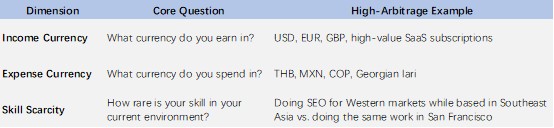
The Key Insight
Your business is not “location-independent.” It is actually location-sensitive.
You just happen to be standing inside an arbitrage window — and you mistake that window for personal freedom.
Let’s look at four real-world scenarios:
Scenario A: An American Designer in Bali
- Income: $4,500/month (USD)
- Expenses: $1,800/month (comfortable Bali lifestyle in IDR)
- Skill scarcity: 6/10 (design skills still have moderate scarcity locally)
- Geographic arbitrage coefficient: 15.0 ✅ Healthy zone
Scenario B: A British Programmer in Lisbon
- Income: £3,500/month (roughly €4,000)
- Expenses: €2,200/month (Lisbon living costs)
- Skill scarcity: 4/10 (European programmer supply continues to increase)
- Geographic arbitrage coefficient: 6.4 ⚠️ Warning zone
Scenario C: A German Consultant in Tbilisi
- Income: €6,000/month (EUR)
- Expenses: $1,200/month (GEL)
- Skill scarcity: 8/10 (German-language consulting expertise is extremely rare locally)
- Geographic arbitrage coefficient: 40.0 🔵 High-arbitrage zone — but with systemic risk
Scenario D: An American Remote Customer Support Worker in Guadalajara
- Income: $2,800/month (USD)
- Expenses: $900/month (MXN)
- Skill scarcity: 3/10 (English-language customer support is not especially scarce and faces AI replacement risk)
- Geographic arbitrage coefficient: 9.3 🟡 Moderate arbitrage — but extremely fragile
Of these four scenarios, only Scenario C derives its arbitrage advantage primarily from genuine skill scarcity.
The other three depend heavily on exchange-rate differences and platform-driven economic advantages — both of which are temporary and highly unstable.

II. The Side-Hustle Trap: What Happens When the Arbitrage Window Closes
Trap 1: The Collapse of Platform-Dependent Arbitrage
A Real-World Example (Based on Industry Observation, Details Anonymized)
Jeff was an American digital nomad living in Bali in 2021. He sold Stoic philosophy-themed T-shirts and artwork on Etsy, earning around $3,000 per month (roughly $120K annually) while spending only $1,200 on living expenses.
His model was classic platform arbitrage:
- Use Etsy to access global buyers
- Use Bali’s lower cost structure to maximize margins
Then things started changing in 2023:
- Etsy adjusted its algorithm, sharply reducing organic traffic
- U.S. inflation weakened discretionary consumer spending
- Rents in popular Bali areas like Canggu rose 10–15% within two years
- Digital nomad visa changes increased compliance costs
By 2024:
- Jeff’s monthly income had fallen to $1,800
- His living costs had climbed to $1,600
His geographic arbitrage window had nearly disappeared. Eventually, he abandoned the digital nomad lifestyle and returned to the United States to look for traditional employment.
The Lesson
Platform-dependent arbitrage is the most fragile kind.
Once the platform changes the rules, your arbitrage can vanish overnight.
Trap 2: The Silent Compression of Salary Localization
A Silicon Valley software engineer earning $150K annually moved to Lisbon in 2022.
The logic seemed obvious:
“I can do the same work while living somewhere that costs one-third as much.”
But by 2024, his employer implemented geographic salary localization.
The reasoning was straightforward:
If you’re no longer living in Silicon Valley, why should you be paid Silicon Valley wages?
His salary was eventually adjusted to €55,000 (roughly $60K).
That was still considered a high salary by Portuguese standards, but compared to his original $150K compensation, his purchasing power fell dramatically.
At the same time, Lisbon rents surged due to the influx of remote workers, bringing living costs closer to cities like Barcelona.
His geographic arbitrage coefficient collapsed from a high-arbitrage profile into the warning zone almost overnight.
Industry Trend
More companies are adopting geographic pay bands.
According to labor-market data from platforms such as Glassdoor, identical remote positions may pay 20–30% less in lower-cost regions.
As remote work shifts from being a special privilege to a normalized labor structure, salary arbitrage is being systematically compressed.
Trap 3: Inflation Blowback in Emerging Markets
Another Real-World Example
An Australian online English teacher moved to Medellín, Colombia in 2019.
At the time:
- Monthly income: $2,500 AUD
- Lifestyle: penthouse apartment, domestic help, regular dining out
She believed she had found “permanent arbitrage.”
But from 2022 to 2024:
- Even though the Colombian peso weakened against the dollar, foreigner-facing rents and services surged
- Digital nomad inflows pushed up local prices
- Competition in Australia’s online English-teaching market intensified
- Platform commission rates rose from 15% to 30%
Her arbitrage reversed direction.
Instead of benefiting from the system, she became part of the force driving local inflation — while her own income deteriorated at the same time.
III. A Practical Framework for Managing Your Geographic Arbitrage Coordinates
Step 1: Map Your Current Coordinates
Answer these questions honestly.
Income Side
- What currency do you primarily earn in?
- If you moved tomorrow to New York, London, or Zurich, would your income change? By how much?
- How diversified are your income sources?
- Are you overly dependent on a single platform or client?
Cost Side
- What percentage of your income goes toward monthly living costs? (Ideally below 60%)
- How much has your rent increased over the past year?
- If you relocated to your “Plan B” city, how would your costs change?
Skill Scarcity
- How many people in your current environment can realistically do what you do?
- Do your clients actually care where you are physically located?
- How exposed is your work to AI substitution?
Step 2: Calculate Your Geographic Arbitrage Coefficient
```text
Geographic Arbitrage Coefficient =
(Income Purchasing Power / Local Living Costs) × Skill Scarcity Score
```
Suggested Interpretation
- Below 5: Danger zone — your “location independence” is mostly an illusion
- 5–10: Warning zone — arbitrage exists but remains fragile
- 10–20: Healthy zone — strong arbitrage position with manageable risk
- Above 20: High-arbitrage zone — large opportunity, but watch for systemic instability
Step 3: Identify Your Arbitrage Type and Build a Defense Strategy
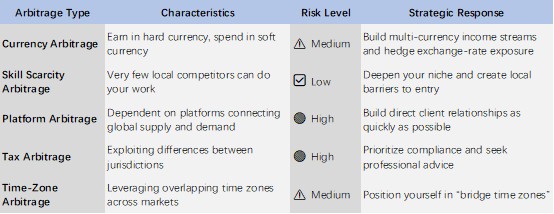
Step 4: Build an Anti-Fragile Geographic Strategy
The Dual-Base Strategy
- Maintain one high-arbitrage living base (parts of Southeast Asia, Eastern Europe, or Latin America)
- Maintain access to one high-network-value base (return to your primary market several times a year for client relationships)
- Avoid becoming overly rooted in any one location
- Preserve mobility
Multi-Currency Income Streams
Maintain income from at least two currency regions.
For example:
- One American client (USD)
- One European client (EUR)
- One local consulting project (local currency)
Upgrade Through Localization
Don’t rely solely on “globally generic” skills.
Layer regional expertise on top:
- An American marketer who understands Latin America
- A European procurement consultant who understands Asian supply chains
- A designer who understands Middle Eastern cultural preferences
That combination is harder to replace.
Step 5: Create an Arbitrage Monitoring System
Quarterly Checklist
- 〇 Have exchange rates shifted by more than 5%?
- 〇 Are local rents or prices rising significantly?
- 〇 Have major platforms or clients changed policies?
- 〇 Are visa or residency rules still stable?
Annual Checklist
- 〇 How has global supply and demand changed for your skill set?
- 〇 Have remote salary benchmarks shifted?
- 〇 Are new competitors entering your niche?
- 〇 Has AI increased replacement pressure in your field?
- 〇 Is your “Plan B” base still viable?
IV. Advanced Thinking: When Everyone Becomes a Digital Nomad, Where Does the Arbitrage Go?
The spread of remote work is systematically compressing traditional geographic arbitrage opportunities.
Trend #1: Salary Convergence
More companies are moving toward:
- Global salary bands
- Geographic compensation tiers
- Location-adjusted remote pay
Remote salaries are increasingly drifting toward a global median.
That means the classic model —
“earn expensive-country income while living in a cheap country”
— is becoming harder to sustain.
Trend #2: Cost-of-Living Convergence
Popular digital nomad destinations such as:
- Bali
- Lisbon
- Mexico City
- Medellín
have all experienced “nomad inflation.”
An influx of foreign remote workers pushes up:
- rents
- cafés
- coworking spaces
- local services
In places like Bali’s Canggu district, rents reportedly rose 10–15% within two years. Similar patterns are visible in Lisbon and Mexico City.
Trend #3: AI Replacement
Low-skill and highly standardized remote work — including:
- basic customer support
- repetitive administrative work
- simple design tasks
— is increasingly vulnerable to AI automation.
A high arbitrage coefficient means little if the underlying job category disappears entirely.
The Next Generation of Arbitrage Opportunities
1. Time-Zone Arbitrage
Become a “bridge-time-zone” operator.
Examples:
- A European serving Asian clients
- A Latin American serving European companies
Time-zone overlap creates communication advantages that are difficult to automate.
2. Regulatory Arbitrage
Cross-border knowledge in areas such as:
- GDPR
- AI compliance
- international taxation
- data governance
will become increasingly valuable.
People who understand multiple regulatory systems simultaneously will develop genuine scarcity.
3. “Slow Nomad” Arbitrage
Deeply integrate into local communities.
Don’t become a “consumption nomad” who only spends money abroad.
Become a “connection nomad” who connects:
- markets
- information
- cultures
- business networks
That creates durable asymmetry.
4. Skill-Stack Arbitrage
The global supply of standalone skills such as:
- coding
- design
- writing
is rapidly increasing.
But combinations remain scarce:
- coding + Southeast Asian market expertise
- design + Middle Eastern cultural fluency
- finance + multilingual cross-border communication
The future belongs to layered capability stacks.
Conclusion: Be Honest About Your Coordinates
True location independence does not mean pretending geography no longer matters.
It means consciously choosing and actively managing your geographic coordinates.
Geographic arbitrage is neither immoral nor permanent.
It is a variable that must be actively managed — not passively enjoyed.
Calculate your geographic arbitrage coefficient.
Manage your coordinates.
Preserve mobility.
That is what real location independence actually looks like.
FAQs
1. Is geographic arbitrage sustainable long term?
It can be sustainable temporarily, but it is rarely permanent. Exchange rates, local inflation, visa rules, platform algorithms, taxation policies, and remote salary localization can all reduce or eliminate arbitrage advantages over time.
2. Why are companies localizing remote salaries?
Many employers now adjust compensation based on an employee’s location rather than company headquarters. As remote work becomes normalized, businesses increasingly use geographic pay bands to control labor costs and standardize compensation structures globally.
3. Which remote jobs are most vulnerable to losing arbitrage advantages?
Highly standardized and easily replaceable remote jobs face the greatest risk. Examples include:
- Basic customer support
- Repetitive administrative work
- Entry-level content production
- Simple graphic design
- Data labeling and repetitive freelance tasks
These roles are vulnerable to both AI automation and global wage competition.
4. Which types of arbitrage are more durable?
Skill-scarcity arbitrage tends to last longer than simple currency arbitrage. Professionals who combine technical expertise with regional knowledge, multilingual abilities, regulatory understanding, or cross-cultural communication skills often maintain stronger long-term positioning.
5. Why are digital nomad hubs becoming more expensive?
Popular destinations such as Bali, Lisbon, Mexico City, and Medellín have experienced rapid demand growth from foreign remote workers. This influx often increases:
- Rent prices
- Coworking costs
- Café and restaurant pricing
- Foreign-targeted housing markets
In some cases, locals are priced out of central neighborhoods.
6. Can AI completely eliminate geographic arbitrage?
AI may significantly reduce arbitrage opportunities in low-skill remote work categories, but it is less likely to fully replace:
- Relationship-driven consulting
- Cross-border regulatory expertise
- Cultural translation work
- High-level strategy
- Specialized technical knowledge
- Complex negotiation and communication roles
The future likely favors hybrid skill combinations rather than isolated technical skills alone.
7. What is a “bridge time zone” strategy?
A bridge time zone strategy means positioning yourself geographically between major economic regions so you can work with multiple markets efficiently. For example:
- Latin America serving U.S. and European clients
- Europe serving both Asian and North American clients
Time-zone overlap can create operational advantages that are difficult to automate.
References
1. Airtasker. (2023). The rise of remote work and geographic salary adjustments. Retrieved from https://www.airtasker.com
2. Glassdoor Economic Research. (2024). Remote work trends and geographic pay structures. Retrieved from https://www.glassdoor.com/research
3. Nomad List. (2025). Cost of living trends in digital nomad cities. Retrieved from https://nomadlist.com
4. OECD. (2024). The future of remote work and labor market transformation. Retrieved from https://www.oecd.org
5. Statista. (2025). Global digital nomad statistics and market trends. Retrieved from https://www.statista.com
6. World Bank. (2024). Global inflation and purchasing power indicators. Retrieved from https://www.worldbank.org
7. World Economic Forum. (2025). AI, automation, and the future of distributed work. Retrieved from https://www.weforum.org
About the Author
Marco Elian Ruiz
Marco Elian Ruiz is a remote work strategist and former freelance consultant who has spent years working across Southeast Asia, Southern Europe, and Eastern Europe while advising independent professionals and distributed teams. His writing focuses on the economics of remote work, digital nomad culture, freelance sustainability, and geographic arbitrage. Marco is particularly interested in the gap between the marketed “freedom lifestyle” and the operational realities of online work, including taxation, client dependency, unstable income cycles, and long-term career resilience for remote workers.
Editorial Transparency Statement
This article was created through a combination of market research, publicly available economic reports, labor-market studies, remote work trend analysis, and long-term observation of digital nomad ecosystems. Examples referenced in the article are anonymized and adapted for educational and analytical purposes.
The editorial goal is to provide readers with balanced, practical, and realistic perspectives on geographic arbitrage and location-independent business models rather than promoting aspirational lifestyle marketing.
Content is reviewed for clarity, factual consistency, and relevance at the time of publication. Because economic conditions, visa policies, exchange rates, and labor markets evolve rapidly, readers should independently verify time-sensitive information.
Disclaimer
This article is intended for informational and educational purposes only and does not constitute financial, investment, tax, immigration, employment, or legal advice. Economic conditions, salary benchmarks, visa policies, exchange rates, and living costs may change over time and vary significantly by jurisdiction and individual circumstances.
Readers should consult qualified professionals, including licensed tax advisors, immigration specialists, legal professionals, or financial consultants, before making relocation, business, or investment decisions related to remote work or international living arrangements.