

By Gideon Straub | Updated on March, 2026 | 🕓 12 minutes
Key Highlights
- What do ghost workers actually do behind the scenes of AI systems?
- Why are AI companies outsourcing moderation and labeling work to developing countries?
- How can users identify products that exaggerate their level of automation?
- Are some AI customer service systems secretly operated by humans?
- How does the global AI industry mirror older forms of economic extraction?
- What should ethical consumers and founders look for before choosing AI tools?
Last year, in a coworking space in Manila, the person sitting at the desk next to mine was a 22-year-old Filipino woman. She worked 10 hours a day drawing bounding boxes around training images for self-driving cars — carefully outlining every vehicle, every pedestrian, and every traffic sign in street-view photos.
She earned $3 an hour. And the data she labeled was helping train a Silicon Valley company’s “fully autonomous driving AI.”
In apartments and internet cafés across Nairobi, Caracas, New Delhi, and Bogotá, countless people are doing similar work: labeling images, moderating content, filtering toxic text, correcting AI-generated answers. They are the invisible backbone of AI systems, yet marketing language repackages their labor as “done automatically by algorithms.”
An investigation by MIT Technology Review found that the AI industry’s record of exploiting workers in low-income countries is deeply troubling. In Kenya, labelers working for Sama earned less than $2 an hour while manually filtering training data containing child sexual abuse material and graphic torture descriptions in order to remove toxicity from training datasets for OpenAI’s ChatGPT. In the Philippines, Scale AI’s Remotasks platform has been criticized by labor-rights organizations for failing to meet basic labor standards and for alleged wage withholding.
These workers are often called “Ghost Workers” — people whose existence is deliberately hidden behind layers of outsourcing contracts, while consumers see only the “AI-powered” label on the product page.
I. The Three Most Common Forms of Fake AI Automation
Pattern One: Data Labeling Factories — The Humans Teaching AI to “See”
AI does not learn by itself. Humans first have to tell it what things are.
ImageNet — the 14-million-image dataset that helped power the modern computer vision revolution — was built through Amazon Mechanical Turk, where millions of anonymous workers around the world labeled images one by one, often for only a few cents per task.
Today, this model has become industrialized. In Uganda, Nigeria, Ghana, and South Africa, young workers log onto platforms such as Appen, Remotasks, and Scale AI to label medical images, identify obstacles for autonomous vehicles, and train conversation datasets for chatbots.
Pattern Two: The Human Shield Behind Content Moderation — The People Protecting AI From the Worst of Humanity
You may think social media algorithms automatically remove violence, hate speech, and child abuse content. In reality, in countries such as Kenya, the Philippines, and Colombia, large numbers of content moderators review 700 to 1,000 cases per day at a pace of one case every 7 to 12 seconds, exposing themselves to the darkest material imaginable.
In 2023, more than 140 moderators in Kenya working for Meta (Facebook’s parent company) through Sama filed lawsuits alleging that prolonged exposure to murder, suicide, child abuse, and other graphic material caused PTSD, depression, and anxiety disorders. Many of them earned only around $1.50 an hour, while reports suggested that OpenAI was paying Sama approximately $12.50 per hour for the moderation work — with the difference disappearing into the outsourcing chain.
Pattern Three: Human Customer Service Disguised as AI — The Gray Zone of “Human-in-the-Loop”
Many conversations you believe are happening with AI customer support systems are actually handled by humans behind the scenes.
When chatbots encounter complicated questions, the system quietly transfers the conversation to a real operator without informing the user. Some companies even intentionally give their AI assistants human names — such as Cursor’s “Sam” — to create the illusion that users are interacting with an intelligent digital being.
An even more hidden model is the “AI transcription + human polishing” workflow. Some so-called “AI writing assistants” or “AI translation tools” actually send the work to low-paid writers or translators in developing countries for editing and refinement before presenting the result as “AI-generated.”

II. Why Companies Need to “Fake” Automation
The reason is simple:
AI valuation = level of automation × user scale.
A startup claiming to offer “fully automated AI” may receive a valuation ten times higher than a company openly describing itself as a human-assisted service platform. Venture capital narratives depend on technological mythology, and technological mythology depends on hiding the existence of human labor.
There is also a brutally direct economic calculation behind outsourcing work to the Global South:
In Silicon Valley, AI researchers earn six-figure salaries.
In Kenya, data labelers may earn less than $2 an hour.
In Venezuela, workers on Remotasks sometimes earn only $6 to $8 per week.
A multinational study conducted by the Weizenbaum Institute, covering Venezuela, Germany, Kenya, and Colombia, found that technology companies systematically encourage workers to believe that resisting exploitation would amount to career suicide. This carefully engineered erosion of self-worth becomes part of corporate discipline, weakening solidarity among workers.
III. What Does This Have to Do With Digital Nomads?
Trap One: The “AI Side Hustle” May Actually Turn You Into Human Infrastructure
If you see remote jobs on Upwork, Fiverr, or crowdsourcing platforms labeled as “AI Trainer,” “Data Annotator,” or “LLM Evaluator,” proceed carefully.
Many of these so-called AI training positions are actually piece-rate microtask jobs that pay below local minimum wage, provide no contract protections, no benefits, and no meaningful appeals process.
An 18-year-old Pakistani teenager named Mutmain told WIRED that he had been working on Appen since age 15 using a family member’s identification documents. He worked from 8 a.m. to 6 p.m., then again from 2 a.m. to 6 a.m., earning less than $50 per month.
Trap Two: The “AI Tools” You Use May Be Built on Exploitation
As digital nomads, many of us rely heavily on SaaS tools to improve productivity. But if the “AI capabilities” inside those tools actually depend on poorly paid moderators and labelers working under harsh conditions, then every use of those tools indirectly supports the system behind them.
IV. Practical Guide: How to Identify, Respond to, and Choose Wisely
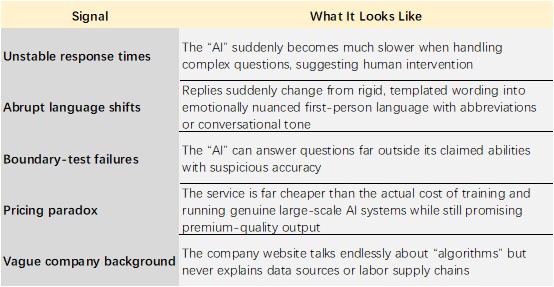
5.1 Five Signs That an “AI Product” May Actually Depend Heavily on Human Labor
5.2 If You Are a Remote Worker
Red Flags to Avoid
- Be cautious of platforms asking you to complete “free trial tasks” before payment
- Check whether the platform has labor-rights certifications such as those issued by the Fairwork Project
- Search Glassdoor, Reddit communities such as r/beermoney, and worker forums for real user experiences
- Refuse to sign overly broad NDAs that could prevent you from filing complaints or sharing evidence
Negotiation Strategies
- Research realistic wage standards in your region instead of accepting lower pay simply because the work is labeled “AI”
- Request clear payment structures based on hourly compensation rather than per-task approval systems
- Keep records of all completed work, screenshots, and communication logs
Skill Upgrade Path
Data labeling sits at the bottom of the AI supply chain, and its skill value decays quickly.
More sustainable directions include:
- Prompt engineering
- AI quality evaluation and RLHF work
- Localization project management
These roles require judgment rather than repetitive labor.
5.3 If You Are a Consumer or Founder
Purchasing Decisions
- Prioritize vendors that openly disclose their human-to-AI workflow ratios
- Check whether suppliers publish ethical supply-chain policies
- Be skeptical of services claiming “100% AI automation” while charging extremely low prices
Lessons for Founders
If you are building AI products, be honest about the necessity of human-in-the-loop systems.
Klarna once aggressively promoted the idea that its AI customer service systems could replace humans entirely. Later, the company publicly acknowledged that “nothing is more valuable than humans,” shifting toward a hybrid model in which AI handles routine requests while humans manage complex situations.
Ironically, that transparency helped strengthen user trust.
V. This Is Not a Technology Problem — It Is a Power Problem
Research from University of Oxford argues that microtask platforms are intentionally designed to anonymize workers and make individual contributions invisible, thereby systematically devaluing labor itself.
The structure resembles historical colonial extraction models in disturbing ways: wealth and value are extracted by wealthy countries, while poorer countries absorb the human cost.
In December 2024, the law firm Clarkson Law Firm filed a class-action lawsuit against Scale AI, alleging that the company misclassified workers as “independent contractors” to avoid labor protections, forced unpaid overtime, and monitored workers through surveillance software tracking every keystroke.
Then, in January 2025, additional workers accused Scale AI of “knowingly and intentionally” failing to pay overtime wages.
A Kenyan court previously ruled that Meta could be sued over labor conditions involving its outsourcing contractor Sama — a landmark decision. Yet in a bitter irony, Kenya later passed a 2024 business law shielding technology platforms from liability for the working conditions of their outsourcing partners. The government chose attracting foreign investment over protecting workers.
Conclusion: You Can’t Make Ethical Choices Until You See the Ghosts
AI does not learn on its own.
Behind every “intelligent” system is a supply chain made of human labor.
Recognizing the existence of these ghost workers is not about rejecting technology. It is about making more informed, conscious decisions about the systems we build, use, fund, and normalize.
Further Reading
- Documentary: The Cleaners (2018, about content moderators in the Philippines)
- Investigative Reporting: Billy Perrigo, TIME Magazine, January 2023 — Investigation into OpenAI and Kenyan workers employed through Sama
- Academic Research: Casilli et al., 2024 — Research on data workers in Venezuela, Brazil, and Madagascar
- Labor Rights: [Fairwork Project](https://fair.work/en/fw/homepage/?utm_source=chatgpt.com) — Evaluating labor standards in the global platform economy
- Legal Developments: Kenyan Employment and Labour Relations Court rulings involving Meta and Sama
FAQs
1. Is all AI fake if humans are involved?
No. Most modern AI systems rely on some level of human involvement, especially during training, moderation, evaluation, and quality control. The issue is not human participation itself, but whether companies hide that participation while marketing products as fully autonomous.
2. What kinds of jobs are commonly outsourced in AI workflows?
Common outsourced AI-related jobs include:
Image and video annotation
Content moderation
Toxicity filtering
AI response evaluation
Speech transcription
Translation editing
RLHF (Reinforcement Learning from Human Feedback) tasks
3. Can AI content moderation harm workers psychologically?
Yes. Many moderators are repeatedly exposed to violent, abusive, or traumatic content. Multiple lawsuits and investigations have linked long-term moderation work to PTSD, anxiety, depression, and emotional burnout.
4. How can users tell if an “AI chatbot” is partially human-operated?
Possible signs include:
Sudden changes in tone or writing style
Delays during complicated questions
Highly accurate answers outside the AI’s stated abilities
Emotional nuance or conversational improvisation inconsistent with earlier responses
However, there is no guaranteed way to detect human intervention from the user side.
5. What is RLHF?
RLHF stands for Reinforcement Learning from Human Feedback. Humans review, rank, and correct AI-generated responses so machine learning systems can improve future outputs.
6. Are there organizations monitoring labor conditions in AI supply chains?
Yes. Groups such as the Fairwork Project, labor-rights NGOs, investigative journalists, and academic researchers monitor working conditions in digital labor platforms and AI outsourcing ecosystems.
7. Why do some startups exaggerate automation?
Investors often reward companies that appear highly scalable and technologically advanced. Claiming “fully automated AI” can increase valuations, attract funding, and create stronger marketing narratives compared to admitting heavy dependence on human labor.
References
1. Casilli, A. A., Tubaro, P., & Le Ludec, C. (2024). The global exploitation of digital labor in AI supply chains. Journal of Digital Economy Studies, 12(3), 45–67.
2. Perrigo, B. (2023, January 18). OpenAI used Kenyan workers on less than $2 per hour to make ChatGPT less toxic. TIME Magazine. Retrieved from https://time.com/
3. Roberts, S. T. (2019). Behind the Screen: Content Moderation in the Shadows of Social Media. Yale University Press.
4. Gray, M. L., & Suri, S. (2019). Ghost Work: How to Stop Silicon Valley from Building a New Global Underclass. Houghton Mifflin Harcourt.
5. International Labour Organization. (2024). Generative AI and digital platform labor: Global employment implications. Retrieved from https://www.ilo.org/
6. MIT Technology Review Insights. (2024). The hidden human labor behind artificial intelligence systems. Retrieved from https://www.technologyreview.com/
7. Oxford Internet Institute. (2024). AI supply chains and platform labor governance. University of Oxford. Retrieved from https://www.oii.ox.ac.uk/
8. Wired Magazine. (2024). The teenagers training AI for pennies. Retrieved from https://www.wired.com/
About the Author
Gideon Straub
Gideon Straub is a software engineer and workplace systems commentator who writes about developer culture, automation, AI-assisted workflows, and the changing structure of technical employment. Drawing from years of experience in software development and distributed engineering teams, his work explores how AI tools are reshaping hiring practices, productivity expectations, workplace management, and the long-term role of human expertise in technical industries. Gideon is particularly interested in the unintended organizational consequences of rapid AI adoption.
Editorial Transparency Statement
This article was produced using publicly available reporting, academic studies, legal filings, labor-rights investigations, and industry analysis. The author independently synthesized the information and did not receive compensation from any company mentioned in the article.
Quotations, wage figures, and legal allegations referenced in this article are based on reports from established publications, court records, nonprofit research organizations, and academic institutions available at the time of writing.
The article may include interpretive analysis and commentary regarding labor conditions, outsourcing systems, and AI industry practices. Readers are encouraged to consult original sources and follow ongoing legal developments, as some cases and investigations remain active or unresolved.
Disclaimer
This content is provided for informational and educational purposes only and does not constitute legal, financial, employment, investment, or psychological advice.
The companies, organizations, and individuals mentioned in this article may dispute certain allegations, legal claims, or interpretations referenced herein. Some cases discussed are ongoing and have not resulted in final judicial determinations.
Readers should independently verify information before making professional, financial, or career decisions based on this material.