

By Leonie Hartmann | Updated on January, 2026 | 🕓 12 minutes
Key Highlights
- What red flags indicate a visa sponsorship offer might be a scam?
- How do scammers structure fake job offers across different countries?
- What are the most common models of visa sponsorship scams worldwide?
- How can high-education or experienced professionals fall victim to these scams?
- What practical steps can you take to verify offers and protect yourself?
1. A "Too Perfect" Offer
In 2024, a Chinese job seeker received an email from a "certified employer" in New Zealand. The position was for an IT Support Specialist, offering an annual salary of 55,000 New Zealand dollars, along with an Accredited Employer Work Visa sponsorship. The sender requested an upfront payment of 18,000 NZD (approximately 80,000 RMB) as a "visa fast-track processing fee."
The job seeker paid the fee and flew to Auckland, only to be taken to a crowded shared apartment. For months afterward, he could not contact the "employer," and the intermediary had already disappeared. When he applied to the New Zealand Immigration Department to review the records, he discovered that the signature on the employment contract was forged and that the company had never authorized this offer.
This is not an isolated incident. In December 2025, police in Haryana, India, uncovered a scam targeting New Zealand work visas. Two men had posted advertisements on social media, claiming they could "guarantee approval" for IT and hospitality visas within thirty days, defrauding victims of a total of 1.5 million Indian rupees. Authorities seized numerous forged job offers and blank passport pages on the scene.
Key Fact: In almost all countries worldwide, labor laws prohibit employers from charging employees for visa sponsorship. This is a red line, but many people remain unaware of it.
2. Five Common "Product Forms" of Visa Scams
Visa sponsorship scams are not random acts; they are a mature gray-market business. Based on operational logic, there are five common types worldwide:
Model 1: "Pay-for-Referral"
Intermediaries claim to have "exclusive partnerships" with companies in the target country. By paying a fee, you can supposedly receive both a job offer and visa sponsorship.
Real Case: Canadian LMIA Black Market
In 2024, Canada’s federal immigration department (IRCC) confirmed the existence of numerous fake job positions supported by sold Labor Market Impact Assessments (LMIA). Scammers forged payslips and tax documents, and some victims were even asked to "pay themselves" to maintain the illusion of employment. In December 2024, Canada announced a major policy adjustment: Express Entry candidates would no longer receive additional points for having a job offer—precisely because this "points bonus" had become an economic incentive for buying and selling fake jobs.
Model 2: "Shell Employer"
Scammers register companies that appear legitimate, with websites and LinkedIn profiles, and can even generate payslips—but the company conducts no actual business.
Real Case: UK Skilled Worker Visa Scandal
In January 2026, undercover investigations by The Times revealed that twenty-six "visa agents" were willing to sell falsified employment records and sponsorship certificates for up to 13,000 GBP. Investigators identified over 250 suspicious sponsorship documents, some linked to shell companies. These agents provided a full suite of falsified materials: fake resumes, fake pay statements, fake bank statements, and fake work histories. The UK government immediately announced that, starting February 2026, posting fake visa sponsorship advertisements itself would be treated as a separate criminal offense, punishable by unlimited fines.

Model 3: "Training-to-Work Visa"
Scammers promote packages claiming "skills training + guaranteed employment + visa sponsorship," charging high tuition fees. After training, the company disappears or indefinitely delays employment.
Real Case: UK Skills Bootcamp Scam
In 2024, the UK Department of Education investigated a training organization named CoGrammar, which had falsified a company called "Staton Group" and invented a fictitious director, "Phillip Staton," even corresponding via email with investigators under his name. They submitted 155 fraudulent employment confirmations to exploit government skills training subsidies. The real company owner, Mike Staton, said he felt "violated" and "extremely frustrated."
Model 4: "Remote Onboarding" (Surge After COVID-19)
The entire process is online: interviews, contract signing, and even sending "welcome emails." Fees are then requested under the pretext of "background checks" or "workspace deposits."
Real Case: Australian Fake Visa Website
In 2018, the Australian High Commission in New Delhi warned that a local employment agency had cloned the Australian Immigration website, including a fake visa-check system. More than fifty victims paid hundreds of thousands of Indian rupees for completely fabricated visa approvals. A spokesperson stated: "We have seen cloned websites, but the latest version links to a fake visa inquiry portal—it contains only fabricated information from intermediaries. It looks convincing but is entirely false."
Model 5: "Visa Umbrella" (Most Concealed)
Victims may indeed receive a legitimate visa, but after starting the job, they find the company requires them to "find their own projects and sustain themselves," or even pay the company monthly to "maintain employment."
Real Case: U.S. H-1B Wage Reimbursement Trap
The U.S. Citizenship and Immigration Services (USCIS) has repeatedly warned that some small IT consulting firms, after obtaining H-1B visas, "host" employees without real work and require them to return part of their wages in cash. In 2023, USCIS received 781,000 H-1B lottery registrations, far exceeding the 85,000 visas available, many from affiliated companies. The agency clarified that even if such abuses are not immediately discovered, approved H-1B visas can be revoked later, and individuals may face mandatory deportation and potential criminal prosecution.
3. The Scam "Supply Chain": How Money Flows
Few people break down the internal structure of this gray-market economy. It generally consists of four stages:
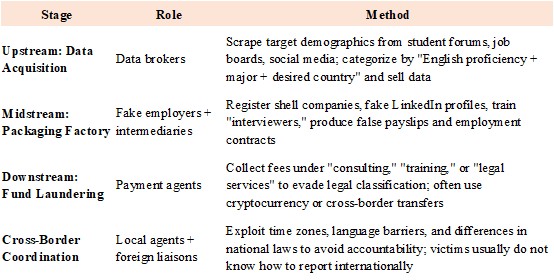
Real Case: Prince Edward Island, Canada Large-Scale Fraud
In July 2025, the Canada Border Services Agency (CBSA) charged fourteen individuals and companies for submitting fake LMIA applications through multiple affiliated businesses (Canadian Nectar Products, Island Gold Honey, etc.), fraudulently obtaining work permits for twenty-seven unnecessary "foreign workers." Key figure Kamalpreet Khaira instructed staff to provide false documents, while Thomas Walker, a former accountant with a revoked license for theft, was also involved. Charges included immigration fraud, unauthorized employment, document forgery, and money laundering.
4. Why Highly Educated and Intelligent People Fall for It
4.1 The "Sunk Cost" Trap
You have already spent money on IELTS, credential verification, and work experience. When the "final step" appears, the brain tends to believe it is real—or else all prior investment is "wasted."
4.2 The "Confidence Paradox"
The 2025 "Stay Secure" study by Visa and Dubai Police found that people who consider themselves "security-savvy" are more likely to fall for scams. Seventy-nine percent of self-proclaimed knowledgeable residents of the UAE responded to fraudulent messages claiming "visa approved," compared to seventy-four percent in cautious groups. Scammers no longer use broken English like the "Nigerian prince" emails; they cite real laws (e.g., Canada’s Bill C-2), use legal terminology, and rent real offices in Business Bay.
4.3 Fake Social Proof
Fraudulent intermediaries create WhatsApp groups with hundreds of "success stories"—mostly bots or paid actors. They also fake Glassdoor reviews and "thank-you videos" from clients.
4.4 Time Pressure
Phrases like "limited spots," "policy changes at month-end," or "position closes tomorrow" create urgency, reducing rational judgment.
5. Global Practical Defense Guide
5.1 Identification Stage: Before Receiving an Offer
Step One: Conduct a Reverse Company Check
Check the actual office address: Use Google Street View to see if it is a shared office, residential building, or empty lot. Many shell companies in the Times investigation had virtual office addresses.
Check business registration: Public databases exist in most countries:
- United Kingdom: Companies House (free)
- Canada: Provincial corporate registries
- United States: Secretary of State business search
- Australia: ASIC Connect
- New Zealand: Companies Office
Step Two: Verify Visa Sponsorship Qualifications
- UK: Check Home Office official sponsor list for company status and sponsorship category.
- Canada: LMIA must be applied for by employers to ESDC; workers do not pay any fees. Suspicious employers can be reported anonymously to Service Canada.
- United States: H-1B employers must have an IRS-issued EIN and can be checked on the USCIS website.
- Australia: Verify whether the employer is on CRICOS or the relevant sponsorship list.
Step Three: Interview "Stress Test"
Ask questions only a real employee could answer, such as: "What technology stack did your last similar project use, and who was the client?" Interviewers from shell companies usually give vague answers.
5.2 Decision Stage: After Receiving an Offer
Iron Rule: Never Pay Fees Upfront
- Legitimate employers will never ask you to pay: visa processing fees, background checks, training fees, workspace deposits, or flight prepayments.
- In Canada, the UK, Australia, and New Zealand, government fees for work visas should be paid directly to immigration authorities, not through intermediaries.
Request a Written Employment Contract, Not Just an Offer Letter
The contract should clearly specify:
- Job description
- Work location (cannot be "TBD")
- Salary structure and payment schedule
- Employer-covered expenses
Cross-Verify: Contact Current Employees
Reach out on LinkedIn: "I am considering a position at your company. Could you share your experience?" Suggested script:
"Hi [Name], I received an offer for [Position] at [Company]. I am excited but doing my due diligence. Would you be open to a brief chat about your experience there? I would really appreciate an insider’s perspective."
5.3 After Victimization (Global Guidelines)
Stop Making Payments Immediately
Do not continue transferring money due to threats like "documents are closing." The "document" may have never existed.
Collect Evidence
- Screenshots of all chats (WhatsApp, WeChat, email)
- Bank transfer receipts
- All documents provided by the scammer (even if fake)
- Business cards, website snapshots (use Wayback Machine)
Cross-Border Reporting Channels
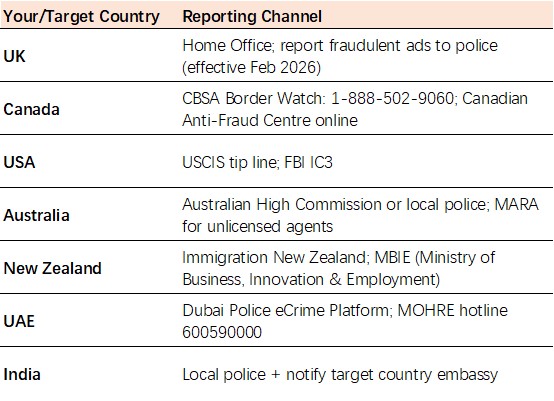
Attempt to Recover Funds
- Credit card payments: request a chargeback within 120 days
- Cross-border transfers: contact the remittance bank to freeze funds (low success rate but worth trying)
- Beware of "secondary scams": some claim to be "lawyers" who can help recover losses—17% of victims in the UAE were scammed multiple times
Assess Immigration Consequences
If you unknowingly submitted applications containing false information:
- Immediately contact the immigration authority to explain. In Canada, misrepresentation can lead to a minimum five-year entry ban, but voluntary disclosure may reduce penalties.
- If you are already in the destination country and find visa/work permit issues, contact a licensed immigration lawyer immediately; do not attempt to leave and re-enter—you may be stopped at the border.
6. Clarification: What Legitimate "Paid Pathways" Look Like
Not all fees are scams. The following are legitimate:
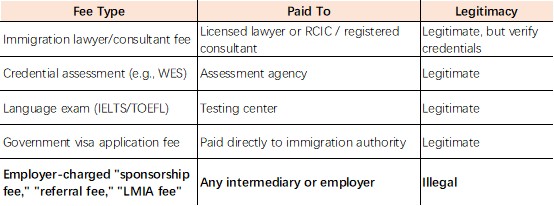
Key Distinction: Is the money paid to a professional service provider (lawyer, translator) or to an intermediary promising a job offer? The latter is a red flag.
7. Official Resources List (Verify Directly, Do Not Rely on Intermediaries)
- UK: Home Office official sponsor list; report fake sponsorship ads (effective Feb 2026)
- Canada: IRCC "Identify Immigration Scams" guide + CICC licensed consultant directory (college-ic.ca)
- USA: USCIS "Avoid Scams" page + verify lawyer credentials via state bar associations
- Australia: MARA registered agent directory + Department of Home Affairs official fee schedule
- New Zealand: Immigration New Zealand official guide + accredited employer list
- UAE: MOHRE system has identified 1,300 non-compliant companies, fines exceeding 34 million AED
Conclusion: Information Gap Equals Profit Gap
Visa sponsorship scams exist not because victims are "stupid," but because the information cost of cross-border employment is extremely high—you must understand labor law, immigration law, company registration systems, and financial transfer rules of the target country, while scammers only need to exploit "human weaknesses."
In November 2025, the UK, Canada, and Australia launched the FightingVisaFraud international initiative, acknowledging it as "an unprecedented level of cooperation" because the organization of these scams has surpassed the enforcement capacity of any single country.
If you are waiting for an "overseas offer," or a friend is going through this process, remember: real opportunities never require you to rush, but scams always create urgency.
FAQs
Q1: Can a legitimate employer ever ask me to pay a visa sponsorship fee?
No. In almost all countries, it is illegal for employers to charge employees for visa sponsorship. Fees for legal services, credential assessment, or government applications are legitimate.
Q2: What should I do if I realize I’ve already paid a scammer?
Stop all payments immediately, collect all evidence, attempt chargebacks if possible, and report to the appropriate authorities in your country and the target country.
Q3: How can I verify if a company is real and authorized to sponsor visas?
Use official government databases such as the Home Office sponsor list (UK), IRCC and provincial registries (Canada), USCIS records (USA), MARA (Australia), or Immigration New Zealand accredited employer list.
Q4: Are online or remote job offers more risky?
Yes, fully online recruitment without verification of the employer and the visa sponsorship is a major red flag, especially if the process involves advance payments for "processing fees" or "training fees."
Q5: What should I do if my visa application was submitted with false information without my knowledge?
Contact the immigration authorities immediately and consult a licensed immigration lawyer. Voluntary disclosure may reduce potential penalties.
References
1. Canada Border Services Agency. (2025). Prince Edward Island Immigration Fraud Prosecution. Government of Canada.
2. Immigration New Zealand. (2024–2025). Accredited Employers and Work Visa Scams. Immigration New Zealand Media Releases.
3. The Times. (2026, January). UK Skilled Worker Visa Shell Company Investigation. London: Times Newspapers Ltd.
4. U.S. Citizenship and Immigration Services. (2023–2025). H-1B Visa Fraud Alerts. U.S. Department of Homeland Security.
5. Australian Senate Committee. (2018). Fake Visa Websites and Employment Agencies. Parliament of Australia.
6. Visa & Dubai Police. (2025). Stay Secure: Visa Fraud Awareness Report. Dubai Police Press Office.
7. Ministry of Human Resources and Emiratisation (MOHRE). (2025). Violation Reports on Visa Sponsorship Practices. United Arab Emirates Government.
About the Author
Leonie Hartmann
Leonie Hartmann is a migration policy writer and cross-border labor researcher specializing in temporary migration systems, international labor mobility, and visa-driven employment markets. Her research explores how governments, employers, and private consulting industries influence migration pathways for students, skilled workers, and digital nomads. Leonie frequently writes about immigration consulting practices, labor shortages, visa sponsorship structures, and the economic realities behind modern migration narratives. Her work combines policy analysis with practical insights for globally mobile professionals.
Editorial Transparency Statement
This article is based entirely on publicly available government reports, investigative journalism, and official regulatory announcements. The author has independently verified the cases cited and does not receive financial compensation from any intermediary or immigration consultancy mentioned in the article. All recommendations reflect factual research and internationally recognized best practices.
Disclaimer
This article is for informational purposes only and does not constitute legal advice. Readers facing specific visa or employment issues should consult a licensed immigration attorney or certified legal professional in the relevant country. The author and publisher are not responsible for any losses incurred as a result of relying on this information.