By Adrian Vale | Updated on January, 2026 | 🕓 12 minutes read
Key Highlights
- What are the different types of "guaranteed admission" services?
- How do agencies profit from your application fees?
- What are the academic and legal risks of using "guaranteed admission" services?
- How can you independently verify your application materials?
- Are there legitimate alternatives to "guaranteed admission" agencies?
This is not a problem unique to any single country. From Seoul to Mumbai, from Lagos to São Paulo, the "guaranteed admission" trap is reaping the same group of anxious students and parents, albeit in different forms.
I. A Nightmare Worth 700,000 RMB
In 2024, Ms. Li from Nanjing spent 700,000 RMB (approx. $100,000 USD) through an agency that promoted "guaranteed admission to top schools" to apply to the University of Hong Kong for her daughter. The agency promised "internal channels, guaranteed admission," and Ms. Li thought the fee was worth it—after all, a degree from HKU is a dream destination for many families.
One year after enrollment, HKU suddenly notified them that her daughter's admission documents were problematic, with the IB grades found to be falsified. Her daughter was immediately expelled, and Ms. Li later discovered that the agency had secretly falsified her daughter's U.S. high school credentials and IB grades—all without her knowledge.
This is not an isolated incident. In 2025, India's Enforcement Directorate (ED), in collaboration with the Ministry of External Affairs, uncovered a massive admissions scam involving 18,000 medical degrees. Agencies colluded with private medical colleges to falsify NRI (Non-Resident Indian) certificates and fake genealogies to secure medical seats for ineligible students. Each NRI quota seat cost between 120 million to 170 million INR (approximately $1.4–2 million USD), and the eight colleges involved earned around 28 billion INR annually from this scheme alone.
Even more alarming: over 90% of the students involved were completely unaware their application materials had been tampered with. They thought they were purchasing "professional services," but in reality, they were buying a ticking time bomb.
II. The Three Faces of "Guaranteed Admission": What Are You Really Facing?
Before signing any contract, it is crucial to understand what you are really dealing with. Globally, "guaranteed admission" services can generally be categorized into three types:
A. The Probability Game: Betting on What You Could Already Achieve
This is the most common and insidious type. Agencies charge exorbitant fees—often 5 to 10 times the cost of regular consulting services—promising "full refund if not admitted."
The reality?
They often place you in a school you would have been admitted to anyway. Out of 10 clients, 8 meet the qualifications on their own, and the remaining 2 who don’t qualify get refunds—making it a risk-free profit. Savvier agencies include clauses requiring applicants to apply to a specific list of schools, which conveniently have commission agreements with the agency.
One insider revealed: "Harvard Extension School isn’t a full-fledged formal degree program; it only grants credits, not degrees… You can literally add the course to your shopping cart and check out online—it’s that simple. The agency, however, won’t tell you this. They will package 'Harvard Extension School' as 'Harvard University official undergraduate program,' charging 2.2 million RMB (approx. $320,000 USD), while the real enrollment fee is just $100."
B. Material Packaging: The Gray Zone Between Polishing and Forgery
This type carries the highest risk and is most widespread. Methods range from "polishing application documents" to outright fabrication:
- Writing essays on behalf of students, inventing internship experiences
- Forging transcripts or recommendation letters
- Falsifying language test results
- Even creating an entire academic background
In June 2025, Hyderabad airport immigration officials uncovered a transnational academic fraud ring. Within two weeks, four students preparing to travel to the U.S. and U.K. were stopped at the gate, carrying forged degrees, altered transcripts, and fake employment verification. One 28-year-old student, Pakeeru Gopal Reddy, had previously entered Webster University in the U.S. using a forged computer science bachelor’s degree and was deported when attempting to re-enter.
In early 2025, the Australian Department of Home Affairs issued a "Student Visa Integrity Alert" to universities nationwide: since September, there has been a sharp rise in forged passports, financial documents, and English test results. Some agencies obtained admission confirmation letters (CoEs) from top universities using forged ID pages.
C. Internal Channel Type: The Most Expensive Illusion
This model targets affluent families. Agencies claim to have "board member connections," "inside access to admissions offices," or even promise entry via "donation channels."
In April 2026, the South Korean Supreme Court upheld a ruling in which an education consultant was sentenced to 1 year and 10 months for claiming they could guarantee admission to Harvard through donations, defrauding 850 million KRW (approx. $560,000 USD). The court explicitly stated: claiming connections with U.S. university admissions offices constitutes fraud, even if the student later gains admission to another top university through legitimate means.
In a more ironic case in Los Angeles, U.S., two education consultants, Yi Chen and Yixin Li, operated a "consulting company," charging foreign students thousands of dollars for "guaranteed admission" to schools including NYU, Columbia, and Boston College. They falsified or altered transcripts and hired proxies to take the TOEFL exam on behalf of students. Both were ultimately indicted by a federal grand jury, facing up to 10 years in prison.
III. The Hidden Profit Map of Agencies: Where Your Money Really Goes
Few people examine this problem from a business model perspective. Understanding how agencies profit is the first step to avoiding being exploited.
Profit Source 1: The "Secret Commission" from Schools
This is an open secret in the industry, but few applicants know it. Many agencies have commission agreements with specific universities and steer students toward those schools, rather than the ones best suited to them.
An Indian education consultant discovered: "Agencies pocket 60% of your first-year tuition as a 'commission' from the university. To hide this, they mark up your fees by $5,000/year. You only find out when you meet a local student and see their receipt."
You may think you are paying for services, but in reality, you might be the product being sold.
Profit Source 2: The "Math Game" of Refund Clauses
"Full refund if not admitted" sounds reassuring, but contracts often hide pitfalls:
- "Deposit non-refundable if failure is due to student cooperation issues" — who decides what counts as "cooperation"? The agency does.
- Must apply to a specified list of schools and cannot DIY at the same time
- "Pay after getting an offer" — once you receive an offer, the agency may threaten: "Pay up, or we’ll report your transcript forgery to the school"
Profit Source 3: The "Premium on Information Asymmetry"
Agencies exploit your unfamiliarity with foreign education systems to create artificial scarcity:
- Present "self-service application systems" as "exclusive technology"
- Market "publicly available school information" as "insider data"
- Package "normal application procedures" as needing "special channels"
One industry insider said: "Studying abroad has always been a business of information asymmetry. 'Guaranteed admission' profits are the highest—fees can be ten times a regular agency."
Profit Source 4: After-Sales "Secondary Harvest"
Even after enrollment, agencies may continue profiting. Some offer "academic tutoring" or "full assistance to guarantee graduation," implicitly acknowledging that students admitted via falsified documents may not be able to complete their studies independently.
IV. The Real Cost: More Than Just Money
The hidden costs of "guaranteed admission" go far beyond agency fees.
Academic Consequences: Lifetime Bans
- UK: Students caught in fraud at Manchester University face expulsion, frozen accounts, voided grades, and a lifetime ban from UK universities.
- US: Harvard once dismissed 27 students for falsified essays; those involved were barred from applying to any U.S. universities for ten years.
- Hong Kong: Forgery can lead to up to 14 years imprisonment; some students have served 17 weeks in jail and were deported.
Visa/Immigration Consequences: Global Reach
The UK bans fraudsters from entry for 5–10 years. The U.S. Anti-Education Fraud Act allows up to 20 years imprisonment for falsified applications. Worse, these records leave traces in global visa systems, affecting your ability to travel anywhere in the future.
Opportunity Cost: The Price of Taking the Wrong Path
Being directed to unsuitable schools or programs wastes not only tuition but time that cannot be recovered. One student who failed to get into the National University of Singapore was refunded in full by the court, but "missing the application season" was an irreplaceable loss.
V. A Global Perspective: This Is Not Country-Specific
"Guaranteed admission" traps exist worldwide:
South Asia: India and Bangladesh — Black Market for Visa Appointments
In 2024, Lindsay Stamsos, an international admissions officer at Portland State University, Oregon, noticed something unusual: a large number of applications from India and Bangladesh, but very few students actually registered for classes.
Upon investigation, her team concluded that about 65% of applications from India and Bangladesh might be fraudulent—either real names with falsified details or completely fictitious identities. The reason? U.S. visa appointments can take 247–254 days in Dhaka and New Delhi. Agencies created a black market: they falsified applications to secure I-20 forms and appointment slots, then sold them to other legitimate students.
Stamsos said: "This is likely a recruiter network manipulating the system for profit. They use student information to secure I-20s and appointments, then sell the slots to other students."
Middle East & North Africa: Pakistan's 'Guaranteed Admission' Industry
In 2024, Lahore student Shahzaib Rasheed paid 1 million PKR (approx. $3,600) to an agency to apply to universities in Hong Kong, but still was not admitted a year later. The agency demanded "installment refunds." Another student, Zainab Tahir, applied to a medical school in Uzbekistan; the agency collected tuition but never submitted the application, wasting an entire year.
Data from Pakistan’s Federal Investigation Agency (FIA) shows that fraud cases involving study abroad companies in five major cities of Punjab increased 20–35% over the past four years: 400 cases in 2021, 770 in 2022, 1,080 in 2023, and 1,409 in 2024.
Key Insight: No matter where you are, if you are unfamiliar with overseas education systems and aspire to change your destiny through education, you may become a target. This is a global information asymmetry problem.
VI. Practical Guide: How to Identify and Avoid "Guaranteed Admission" Traps
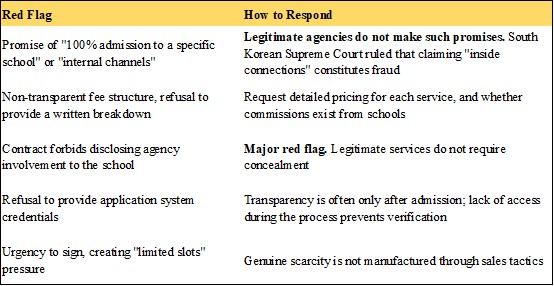
6.1 Pre-Contract "Red Flag" Checklist
Before signing a contract, check each point carefully:
6.2 Principles for Protecting Your Documents and Materials
Iron Rule: Review and understand all materials before submission.
❌ Refuse any "writing on your behalf" services — you may request editing, but not ghostwriting
❌ Recommendation letters must be uploaded or sent by real recommenders, not the agency
❌ Reject offers of "background support" — these usually aim to cover up forgery rather than verify authenticity
✅ Keep all original documents and communication records (emails, chats, contracts)
6.3 Independent Verification Channels (by Region)
Do not rely on agencies; use official, free resources:
United States
- EducationUSA (U.S. Department of State certified centers)
- Common App / Coalition App direct applications
- School websites: Admission FAQs
United Kingdom
- UCAS official system
- UKCISA (UK Council for International Student Affairs)
- University websites
Canada
- IRCC (Immigration, Refugees, and Citizenship Canada)
- Provincial education certification verification
- Check if school is a DLI (Designated Learning Institution)
Australia
- CRICOS course registration (all courses accepting international students must be registered)
- TEQSA institutional accreditation
General Verification Methods
- Contact current students on LinkedIn to ask about real experiences
- Reddit (r/gradadmissions, r/intltousa), Quora, The Student Room
- Contact university international offices directly (using official emails, not agency-provided addresses)
6.4 If You Have Already Signed, How to Limit Damage
If you suspect you are caught in a trap:
Step 1: Stop Payments
Immediately halt all further payments. Do not pay any "expedite fee" or "special channel fee."
Step 2: Review the Contract
- Identify specific refund clauses
- Check for vague terms like "non-refundable if due to student cooperation"
- Keep all written evidence
Step 3: Verify Actively
- Contact the school admissions office directly to confirm submission of your materials
- Request login credentials for the application system; refusal is a major red flag
Step 4: Seek External Help
- File complaints with local consumer protection agencies
- If there is suspected visa fraud, consult an immigration lawyer proactively
- Share your experience on social media and communities like Reddit to help others avoid traps
Step 5: Legal Action
- South Korean cases show that even if a student later enters another top school, the agency's "false promise" still constitutes fraud
- Keep all evidence, including chat records, transfer receipts, and contract text
VII. Alternatives: How to Improve Admission Chances Without "Guaranteed Admission"
1. Free Official Resources (Most Underestimated Treasure)
- EducationUSA: U.S. Department of State centers worldwide, free guidance
- British Council: Free U.K. study abroad consulting
- University official webinars: Hear directly from admissions officers
2. Community Support (More Realistic Than Agencies)
- Reddit: r/gradadmissions, r/intltousa, r/IntltoUK
- The Student Room: Real discussions from U.K. students
3. Paid but Transparent Services
- Independent consultants paid by the hour, not packaged "guaranteed admission" plans
- Essay editing services, e.g., Grammarly or native speaker friends (strictly editing, not ghostwriting)
- Mock interview services tailored to specific schools
4. Develop Core Skills: Read University Websites
Learn to interpret admission requirements yourself. This is far more reliable than any agency. Admission criteria are typically public and quantifiable (GPA, language tests, number of recommendation letters) — there is no "special channel" hidden information.
Your dreams should not become someone else’s profit.
"Guaranteed admission" essentially turns education—a public good—into a tool for arbitrage under information asymmetry. It exploits not only your anxiety but also your belief in fairness: that paying enough money guarantees a result.
But education is an investment in yourself, not in a purchased outcome. The most expensive cost is not the agency fee—it’s the judgment and future opportunities you give up.
If you are considering using an agency to apply to schools, remember: any service requiring you to conceal the agency, hide information from visa officers, or even hide yourself is not worth purchasing.
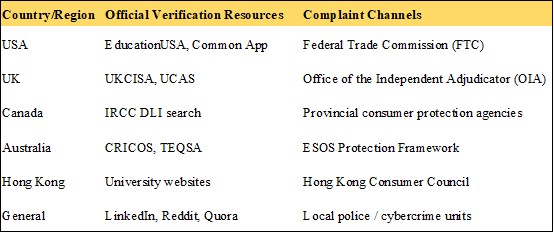
Appendix: Quick Reference Table of Resources
FAQs
Q1: Is it ever legal for agencies to guarantee admission to universities?
No. Claiming internal connections or guaranteed admission is considered fraud in most jurisdictions. Legitimate agencies provide guidance but cannot guarantee outcomes.
Q2: Can I recover money if I’ve already paid a fraudulent agency?
It depends on the contract and local consumer protection laws. Immediate steps include stopping further payments, documenting evidence, and contacting legal or consumer protection authorities.
Q3: How can I verify if my application was submitted correctly?
Contact the admissions office of the university directly using official school emails, and request login access to your application portal.
Q4: Are there safe paid services for improving my admission chances?
Yes. Hourly-based independent consultants, essay editing, and mock interview services are safe, as long as they are transparent and do not promise guaranteed results.
Q5: Could prior use of fraudulent agencies affect future visas?
Yes. Academic fraud or forged documents can leave permanent records affecting global visa applications.
References
1. EducationUSA. (2025). Study Abroad Advising Centers. U.S. Department of State. [https://educationusa.state.gov]
2. UK Council for International Student Affairs. (2024). International Student Guidance. [https://www.ukcisa.org.uk]
3. Federal Trade Commission. (2025). Student Loan and Education Scams. [https://www.ftc.gov]
4. South Korean Supreme Court. (2026). Ruling on Admission Fraud Case. [https://www.scourt.go.kr]
5. Australian Government TEQSA. (2025). Higher Education Accreditation and Compliance. [https://www.teqsa.gov.au]
6. The Student Room. (2024). International Student Admissions Discussion. [https://www.thestudentroom.co.uk]
7. Stamsos, L. (2024). Observations on fraudulent applications from South Asia. Portland State University International Admissions Report.
About the Author
Adrian Vale
Adrian Vale is an independent researcher and former international admissions advisor who has worked with students applying to universities across Canada, the United Kingdom, Germany, and Australia. Over the past decade, he has studied how universities, education agencies, and migration policies shape the global study-abroad industry. His work focuses on international student recruitment systems, university rankings, visa approval trends, and the hidden commercial incentives behind cross-border education pathways. Adrian writes long-form analyses aimed at helping students and families make more informed decisions before committing to expensive international education plans.
Editorial Transparency Statement
This article was researched and written by XXX, drawing exclusively from publicly available, verifiable sources and official government or institutional websites. All claims are cited, and no sponsorship or affiliate relationship influenced the content. The purpose of this article is to provide factual guidance to prospective international students and parents, helping them make informed decisions regarding education services.
Disclaimer
This article is based on publicly available reports and official sources. It is intended for informational purposes only and does not constitute legal or immigration advice. For specific legal issues, consult a licensed lawyer or official agency.