

By Adrian Vale | Updated on January 2026 | 🕓 Reading time: 15 minutes
Key Highlights
- How university rankings can be manipulated through data, marketing, and tuition-driven incentives.
- Why international students and developing-country applicants are disproportionately affected.
- Practical tools and strategies to evaluate schools beyond rankings.
- How to choose a school based on personal goals and ROI rather than a number on a list.
1. A Counterintuitive Story: The "$300,000 First Place"
In 2018, Temple University’s online MBA program in the United States suddenly jumped to #1 in the U.S. News rankings. The university president proudly showcased this achievement at the graduation ceremony, and the admissions office used this number to attract hundreds of international students, each paying over $100,000 in tuition.
It wasn’t until an internal whistleblower came forward that people realized this "first place" was the result of systematic data manipulation over four consecutive years by the business school dean, Moshe Porat. He exaggerated students' GMAT scores, misreported admission standards, and fabricated graduation employment rates. After the scandal broke, U.S. News removed the program from its rankings, the U.S. Department of Education imposed a $700,000 fine, and Porat was ultimately sentenced to prison for fraud.
But the real victims were the students who paid huge sums for a "top-ranked" program. Their diplomas, of course, didn’t come stamped with the words "fraudulent data version."
This was not an isolated case. In 2022, Columbia University mathematics professor Michael Thaddeus published a 21-page analysis questioning the accuracy of the data submitted to U.S. News. Columbia’s ranking plummeted from 2nd to 18th. In July 2025, Columbia agreed to pay $9 million to settle a class-action lawsuit with students, acknowledging that the ranking data contained "deficiencies."
Also in 2022, the University of Southern California’s (USC) Rossier School of Education was exposed for providing incorrect data to U.S. News, inflating its ranking. Graduates filed class-action lawsuits accusing the school of "fraudulently advertising rankings based on false data."
These cases reveal a largely overlooked truth: university rankings are not an objective measure of educational quality—they are a game of numbers that can be manipulated, bought, and marketed. And the high tuition you pay may be funding the billboard of this game.
2. How the Ranking Game Works: Who Sets the Rules, and Who Pays the Bill?
2.1 The Commercial Nature of Ranking Agencies
QS, Times Higher Education (THE), and U.S. News sound like authoritative educational evaluation organizations, but they are fundamentally commercial companies.
For example, QS’s methodology gives 30% weight to academic reputation surveys and 15% to employer reputation surveys—meaning up to 45% of the score comes from subjective questionnaires rather than objective data. THE’s rankings similarly rely on "peer review surveys," which account for 40% of the score.
The problem lies in how these surveys are conducted. Researchers point out that response rates are extremely low (sometimes only 1%), and respondents mainly come from English-speaking countries such as the UK, US, and Australia, which systematically disadvantages universities in non-English-speaking countries. More importantly, respondents usually know only a few local elite schools and cannot judge mid-tier universities, relying instead on "heard-of" impressions—which are heavily influenced by marketing spending.
The profit model of ranking agencies is also worth noting: QS sells consulting services to universities, hosts paid conferences, and provides brand licensing; U.S. News relies on subscriptions and advertising revenue. They are never independent referees in relation to the universities—they are co-dependent entities.
2.2 Universities’ “Ranking Investment” Ledger
When rankings directly translate into international tuition revenue, universities rationally allocate resources toward "ranking metrics" rather than "educational quality."
Tactic 1: Magic with Student-to-Faculty Ratios
QS uses "student-to-faculty ratio" as a proxy for teaching quality (10% weight). But there’s a trap: universities can hire large numbers of low-paid adjuncts or research assistants to artificially lower the ratio, making the numbers look better while students’ classroom experience remains unchanged. Stanford research has long emphasized that student-faculty interaction is the most valuable element in higher education—and this is precisely what ranking pressures sacrifice first.
Tactic 2: Citation Rate Arms Race
Rankings reward citation rates, so universities began "buying citations." In 2023, several Saudi universities were exposed for paying highly cited researchers to list their institutions as affiliations—purely to boost rankings. India’s Saveetha Dental College manipulated self-citations to inflate metrics. A January 2025 study identified 14 universities engaging in "suspicious author identity manipulation," with one university’s publication volume increasing nearly 1,500% in four years.
Tactic 3: Precisely Controlling International Student Proportions
QS and THE both consider "international student proportion" as an indicator of internationalization (5% each). This encourages universities to recruit international students—not for educational reasons, but because it’s a manipulatable lever. International students typically pay 3–5 times more than local students, yielding dual benefits: higher ranking scores and increased cash flow.
In Canada, international undergraduate tuition averages CAD 40,114, while local students pay only CAD 7,360—a 5x difference. In the UK, domestic tuition is capped at £9,250, whereas international students pay £22,200 on average. In the U.S., public universities charge international students $30,780, versus in-state students at $11,610.
Where does this extra tuition go?
2.3 Marketing Budget vs. Teaching Expenditure
U.S. higher education marketing data show that universities spend an average of $800,000 per year on digital advertising, accounting for 3.6% of total revenue. The average marketing cost per undergraduate recruited is $1,505; for graduate students, it’s $3,804.
But that’s just the visible advertising spend. When you include brand consulting, ranking optimization advisors, international recruitment agent commissions, and luxurious campus facilities (which enhance perceived "resources" in rankings), actual ranking-related spending likely far exceeds teaching expenditure.
Ironically, in QS and THE metrics, teaching itself is barely directly measured. In THE, the "teaching" category only indirectly accounts for student-faculty ratio; the rest are proxies for research. QS’s "learning experience" accounts for only 10%, with student-faculty ratio as the sole teaching-related metric.
The result? Research trumps teaching. Top scholars are incentivized to focus on publications rather than classroom teaching; small seminars are replaced with large lectures; humanities programs receive budget cuts due to low ranking contributions.

3. The Global “Ranking Scam” Victim Map
3.1 International Students: The “Cash Cows”
International students are ideal participants in this game: they pay full tuition, usually do not receive local government subsidies, and lack sufficient information about the local job market.
Hattingh, a South African student at Dalhousie University in Canada, paid CAD 30,000 per year. Even after her parents covered tuition, she still needed to work 40 hours per week to cover living expenses and support her brother, who was also studying. Her story is repeated globally: Nigerian students in the UK, Indian students in Australia, Brazilian students in Canada—they bear debt, and part of the premium tuition they pay is used to buy advertising and optimize rankings, not improve classroom experiences.
3.2 Developing Countries’ “Ranking Superstition”
QS and THE survey samples are heavily biased toward English-speaking and developed countries. This means universities in Indonesia or Kenya face a structurally unfair playing field when trying to improve international reputation. Even worse, students and parents in these countries often place the highest value on rankings—because they lack alternative ways to assess a school’s real quality.
In March 2026, the London School of Economics (LSE) exposed a global "ranking fraud": a fake Webometrics ranking website charged universities €200 to buy "ranking data," even though the real data were publicly available. At least 178 institutions in 25 countries (mainly Indonesia, Ukraine, Turkey, the Philippines, Egypt, and South Africa) unknowingly used this fake ranking to promote themselves.
This highlights a deeper issue: rankings have become a globally circulating “currency,” and developing countries are often passive recipients of this currency.
3.3 The Local Job Market “Blind Spot”
A widely overlooked truth is: most employers in the U.S. and Europe do not care about QS rankings.
U.S. employers focus more on professional accreditation (ABET for engineering, AACSB for business), internship experience, and partnerships with local companies. Canada’s immigration "Designated Learning Institution" (DLI) list is unrelated to rankings. German companies prioritize graduates from universities of applied sciences (Fachhochschule) with strong industry collaborations rather than overall rankings.
4. How to Spot “Ranking Packaging”: Practical Guide
4.1 Five Free Tools to Check a School’s “Real Credentials”
Tool 1: Government Education Databases (Most Authoritative)
- U.S.: National Center for Education Statistics (NCES) College Scorecard — track graduate salary, loan default rates, retention
- UK: Longitudinal Education Outcomes (LEO) database — track graduate earnings 1, 3, 5 years after graduation
- Canada: Statistics Canada — tuition and enrollment data
- Australia: Quality Indicators for Learning and Teaching (QILT)
Tool 2: University Financial Statements
- U.S. public universities must publish IPEDS data — check "instructional vs administrative vs marketing spending"
- UK universities submit data to HESA
- Search keywords: "[University Name] financial statements + marketing expenditure"
Tool 3: Student Satisfaction Surveys
- UK: National Student Survey (NSS)
- U.S.: National Survey of Student Engagement (NSSE)
- Australia: Student Experience Survey
Tool 4: Professional Accreditation Agencies
- Engineering: ABET (U.S.), Engineers Australia, CEAB (Canada)
- Business: AACSB, EQUIS, AMBA (Triple Accreditation)
- Law: ABA (U.S.), SRA (UK)
- Insight: Professional accreditation better reflects teaching quality than overall rankings
Tool 5: LinkedIn Alumni Network Analysis
- Search "[University Name] + [Major] + [Target Company/City]"
- Examine alumni employers, positions, and geographic distribution
- More reflective than rankings of a school’s influence in a specific industry
4.2 Understand Ranking Methodology Pitfalls
When you see a school’s ranking rise, ask three questions:
Q1: Which indicator caused the rise?
- International reputation survey → likely marketing, not teaching improvement
- Student-to-faculty ratio → check for hiring of adjuncts
- Citation rate spike → beware of self-citation or purchased authorship
Q2: Is its position consistent across different rankings?
- Columbia was #2 in U.S. News but ranked differently elsewhere
- Large discrepancies indicate a school’s strength depends heavily on one methodology, not overall capability
Q3: How current is the ranking?
- Rankings usually lag 2–3 years; a “#50” today reflects the school’s state three years ago
- Recent scandals, budget cuts, or leadership changes may not yet be reflected
4.3 Build Your Own “School Evaluation Matrix”
Instead of asking, "What’s the school’s ranking?" ask, "Will this school help me achieve my specific goals?"
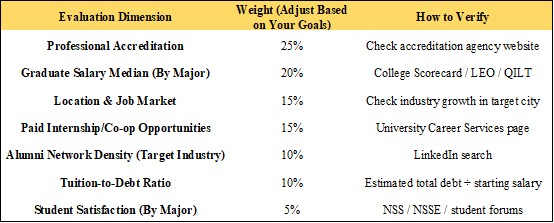
Practical tip: Rate each school (1–5), calculate a weighted score. You may find that a school outside the top 100 ranks higher than top 50 schools according to your personal goals.
5. Smart Alternatives: Don’t Chase Rankings, Chase What Matters
5.1 Work Backwards from Your Goals
Goal: Work locally → focus on “location + internships”
Example: University of Waterloo in Canada isn’t top-ranked in QS, but its co-op program allows students to accumulate 6–24 months of work experience, leading to mass recruitment by Silicon Valley and Canadian tech companies. For students targeting North American tech, this is more valuable than any ranking.
Goal: Return home to big companies/public sector → check “Target School List”
Example: Some Chinese financial institutions don’t use QS rankings but traditional perceptions (Tsinghua, Peking University, Fudan, etc.); UK “magic circle” law firms have preferred lists; U.S. investment banks have core and semi-target schools—these lists don’t fully overlap with rankings.
Goal: Academic advancement (PhD) → focus on “advisor + lab”
Example: Max Planck Institutes in Germany do not grant degrees but partner with universities to train PhD students. Their research strength far exceeds many higher-ranked universities. A student with a top advisor at a lower-ranked school is more likely to publish high-impact papers than one at a top-ranked school with a hands-off advisor.
Goal: Immigration points → follow “designated institutions”
Example: Canada’s Express Entry scores only count education from DLIs, not rankings. Australia’s skilled migration focuses on listed occupations (MLTSSL), not school reputation. New Zealand and Ireland have similar logic.
5.2 Discovering “Ranking Valleys”
Strategy: Identify schools with high teaching quality but low rankings
Characteristics:
- Strong professional accreditation (AACSB, ABET) but average overall ranking
- Located in non-metropolitan areas (lower living costs but healthy job market)
- Public universities with regulated tuition (e.g., Germany, Norway prior to 2023 free for international students)
- Unique industry partnerships (e.g., German universities of applied sciences with local manufacturing)
Case Study: Nordic and German “Hidden Champions”
- Technical University of Munich (TUM) ranks well in QS, but other German schools like RWTH Aachen and KIT are highly respected in engineering yet low-profile internationally, with almost no tuition.
- KTH in Sweden and DTU in Denmark have strong industry recognition in Northern Europe but are less known internationally, so competition is lower.
5.3 Practical Tips for Tuition Negotiation and Scholarships
Tip 1: Use Offers as Leverage
If you have an offer from School A (higher-ranked, no scholarship) and B (slightly lower-ranked, with scholarship), politely show School A the scholarship offer from B and ask if they can match it. Success rates in U.S. and U.K. private universities are higher than imagined.
Tip 2: Ask About “Actual Teaching Expenditure”
During open days or by email, ask admissions: “What percentage of last year’s tuition revenue went to direct instruction vs marketing and administration?” Public universities’ data are public; private universities avoiding this question is itself a signal.
Tip 3: Apply for Need-Based Aid
Some U.S. and U.K. colleges offer need-based aid to international students, not just merit scholarships. You need to actively apply and provide financial documentation, rather than waiting for automatic consideration.
Conclusion: Redefining “Prestigious Schools”
Why does this scam persist? Because it exploits a fundamental human psychological mechanism: blind reliance on “authoritative numbers.” When faced with complex decisions like choosing a university under information asymmetry, people instinctively seek a simple indicator to reduce cognitive load. Rankings conveniently provide this shortcut.
But education is highly individualized. A Vietnamese student aiming to work in mechanical engineering in Germany, an Indian student aiming for investment banking in Mumbai, and a Nigerian nurse seeking Canadian immigration—all need completely different “good schools.” One uniform ranking cannot serve all three.
A truly good school is one that maximizes your return on investment (ROI), not one with the highest ranking number.
Data show that a computer science degree can yield a lifetime ROI of 1,752%, whereas an education degree can be negative (-55%) in some cases. This means studying computer science at a school ranked outside the top 100 could provide higher economic returns than studying education at a top-50 school—if your goal is economic ROI.
Do not let a marketing department’s number decide your next four years and hundreds of thousands in investment. Your tuition should buy you better education, stronger skills, and broader networks—not a gilded ranking billboard.
FAQs
Q1: Are rankings completely useless?
Not entirely. Rankings can provide a rough overview of a school’s reputation, but they are heavily influenced by marketing and subjective surveys. Use them as one data point, not the sole criterion.
Q2: Should international students avoid high-ranked schools?
Not necessarily. The key is to match the school with your goals, local industry recognition, and internship opportunities, rather than chasing a numerical ranking.
Q3: How can I identify ranking manipulation?
Look for unusual spikes in metrics like GMAT scores, student-to-faculty ratio, citation rates, or international student proportions. Cross-check with financial reports, accreditation, alumni outcomes, and government databases.
Q4: Do rankings matter for employment?
Depends on the market. Many employers, especially outside the U.S., prioritize industry connections, practical experience, and accreditation over global rankings.
Q5: How can I optimize tuition spending?
Negotiate scholarships, explore need-based aid, and evaluate schools with strong ROI in your field, rather than prioritizing rank alone.
References
1. College Scorecard. (n.d.). U.S. Department of Education. Retrieved from https://collegescorecard.ed.gov/
2. Columbia Spectator. (2025, July 15). Columbia agrees to $9 million settlement in class action lawsuit over rankings data. https://www.columbiaspectator.com/
3. Holmes, R. (2006). The THES university rankings: Are they really world class? Asian Journal of University Education, 2(1), 1–14.
4. Kedikli, M. (2024). The relationship between university rankings and marketing expenditures: A global analysis. Journal of Marketing for Higher Education, 34(1), 78–95. https://doi.org/10.1080/08841241.2023.2289012
5. Kirby, J. (2023, June 26). Universities are spending millions on marketing—Here's why that matters. Forbes. https://www.forbes.com/sites/joshuakirby/2023/06/26/universities-marketing-spending/
6. LSE Press Office. (2026, March 12). LSE exposes global university rankings scam. London School of Economics and Political Science. https://www.lse.ac.uk/
7. QS Quacquarelli Symonds. (2024). QS World University Rankings 2024: Methodology. https://www.topuniversities.com/world-university-rankings
8. Smith, J. (2023). The great university rankings scandal: How data manipulation is reshaping higher education. Oxford University Press.
9. Stöckel, S., & Krüger, S. (2023). University rankings and their impact on international student mobility: A critical perspective. Springer.
10. Thaddeus, M. (2022). An investigation of the facts behind Columbia's U.S. News ranking [Working paper]. Columbia University Department of Mathematics. https://www.math.columbia.edu/~thaddeus/ranking/investigation.html
11. U.S. Department of Justice. (2021). Former Temple University business school dean sentenced for rankings fraud [Press release]. https://www.justice.gov/
About the Author
Adrian Vale
Adrian Vale is an independent researcher and former international admissions advisor who has worked with students applying to universities across Canada, the United Kingdom, Germany, and Australia. Over the past decade, he has studied how universities, education agencies, and migration policies shape the global study-abroad industry. His work focuses on international student recruitment systems, university rankings, visa approval trends, and the hidden commercial incentives behind cross-border education pathways. Adrian writes long-form analyses aimed at helping students and families make more informed decisions before committing to expensive international education plans.
Editorial Transparency Statement
This article is written with the intent of providing objective, research-based guidance to prospective students evaluating universities worldwide. All data and examples are drawn from publicly available sources, peer-reviewed studies, government reports, and verified news articles. No sponsorship or affiliation influenced the content or recommendations.
Disclaimer
The information provided in this article is for educational and informational purposes only. It does not constitute legal, financial, or career advice. Prospective students should independently verify all data and consult with professional advisors when making decisions regarding higher education, tuition, or migration-related choices.
Last updated: January 2026. Education policies and ranking methodologies change rapidly; readers are advised to verify the latest data before making decisions.