

By Adrian Vale | Updated on: February, 2026 | 🕓 12 minutes read
Key Highlights
- What are the hidden risks of international study programs regarding work permits?
- How can students pre-plan to maximize their post-graduation work opportunities?
- Which common pitfalls cause students to lose legal status after graduation?
- How do universities’ incentives and agents’ commissions affect immigration outcomes?
- What practical steps can be taken to ensure compliance and prepare for plan B?
1. Introduction: The "Free Lottery Ticket"
In 2019, Chidi, an international student from Nigeria, stepped into a public college in Ontario, Canada, full of hope. His admissions advisor patted him on the shoulder and said, "Don’t worry. You’ll get a three-year work permit after graduation, then proceed to experience-based immigration—completely secure."
Five years later, Chidi was sitting in a lawyer’s office with a rejection letter in hand. The reason? In his final semester, he had to retake a failed course, which made him a part-time student. The Immigration, Refugees and Citizenship Canada (IRCC) rejection letter had only one sentence: “Did not maintain full-time status for all semesters; ineligible for PGWP.”
He spent two years studying and $40,000 CAD, only to end up with no work permit.
This is not an isolated incident. Tens of thousands of international students worldwide face this systemic trap every year.
Post-Graduation Work Permits/Visas (PGWP, PSW, Graduate Visa, or Australia’s 485 Visa) are often marketed by universities as a "graduation comes with a job" benefit and by agents as a "fast-track to immigration." But the truth is: a work permit is not a guarantee of immigration; it’s a timed lottery ticket. Many students only realize after obtaining it that the rules are complex, the margin for error is tiny, and universities never disclose this in their admissions brochures.
2. Dark Side #1: The "Invisible Ceiling" of Work Permits—What Seems Like Leeway Is Actually a Narrow Gate
2.1 The "Work-Permit-Compatible" Trap in Choosing Majors
Case: Indian Student Rahul’s Two-Year Master’s Was Wasted
On November 1, 2024, IRCC implemented a "field-of-study requirement": graduates of non-degree programs (college diplomas or certificates) must complete courses approved under IRCC's CIP (Classification of Instructional Programs) codes to be eligible for a PGWP.
Rahul, from India, began a marketing diploma program at a Canadian college in early 2024. His admissions advisor never mentioned CIP codes. In June 2025, IRCC updated the eligible program list—removing 178 programs and adding 119, mainly keeping healthcare, social services, education, and trades. Unfortunately, marketing was removed. After two years and nearly $30,000 CAD in tuition, Rahul’s diploma could not qualify him for a PGWP.
Ironically, IRCC’s "grandfather clause" protects students whose programs were listed when they applied for a study permit. Rahul applied before November 2024, so he could have been exempt—but his school’s international office never informed him before graduation.
Practical Tip: How to Reverse-Check Your Major for Immigration Eligibility Using Occupational Codes
Don’t ask an advisor, “Is this major good for finding a job?” Instead, ask:
- What is the Canadian NOC code for this profession? Is it on the Express Entry priority list?
- What is the Australian ANZSCO code? Is it on the MLTSSL (Medium and Long-Term Strategic Skills List)?
- What is the UK SOC code? Does it meet RQF Level 6 or above?
Pre-Enrollment Checklist:
1. Find your program’s official classification code (Canada CIP, Australia CRICOS/CIP, UK JACS).
2. Check the immigration website to see if this code qualifies for a work permit.
3. Review official labor statistics to understand 10-year supply/demand forecasts for your occupation.
4. Use LinkedIn to track graduates of your program over the past three years and verify their visa and career paths.
2.2 The “Precise Duration” Trap During Studies
Case: Brazilian Student Ana’s Credit Transfer Nightmare
Ana completed a two-year hotel management diploma in Brazil and transferred to a Canadian university for a bachelor’s degree. Her transfer credits reduced her first semester to part-time status—a perfectly legitimate academic adjustment but a fatal mistake under immigration law.
IRCC reviews PGWP applications semester by semester. Ana’s first semester counted as part-time, but the PGWP rules require all semesters except the final one to be full-time. Her application was denied. A 2025 federal court ruling confirmed that transferred credits causing part-time semesters do not count as "justifiable exceptions," even if the student is not at fault.
Another Hidden Trap: Online Coursework
During the pandemic, some countries temporarily allowed online courses to count for PGWP eligibility. Canada, however, clarified that programs starting after September 1, 2024, cannot count offshore online courses toward PGWP. Many students only realized after enrollment that attending a few online classes from home could drastically reduce—or even void—their work permit duration.
Practical Tip: Start a "Work-Permit Compliance File" on Day One
Maintain a digital folder updated each semester:
〇 Official transcript showing full-time enrollment
〇 Course registration confirmation (credit count specified)
〇 Official notes for transferred or waived credits
〇 Approved leave/absence documents (if applicable, within 150 days)
〇 Online course records (specifying location: domestic vs. abroad)
Key Red Lines:
Canada: Full-time typically ≥12 credits per semester; last semester can be part-time
UK: Students may not exceed 20 working hours per week during term
Australia: Attendance must be ≥80%
USA: F-1 students must maintain full-time enrollment; SEVIS terminated if not
2.3 The "Death Window" Between Graduation and Work Permit Application
Case: Vietnamese Student Minh’s 180-Day Countdown
Minh completed a computer science master’s at the University of Toronto. IRCC requires PGWP applications within 180 days of graduation confirmation. His graduation ceremony was in June, but the school didn’t issue the Completion Letter until August. Minh assumed "graduation" meant the day he received his diploma and prepared materials leisurely.
When he submitted in November, the 180-day window had passed. The application was rejected. He had to leave Canada and reapply from Vietnam—by then, his study permit had expired, leaving him without legal status.
Another Hidden Time Trap: Passport Validity
PGWP length cannot exceed passport validity. Many students discover too late that a passport expiring in six months limits the work permit to the same duration, and extensions are cumbersome.
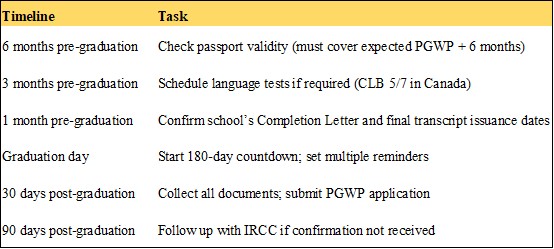
Practical Tip: "Countdown Checklist" Six Months Before Graduation
3. Dark Side #2: “Structural Unemployment” During Work Permit—Legally Working but Hard to Stay
3.1 Employer Sponsorship Chicken-and-Egg Paradox
Case: Pakistani Student Omar’s Three-Year Job-Hopping Loop
Omar obtained a two-year Graduate Visa after a master’s in Manchester, thinking it was a bridge to permanent residency. Reality hit:
He needed an employer willing to sponsor a Skilled Worker Visa within two years. Employers, knowing his visa had only 18 months left, refused to invest time and money—"we’ll wait until your visa is almost up" became standard. He changed three jobs, each time running into budget freezes or project restructuring during sponsorship requests.
This is a structural dilemma: you need an employer to stay, but employers hesitate because your time is limited.
Practical Tip: Identifying "Willing Sponsors" During Job Search
Interview questions (subtle but effective):
- "How many international employees have you sponsored in the past three years?"
- "If I meet expectations, how long before sponsorship usually starts?"
- "What is your current sponsor license status, and until when is it valid?"
Red flags in contracts:
- Vague position descriptions avoiding skill level requirements
- Salary includes heavy performance bonuses, barely meeting sponsorship thresholds
- Probation exceeding six months (UK Skilled Worker rule: ≤6 months)
3.2 The “Salary Inversion” Trap
Case: Filipino Student Maria’s "Immigration Salary"
Maria graduated with a master’s in accounting in Sydney and got a two-year 485 visa. Local starting salaries were AUD 65,000, but she accepted AUD 52,000 because the employer promised help with migration assessment.
Two years later, her salary was below industry standards, and her immigration points (EOI) remained too low for invitations. When her visa expired, she was over 35 (Australia cut the 485 age limit from 50 to 35 in July 2024), making her ineligible to reapply.
She sacrificed income to accumulate immigration points, only to fail in both money and residency.
Practical Tip: Calculating True ROI of "Immigration Time Cost vs. Salary Loss"
Excel model:
Total immigration path cost = Tuition + Living expenses + Salary loss (local salary -actual salary) × years
Immigration success probability = Estimated from historical invitation cutoffs
Expected return = Quantified value of permanent residency
If (Immigration probability × Expected return) < (Total cost × 1.5)
→ Risk-reward ratio is unreasonable; reconsider the path
3.3 The Domino Effect of Work Permit Interruption
Case: Chidi’s Second Blow (continued)
After PGWP rejection, Chidi lost legal work status and faced chain reactions:
- Lease termination by landlord
- Bank accounts frozen
- Tax records disrupted (affecting future immigration)
- Must leave Canada within 90 days or face deportation
Practical Tip: "Plan B Survival Kit" During Work Permit
72-Hour Post-Job-Loss Checklist:
1. Calculate legal stay buffer (Canada PGWP: 90 days; UK Graduate Visa: no unemployment buffer; US OPT: ≤90 days unemployment)
2. Contact former employer for ROE (Record of Employment) for benefits and proof of work experience
3. Evaluate alternative visa paths:
- Spousal work permit
- Provincial nomination (if enough experience)
- Visitor visa transition (buy time to replan)
4. Keep all proof of employment: payslips, tax forms, recommendation letters—even if work permit is interrupted
4. Dark Side #3: Universities’ Conflicts of Interest—Why They Never Tell You
4.1 Admissions Data vs. Immigration Success Rate: Selective Disclosure
Universities proudly report "90% graduate employment," but rarely clarify:
- Local vs. international student employment
- Jobs with work permit vs. without
- Field-related vs. any employment (even part-time retail counts)
Practical Tip: Reverse-Engineer a School’s True Immigration Conversion Rate
LinkedIn Alumni Tracking Method:
1. Search "School Name + Graduation Year + Current Location"
2. Identify international alumni (name, photo, language cues)
3. Track career path: first job → current role → location
4. Calculate proportion who stayed in target country and work in relevant field
Cross-Check Immigration Data:
- Canada: IRCC monthly Express Entry data by NOC
- UK: Home Office Graduate Visa to Skilled Worker conversion rates
- Australia: Department of Home Affairs Skill Select invitation trends
4.2 Partner Agents’ Incentive Chains
Many universities officially recommend "partner immigration agents" with commission agreements. Their "guaranteed solutions" (like transferring to another program to extend stay) may not be optimal but generate another tuition commission for them.
Practical Tip: Triple Verification for Immigration Paths
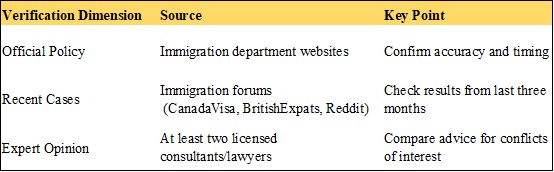
Principle: If the recommended path deviates from official policy, request specific legal references, not anecdotal "experience says."
4.3 Program Design: “Immigration-Unfriendly” Structure
Case: Bangladeshi Student Tariq’s Intensive Master’s
Tariq completed a one-year UK master’s with a packed curriculum—no internships or projects. His CV only had the degree. During two-year Graduate Visa, he sent 200 applications, repeatedly rejected for "lack of UK work experience."
Many one-year programs advertise "short, low-cost, fast returns," but fail to mention: without embedded internships, it’s almost impossible to gain local competitive experience within the limited Graduate Visa period.
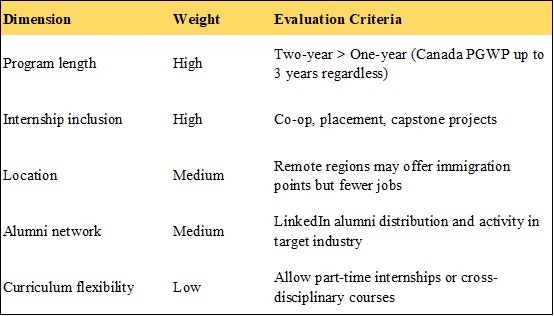
Practical Tip: Assessing "Work-Permit-Friendliness" of Programs
5. Dark Side #4: Country-Specific Policy “Sudden Death” Risk
5.1 Historical Policy Changes
Canada (2024–2025 Triple Tightening)
- Jan 2024: Study permit proof of funds doubled from CAD 10,000 to 20,635
- Mar 2024: Spousal work permits limited to master’s and doctoral students
- Nov 2024: CIP code restriction for non-degree programs
- Jun 2025: CIP list major revision, removing 178 programs
- Dec 2025: Language + field requirements clarified for all graduates
UK: “Graduate Visa Slowly Tightening”
- 2024: No dependents for taught master’s
- Oct 2025: From Jan 2027, Graduate Visa for non-PhDs shrinks from 2 years to 18 months
- PR path extended from 5 years to 10 years
Australia: 485 Visa Age Discrimination
- Jul 2024: Age limit cut from 50 to 35 (except research-focused masters/PhDs)
- Simultaneously: 2-year post-master visa duration removed for some programs
New Zealand: Countertrend
In 2026, NZ introduced "short-term graduate work visa" (6 months) and expanded Post Study Work Visa coverage—but 6 months is merely a job-search buffer, not a true immigration bridge.
5.2 Systemic Tech Failures: When the Machine Fails, You Pay
Case: Canada PGWP “Language Test Gate” (2024–2026)
In Nov 2024, Canada added language test requirements. Thousands received rejection letters for "no language results," even though they submitted IELTS or CELPIP through GCKey. Portal errors caused submissions to be unread by reviewers.
One IT graduate in Ontario, with CLB 9, was rejected and had to hire a consultant for a reconsideration request, which successfully overturned the denial. Over 70 cases were overturned by early 2026, but many unknown students either lacked funds, awareness, or missed appeal deadlines.
Practical Tip: Build a Personal "Policy Alert System"
Subscribe to official channels:
- Canada: IRCC Newsroom RSS, Canada Gazette
- UK: Home Office Policy Updates, UKCISA Newsletter
- Australia: Department of Home Affairs News, Minister Media Releases
- USA: USCIS Policy Manual Updates, Federal Register
- New Zealand: Immigration New Zealand News
Policy Reading Tips:
- Watch "Consultation" periods for upcoming changes
- Read Regulatory Impact Analyses for objectives and impacts
- Join free licensed lawyer mailing lists for 24-hour post-change insights
5.3 Hidden Clause: “Graduate and Depart”
Case: Egyptian Student Ahmed
Ahmed applied for a study permit extension before expiration, but his final semester part-time status caused rejection. He assumed graduation automatically allowed PGWP application—he was wrong.
Study permit rejection meant immediate loss of legal status; he had to leave Canada to reapply, adding four months and thousands of CAD for flights and accommodation.
Key Misconceptions Clarified:
- Maintained status ≠ automatically legal
- Graduation ≠ PGWP eligibility (requires Completion Letter + final transcript)
- In-country submission ≠ safe waiting (overstayed or expired permits may force departure)
6. Practical Guide: The International Student “Work-Permit Survival Handbook”
6.1 Pre-Enrollment: Reverse Planning
Start from “where do I want to live?” rather than “what do I want to study.”
Step 1: Determine Immigration Endpoint
- Target country, city, profession
- Immigration path: skilled, employer-sponsored, provincial, investment
Step 2: Verify Path Feasibility
- NOC/ANZSCO/SOC code for occupation
- Eligibility on shortage lists
- Historical invitation scores
Step 3: Match Education Path
- Degree level required
- Programs on work-permit-approved lists
- Program structure supports local work experience
Step 4: Calculate Real Costs
- Tuition + living + salary loss + application fees + rejection risk
- If immigration fails, does the degree have domestic value?
6.2 During Studies: Build an “Immigration Evidence Chain”
Update each semester:
```

📁 Immigration Evidence Chain
├── 📂 Academic Compliance
│ ├── Official transcript
│ ├── Registration confirmation (full-time status)
│ ├── Transferred/waived credits
│ └── Leave/absence approvals
├── 📂 Work Records
│ ├── Employment contracts
│ ├── Payslips
│ ├── Tax documents (T4/ROE/P60)
│ └── Reference letters
├── 📂 Language Scores
│ ├── IELTS/CELPIP/PTE/TOEFL originals
│ └── Expiration reminders
├── 📂 Identity Documents
│ ├── Passport scans
│ ├── Visa stamps
│ └── All immigration correspondence
└── 📂 Financial Proof
├── Tuition receipts
├── Bank statements
└── Scholarship/financial aid

```
6.3 Six Months Before Graduation: Start the “Work-Permit Sprint”
Canada PGWP Countdown:
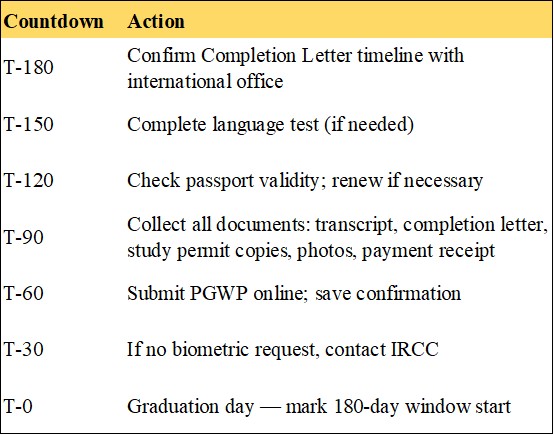
Reminders:
- Completion Letter + final transcript = “graduation” in IRCC terms
- Screenshot upload confirmations
- Fees: CAD 255 + CAD 85 biometric; additional CAD 229 if restoring status
6.4 During Work Permit: Parallel Strategies
Track A: Full Immigration Push
- Track responsibilities vs. NOC/ANZSCO
- Update immigration points every 6 months
- Discuss sponsorship timeline with employer
Track B: Prepare Plan C
- Spousal/partner visa evaluation
- Other countries’ backup paths
- Domestic career hedging
6.5 Final 90 Days Before Expiry: Last-Resort Checklist
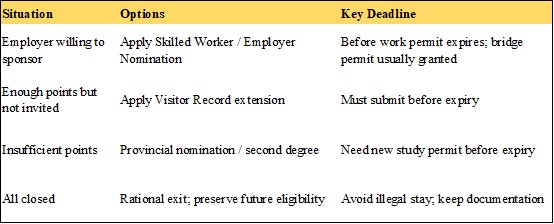
Rational Exit Checklist:
- Exhausted legal options?
- Future 12–24 month ROI positive?
- If leaving, maximize value of experience
- Preserve employment and degree proofs
Conclusion: Information Symmetry Is the Best Risk Mitigation
Admissions advisors’ KPIs = enrollments, not immigration success. Agents earn from tuition rebates, not your work permit approval. Only you must know the rules better than anyone else.
Work permits are tools, not promises. Those who use them must understand the rules better than those who issue them.
Information symmetry won’t guarantee success, but it ensures you know why you fail.
References
1. Immigration, Refugees and Citizenship Canada. (2024–2026). Post-Graduation Work Permit Program (PGWPP) policy updates. https://www.canada.ca/en/immigration-refugees-citizenship/services/study-canada/work/after-graduation.html
2. UK Home Office. (2024–2025). Graduate Visa guidance. https://www.gov.uk/graduate-visa
3. Australian Department of Home Affairs. (2024–2025). Temporary Graduate visa (subclass 485) program information. https://immi.homeaffairs.gov.au/visas/getting-a-visa/visa-listing/temporary-graduate-485
4. New Zealand Immigration. (2025–2026). Post Study Work Visa policy updates. https://www.immigration.govt.nz/new-zealand-visas
5. CanadaVisa Forum. (2025). Student work permit issues and success cases. https://www.canadavisa.com/canada-immigration-discussion-board
About the Author
Adrian Vale
Adrian Vale is an independent researcher and former international admissions advisor who has worked with students applying to universities across Canada, the United Kingdom, Germany, and Australia. Over the past decade, he has studied how universities, education agencies, and migration policies shape the global study-abroad industry. His work focuses on international student recruitment systems, university rankings, visa approval trends, and the hidden commercial incentives behind cross-border education pathways. Adrian writes long-form analyses aimed at helping students and families make more informed decisions before committing to expensive international education plans.
Editorial Transparency Statement
This article is based on publicly available immigration regulations, policy updates, and practitioner case studies. The author has no financial affiliation with universities, immigration agents, or program providers. All recommendations are intended to provide educational guidance for international students and prospective immigrants.
Disclaimer
Based on public policy documents, court rulings, and practitioner cases. Not legal advice. Policies change frequently; consult official sources or licensed consultants for specifics.