——From “Just Unlucky” to “Understanding the Rules”: A Diagnostic Manual for Global Applicants
By Adrian Vale | Updated on: March 2026 | 🕓 12 minutes read
Key Highlights
- Why student visa rejections in G7 countries are rarely random.
- The four major risk dimensions embassies consider: immigration intent, economic dependence, security/compliance, and program fit.
- How nationality influences risk assessment and why applicants from Global South countries face stricter scrutiny.
- Country-specific “hidden scorecards” and practical countermeasures.
- Step-by-step diagnosis and strategies for reversing visa rejections.
1. That Sleep-Stealing Rejection Stamp Was Never Random
When you got that rejection letter, your first thought probably was: “Was the officer just in a bad mood today?”
It’s natural to feel like a victim, but this perspective hides the truth: student visa approvals in G7 countries (U.S., U.K., Canada, France, Germany, Italy, Japan) follow highly systematized risk assessment processes. Rejections are rarely random—they follow identifiable patterns that you can prepare for.
Consider 2025 statistics:
- U.S. F-1 visas: 35% rejection rate (ten-year high)
- Canada study permits: peaked at 52% in 2024
- U.K. visas: jumped from 4% to 12% in Q1 2025
These numbers aren’t about luck—they’re about systemic risk management.
2. The Hidden Logic of Embassy Decisions: They’re Managing Risk, Not Just Checking Papers
All G7 countries use a similar underlying evaluation framework, with different emphasis on certain factors. Understanding this framework is far more important than memorizing a checklist of documents.
2.1 The Four Major Risk Dimensions
Immigration Risk: Will you overstay or remain illegally? Critical for the U.S., Canada, and Japan.
Economic Dependence Risk: Could you become a public burden? Especially scrutinized by the U.K., Germany, and France.
Security and Compliance Risk: Is your background safe, your major non-sensitive, and your finances legitimate? Tightened in the U.S. in recent years.
Program Fit Risk: Is your study plan coherent and logical? French, Italian, and German officers often focus heavily here.
2.2 An Overlooked Truth: Your Nationality Is a Risk Factor in Itself
Shorelight’s April 2026 report shows that U.S. F-1 visa rejections cluster geographically:
- Africa: 64% rejection rate
- South Asia (India, Nepal, Bangladesh): >60%
- Europe: 9%
Canada and the U.K. show similar trends. This isn’t discrimination—it’s probability-based decision-making: applicants from countries with higher historical overstays or document fraud are automatically treated as higher risk.
Tip: If you’re from a high-risk country, your application must be significantly stronger than others. Officers start with more skepticism.
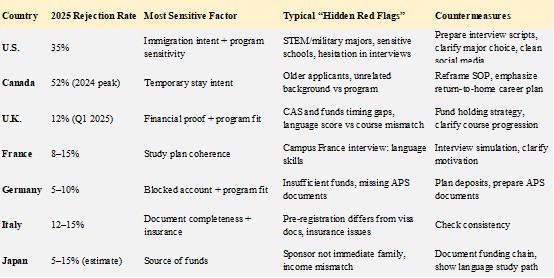
3. The “Hidden Scorecards” of G7 Countries: Same Risks, Different Weighting
4. The Real Process Inside the Embassy “Black Box”: How Documents Are “Read”
4.1 Initial Screening: OCR + Keyword Scan (30 Seconds to Decide Your Fate)
Your documents first enter an automated screening system. The format of financial proof, photo specifications, and form completeness are all mechanically judged. A common “death sentence”: unstable account history or a sudden large deposit just before application—these trigger automatic red flags.
Real Case: A Bangladeshi applicant for a Canadian study permit submitted only one month of bank statements and was immediately rejected. After providing six months of certified statements plus a GIC (Guaranteed Investment Certificate), the appeal succeeded.
4.2 Human Review: The Officer’s “Mental Ledger”
Once your application reaches human review, officers perform a quick mental calculation: “Does this applicant’s story make sense?”
Story Consistency Principle: Do your undergraduate background, work experience, chosen program, and career plan tell one coherent story?
Outlier Flagging: A 29-year-old applying for undergraduate studies, going backward from an MBA to a community college, or holding a PhD but applying to a language school—these trigger intuitive doubts.
Batch Decision Patterns: During peak season (June–August), approval standards tighten, as officers handle double the cases daily, leaving less room for error.
Real Case: A Nigerian applicant for a Canadian study permit was rejected because the SOP did not clearly explain how the chosen courses related to prior education. After rewriting the SOP to include specific career background and verified financial proof, the appeal was approved.
4.3 Backend Database Cross-Verification (Rarely Discussed)
G7 countries do not directly share rejection records, but each maintains permanent internal logs of your applications. The U.S. VISAS system, Canada’s GCMS, and the U.K.’s CID system record every application, rejection, and entry. Future applications are cross-checked against these records.
Key Reminder: Hiding past rejections is a fatal mistake. Nearly all G7 application forms explicitly ask if you have ever been rejected by any country. Lying constitutes “misrepresentation”, potentially leading to a five-year ban.
5. Practical Toolbox: “Diagnosis Checklist” and “Comeback Strategies” After Rejection
5.1 Three-Step Rejection Diagnosis
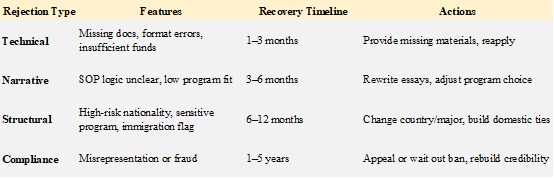
Step 1: Read the “Language” of the Rejection Letter
- Template phrases (e.g., U.S. 214(b), Canada “does not meet temporary resident intent”) point to systemic risks, not specific document errors.
- Specific reasons (e.g., “insufficient funds,” “insurance missing”) are “technical rejections” and easier to reverse.
Step 2: Review Material Timeline
Lay out all your documents chronologically. Identify breaks in logic: sudden fund deposits, gaps in education, conflicting addresses.
Step 3: Compare Against the “Risk Scorecard”
Refer to the table in section 3 to see which dimension your target country emphasizes. A Canadian rejection likely points to “temporary stay intent”; a U.S. rejection often involves “immigration intent” or “program sensitivity.”
5.2 Comeback Strategy Matrix
5.3 How to Write a “Cover Letter” After Rejection
When reapplying, a cover letter is not an apology—it is a “risk mitigation letter.”
Structure Template:
1. Acknowledge Concern: “I understand the officer’s concerns regarding [specific issue] are reasonable.”
2. Provide New Evidence: “Since my last application, I have [provided six months of bank statements / obtained a new job offer / completed a language course].”
3. Reframe Narrative: “The connection between my study plan and career goals is [specific explanation].”
4. Explicit Commitment: “After completing my studies, I will return to [home country] to work as [specific profession] because [specific reason].”
Real Case: A Brazilian applicant was rejected by Canada for submitting unverified education credentials (ECA scan). By resubmitting verified credentials through the official portal, the application was approved.
6. Beyond Individual Cases: Predicting Visa Policy Fluctuations
6.1 Election Cycles
U.S. visa policies fluctuate with presidential terms. Trump’s return in 2025 pushed F-1 rejections from 31% to 35% and froze certain nationalities. The U.K. introduced a “red-green light” system: universities with >4% rejection marked “amber,” limiting enrollments.
6.2 Geopolitical Ripple Effects
Shifts in student demand affect scrutiny. In 2025, Nigerian interest in U.S. dropped 50%; France +40%, Italy +33%, Australia +21%. Sudden surges trigger stricter embassy review.
6.3 Building a “Visa Intelligence System”
Official sources: Immigration websites (IRCC, UKVI, U.S. State Dept)
Reliable unofficial sources: ICEF Monitor, The PIE News, university international offices
Timing strategy: Avoid June–August peak, election years, apply at the fiscal year start

Conclusion: From “Unlucky” to Strategic
The most common reaction after rejection is “I just wasn’t lucky.” But data shows that visa approval is a game of information asymmetry, and those who understand the rules consistently outperform the “lucky” ones.
The global student visa landscape in 2025 is being reshaped: the U.S. is no longer the default option, Canada’s high rejection rate discourages many applicants, and Europe (especially France, Germany, Italy) attracts increasing attention due to relative stability. This means your Plan B and Plan C deserve equal preparation.
Remember: the embassy walls don’t say “Welcome All.” They say “Prove Yourself.” And the ways to prove yourself have always been systematic and traceable.
Appendix: Core G7 Student Visa Resources (Updated May 2026)
- U.S.: State Department Visa Refusal Rates by Nationality (annual public data)
- Canada: IRCC Open Data Portal (study permit processing data)
- U.K.: Home Office Visa Statistics (quarterly release)
- France: Campus France EEF System (pre-registration and interview process)
- Germany: APS Verification Office Website (degree verification process)
- Italy: Study in Italy Official Portal (pre-registration guide)
- Japan: Immigration Services Agency of Japan (Certificate of Eligibility process)
FAQs
Q1: Can a rejection ever be truly random?
No. Visa decisions follow systematic risk assessment, even if it feels arbitrary.
Q2: How much does nationality affect the decision?
Significantly. Historical data on overstays and document fraud influence embassy preconceptions.
Q3: Can rewriting the SOP really help?
Yes. Reframing your narrative to align your education, career plan, and program choice reduces perceived risk.
Q4: Should I hide a previous rejection?
Never. Misrepresentation can result in bans of up to five years.
Q5: Are peak seasons riskier for applications?
Yes. Officers have higher caseloads, reducing tolerance for inconsistencies or missing information.
References
1. Shorelight Education. (2026, April). Global F-1 Visa Trends 2025. Shorelight Research.
2. U.S. Department of State. (2025). Visa Refusal Rates by Nationality. Retrieved from https://travel.state.gov
3. Immigration, Refugees and Citizenship Canada (IRCC). (2024). Study Permit Processing Data. Open Data Portal.
4. UK Home Office. (2025). Visa Statistics Quarterly Release.
5. Campus France. (2025). EEF System Guidelines for International Students.
6. APS Germany. (2025). Degree Verification Process.
7. Study in Italy. (2025). Official Pre-Registration Guide for International Students.
8. Immigration Services Agency of Japan. (2025). Certificate of Eligibility Process.
About the Author
Adrian Vale
Adrian Vale is an independent researcher and former international admissions advisor who has worked with students applying to universities across Canada, the United Kingdom, Germany, and Australia. Over the past decade, he has studied how universities, education agencies, and migration policies shape the global study-abroad industry. His work focuses on international student recruitment systems, university rankings, visa approval trends, and the hidden commercial incentives behind cross-border education pathways. Adrian writes long-form analyses aimed at helping students and families make more informed decisions before committing to expensive international education plans.
Editorial Transparency Statement
This article is based on publicly available data, verified reports, and real-world cases. The author does not receive compensation from any government, embassy, or university. All recommendations are intended to provide practical guidance for international applicants.
Disclaimer
The information in this article is for general educational purposes only. Visa policies may change without notice, and outcomes depend on individual circumstances. Readers should consult official embassy sources or qualified advisors for their specific cases.