

By Leonie Hartmann | Updated on: February, 2026 | 🕓 Reading time: 12 minutes
Key Highlights
- What is the difference between visa expiration, legal stay, and unlawful presence?
- How can you prevent unlawful overstay before your visa expires?
- What strategies exist during the 0–180 day "gray zone" of overstay?
- How do different countries enforce overstay penalties?
- What long-term options exist for those with 180+ days of unlawful presence?
- How do global visa credit systems affect future visa applications?
1. Timeline Thinking – Visa Expiration Doesn’t Equal Doomsday
In 2019, a Japanese student named Kenji completed his studies in the United States. His F-1 visa expired shortly after graduation, but he decided to stay to pursue a relationship with a U.S. citizen and eventually marry. It took him 200 days to realize he was already "out of status." He hastily decided to return to Japan to apply for a green card, but upon departure, he triggered a three-year reentry ban—because he had accumulated over 180 days of unlawful presence. If he had understood "timeline thinking," all of this could have been avoided.
Another scenario: in early 2024, a Brazilian digital nomad on a Schengen tourist visa stayed in Portugal for 95 days. He assumed the 90-day limit was based on a fixed calendar period, unaware that the Schengen Area uses a rolling 180-day calculation. When he tried to leave from Frankfurt Airport, the EES (Entry/Exit System) automatically flagged his overstay. He was fined €500 and told he would be barred from entering any Schengen country for the next three years.
Key Concepts to Distinguish
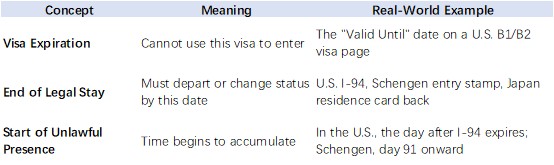
Most people make the mistake of looking only at the visa page in their passport and ignoring the actual expiry on I-94, entry stamp, or residence card. In the U.S., as long as the I-94 is valid, you remain lawful even if your visa has expired. Conversely, if the I-94 has expired but the visa is still valid, you are already accruing unlawful presence.
2. Stage One: 30 Days Before Expiration – Preventive Actions
5 Immediate Checks to Execute
1. Verify the Real Expiry Date: In the U.S., check CBP’s I-94 website; for Schengen, use the EU 90/180-day calculator; in Japan, check the back of your residence card.
2. Confirm Grace Periods: U.S. F-1 has 60 days, J-1 has 30 days; Australia student visa 28-day remedy period; Canada 90-day restoration window. Japan, Schengen, Singapore, Thailand have no grace periods—expiry = unlawful presence.
3. Pending Status Protection: In the U.S., filing I-539 for extension or I-485 adjustment before expiration generally stops unlawful presence from accruing during processing.
4. Inventory Status-Change Options: Student → work visa, tourist → spouse visa, humanitarian extension (medical emergencies, natural disasters).
5. Prepare an Evidence Package: If you cannot leave due to medical emergencies, natural disasters, or family issues, preserve all proof. U.S. USCIS accepts "Extreme Circumstances" extensions, but submission must be before or immediately after expiration.
3. Stage Two: 0–180 Days – The Gray Zone
This stage is rarely systemically discussed. The 180-day mark is critical in most countries' penalty frameworks.
United States: 180 Days = 3-Year Ban, 1 Year = 10-Year Ban
U.S. immigration law (INA §212(a)(9)(B)) states: unlawful presence of 180 days to less than 1 year triggers a 3-year reentry bar; over 1 year triggers a 10-year bar.
Key strategy: as long as you don’t leave the U.S., the 3-year/10-year bar does not apply. U.S. citizen immediate relatives (spouse, parent, minor child) can adjust status within the country regardless of unlawful presence.
Example: after the 2022 Russia–Ukraine war, a Russian tourist overstayed a U.S. visa due to the conflict. After marrying a U.S. citizen, despite overstay, he successfully adjusted status via I-485 because he had "lawful entry" and a citizen spouse.
Schengen Area: EES System – Overstay Recorded from Day One
The fully operational EES (Entry/Exit System) in late 2025 transformed enforcement. It digitally records every entry and exit via fingerprint and facial recognition and automatically calculates the 90/180-day rule.
Real case: in early 2026, a Canadian backpacker overstayed by 3 days in Greece. At Athens Airport, the system flagged the overstay. He was fined €600 (Greece charges per violation, not per day) and entered into SIS II (Schengen Information System), meaning he cannot enter any of the 29 Schengen states for 1–3 years, and all consulates can see this record.
Schengen has no "in-country status adjustment." Once overstayed, options are limited to:
- Immediate voluntary departure (nearly impossible under EES era)
- Humanitarian exceptions (sudden illness, flight cancellations, with official proof)
- Apply for long-term visa changes after months or years of overstay (e.g., Spain’s arraigo, Portugal’s manifestação de interesse)
Japan: Voluntary Departure Can Reduce 5-Year Ban to 1 Year
As of January 2024, Japan had 79,113 illegal residents, and enforcement is strict. Three possible paths: voluntary departure (report and leave within 15 days, 1-year ban), special residence permits (requires Japanese spouse or compelling factors), or forced deportation (5–10-year ban).
Thailand: Voluntary vs Arrested – Dramatic Difference
Thailand fines up to 20,000 THB, but reentry bans grow exponentially with overstay.
- Voluntary reporting: under 90 days = fine only, no ban; over 5 years = fine + 10-year ban.
- Caught by authorities: under 1 year = 5-year ban; over 1 year = 10-year ban.
Example: in 2025, a British retiree overstayed 45 days, reported voluntarily, paid 22,500 THB, and avoided blacklisting. Meanwhile, a Russian tourist overstaying 42 days, caught by police, paid the same fine but received a 5-year ban.

4 Must-Do Actions in This Stage
1. Build a Timeline Evidence Package: scan and cloud backup all entry stamps, I-94/residence card/permits, visa denial letters, medical records, and flight cancellation proofs—critical for future waiver or humanitarian applications.
2. Financial Isolation: gradually move funds to non-home country accounts (Wise, Revolut). In some countries (e.g., U.S.), there’s no restriction for undocumented persons, but departure could trigger tax review or asset freeze.
3. Medical Contingency Plan:
- U.S.: no access to Obamacare, but community health centers offer sliding-fee care
- Europe: undocumented persons can’t use public healthcare but emergency care is required (expensive)
- Southeast Asia: international travel insurance covering "accidents only" recommended
4. Digital Footprint Management:
- Close government-linked accounts (driver’s license, library card, voter registration)
- Avoid apps requiring verified identity
- Use encrypted communication for lawyers/advisors
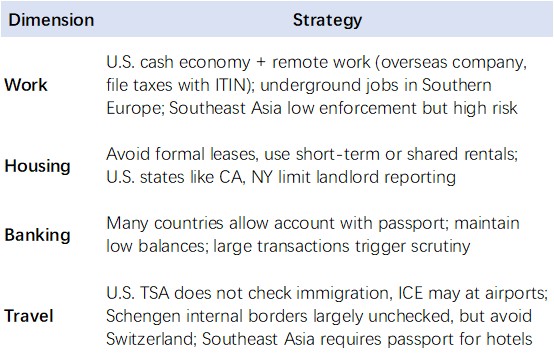
4. Stage Three: 180+ Days – Long-Term Life Without Status
Survival Framework
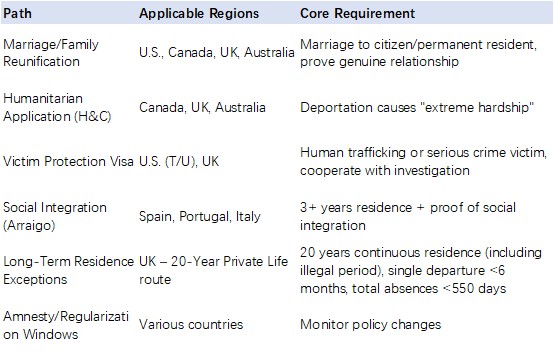
Unconventional Legalization Paths (Priority Order)
Voluntary Departure vs Forced Deportation
Voluntary Departure:
- U.S.: apply with immigration judge, avoids deportation record
- Japan: voluntary = 1-year ban vs forced = 5-year ban
- New Zealand: voluntary departure may reduce or cancel reentry ban
U.S. Special Strategy: I-601A Provisional Waiver
- For over 1-year unlawful presence with immediate U.S. citizen/green card relative: apply for "extreme hardship" waiver without leaving first. Once approved, depart for interview; the 10-year bar is waived.
5. Stage Four: Global Visa Credit System
Data Sharing Networks
- Five Eyes Alliance (U.S., UK, Canada, Australia, New Zealand): share visa refusals, deportations, criminal records
- Schengen Area: 27 countries share SIS II database; one-country ban = whole region ban
- U.S. CLASS system: global consulates can see overstay, refusals
Repair Strategies
Example: an Indian engineer overstayed H-1B by 8 months in the U.S., left voluntarily, then applied for a Canadian work visa and was denied—IRCC cited "lack of intent to comply with visa terms."
Response:
1. Establish a clean record in a third country (non-Five Eyes / non-Schengen) for 2–3 years
2. Passage of time: countries focus on recent 5-year records
3. Proactively disclose prior overstay and provide unavoidable circumstance evidence—better than hiding and being discovered
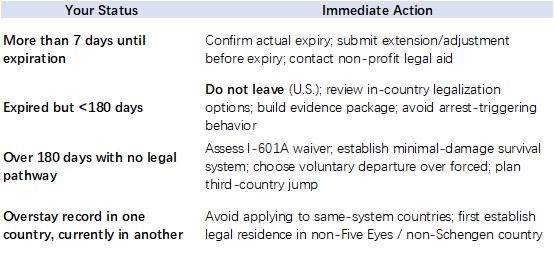
6. Decision Tree – What Should You Do Now?
Conclusion: Make Informed Choices
Being undocumented is not a moral judgment—it’s a risk cycle requiring meticulous management. Every choice has consequences:
- Stay in-country waiting for legalization = years underground
- Voluntary departure = 3–10 years separated from loved ones
- Restarting in a third country = giving up established social networks
There is no "correct" answer—only informed choices.
FAQ
Q: Does paying taxes while overstayed help?
A: In the U.S., using an ITIN to file taxes can demonstrate "good moral character" for future green card applications but does not exempt unlawful presence penalties.
Q: Can I "clean slate" in a third country?
A: U.S. overstay automatically voids visa (INA §222(g)); must apply from home country. Third-country applications are usually denied; CLASS system shares records globally.
Q: Can marriage during overstay grant a green card?
A: Only immediate relatives of U.S. citizens can adjust status within the U.S., and entry must have been lawful. Green card holders’ spouses cannot adjust in-country. Illegal entry + citizen spouse ≠ in-country adjustment.
Q: If stopped by police for traffic violation in overstay country, will they check my immigration status?
A: Depends on country. U.S.: some states (AZ, TX) may inquire; CA, NY limit such questions. Europe: police can request passport. Southeast Asia: frequent ID checks, often coordinated with immigration.
Q: How long do overstay records last?
A: Never deleted, but impact decreases over time. U.S. records are permanent; with a 10-year gap and good behavior, approval chances improve. Schengen SIS II bans have a term (1–5 years), but overstay fact is permanently archived.
References
1. U.S. Citizenship and Immigration Services (USCIS). (2026). Unlawful presence and bars to admissibility. [https://www.uscis.gov]
2. European Union, European Border and Coast Guard Agency (Frontex). (2025). EES Entry/Exit System Implementation Guide. [https://frontex.europa.eu]
3. Government of Japan, Ministry of Justice. (2024). Illegal stay and deportation statistics. [https://www.moj.go.jp]
4. U.S. Department of State. (2026). Visa reciprocity and unlawful presence overview. [https://travel.state.gov]
5. Thailand Immigration Bureau. (2025). Overstay penalties and voluntary departure regulations. [https://www.immigration.go.th]
6. U.S. Immigration and Nationality Act (INA) §212(a)(9)(B) & §222(g). [https://www.law.cornell.edu/uscode/text/8/chapter-12]
About the Author
Leonie Hartmann
Leonie Hartmann is a migration policy writer and cross-border labor researcher specializing in temporary migration systems, international labor mobility, and visa-driven employment markets. Her research explores how governments, employers, and private consulting industries influence migration pathways for students, skilled workers, and digital nomads. Leonie frequently writes about immigration consulting practices, labor shortages, visa sponsorship structures, and the economic realities behind modern migration narratives. Her work combines policy analysis with practical insights for globally mobile professionals.
Editorial Transparency Statement
This article is based on publicly available government resources, official immigration regulations, and recent case studies. All recommendations are intended to provide informational guidance; the content has been reviewed for accuracy as of May 2026.
Disclaimer
This content is for informational purposes only and does not constitute legal advice. Individual circumstances vary widely. Readers should consult licensed immigration attorneys or qualified legal professionals before taking any action related to visa status, overstay, or international travel compliance.