By Selma Idrissi | Updated on April, 2026 | 🕓 18 minutes
Key Highlights
- What are the most common signs of fabricated social proof and testimonials?
- Why do many “AI automation” gurus make more money selling courses than operating businesses?
- How can consumers independently verify claims about online income and success?
- What are safer and more realistic alternatives to online “get rich quick” systems?
I. The Birth of a “Perfect Success Story”
In early 2024, I met Marcus (not his real name) at a coworking space in Ubud, Bali. He had just spent $800 attending an in-person “AI Ecommerce Automation” workshop. The instructor had over 200,000 followers on Instagram, and his feed was packed with Dubai ocean-view apartments, close-up shots of Lamborghini steering wheels, and Shopify dashboard screenshots showing “Today’s Revenue: $47,000.”
Three months later, Marcus told me his “AI store” had never sold a single product. Meanwhile, according to a March 2025 lawsuit filed by the U.S. Federal Trade Commission (FTC), the instructor’s real income mainly came from charging people like Marcus between $15,000 and $40,000 in “management fees.”
This was not an isolated scam.
Once I started systematically tracking these accounts, I noticed a disturbing pattern: the “passive income” narrative has evolved into a mass-produced performance industry. More surprisingly, the cost of manufacturing that performance is far lower than most people imagine.
II. The Four Factories Behind the “Success Myth”
Factory 1: The “Daily Rental Magic” of Physical Assets
Influencer Vanessa (online name: Simply Nessa) exposed part of the industry in 2024. She revealed that among those 19-year-old “entrepreneurs” driving Lamborghinis and living in penthouse apartments, roughly 90% of the luxury lifestyle content was based on rented assets.
She personally witnessed people spending $1,000 to rent a supercar for a week, filming a “picked up my new car” vlog, and then returning the vehicle immediately afterward.
In May 2024, an Airbnb host posted a TikTok video exposing an even more absurd scenario: a social media influencer had rented his luxury home and pretended it was his actual residence while promoting an online dropshipping course.
One of the host’s friends recognized the property and messaged him: “Wait, isn’t that your house?”
The host responded bluntly in the video:
“That course is definitely garbage, because that’s not his house — it’s mine. He rented it from me.”
The globalization of this “rented identity” phenomenon is astonishing. An entire international “visual success supply chain” now exists.
Reader Verification Toolkit
- Property verification: Upload images to Google Images or TinEye for reverse image searches to see whether the property appears on Airbnb, Booking.com, or rental platforms.
- Vehicle verification: In the United States, services like Carfax can help check vehicle history through license plate data. Some European countries also provide public transportation registration databases for cross-referencing.
- Location verification: Use Google Street View to examine surrounding neighborhoods and determine whether the environment actually matches the influencer’s “luxury lifestyle” claims. Many so-called “private villas” are actually publicly rentable commercial photography locations.
Factory 2: The “Screenshot Factory” for Digital Assets
If rented luxury assets establish “offline credibility,” then fake revenue screenshots create the illusion of an “online evidence trail.”
According to analysis from ecommerce technology blog Spocket, there are three mainstream methods for faking Shopify revenue screenshots, and all of them are extremely easy to execute.
Method A: Inflating Revenue with Draft Orders
Inside Shopify, scammers can click “Create Order,” add arbitrary products, mark the order as “payment due later,” and then manually mark it as paid.
Repeat the process 100 times, and suddenly a screenshot displaying “$12,000 Daily Revenue” is born.
Common Signs:
- Order timelines showing “Payment due later” or “Marked as paid manually”
- Analytics traffic data completely inconsistent with the number of reported orders
Method B: Browser Element Manipulation
Scammers open a real Shopify dashboard — which may actually contain zero sales — then right-click and choose “Inspect” to edit the HTML elements directly inside the browser.
They change the displayed revenue figures, record a tutorial video, and once filming is complete, refreshing the page resets everything back to normal.
The database itself is never altered. Only the browser window is manipulated.
Common Signs:
- Revenue numbers suddenly spike while line graphs remain flat
- Changing the date filter immediately causes the “earnings” to disappear
Method C: Third-Party “Simulation” Applications
Some gray-market applications generate fake pop-up notifications such as:
“Someone from Miami just purchased Product X!”
These notifications are designed to manufacture fake social proof.
Common Signs:
- Pop-ups triggering at perfectly regular intervals, even at 3 a.m.
- No matching transactions appearing in the actual order records
In July 2025, the FTC’s permanent injunction against FBA Machine (formerly known as Passive Scaling) documented the industrial-scale use of these deceptive practices.
The company falsely promised consumers passive income through AI-powered online stores and defrauded customers out of more than $15 million.
Its founder, Bratislav Rozenfeld, was permanently banned from participating in any business opportunity marketing activities.
Reader Verification Toolkit
- Screen recording test: Ask for live screen recordings with real-time timestamps, such as a visible current news broadcast or same-day newspaper, rather than static screenshots.
- Cross-platform consistency check: Revenue screenshots should align with data from Google Analytics, Facebook Ads Manager, and other third-party platforms.
- Transaction ID verification: Stripe transaction IDs follow specific formatting rules, typically beginning with “ch_” followed by a 26-character string, and can often be validated inside legitimate Stripe dashboards.
Factory 3: The “Paid Actor” System Behind Fake Social Proof
If screenshots create “data credibility,” then fake testimonials create “human credibility.”
This is essentially an open secret.
On freelance marketplaces like Fiverr, you can buy a professional-looking testimonial video for as little as $20.
Sellers will read almost any script you provide. They may claim:
“This supplement made me look 20 years younger.”
or
“This course taught my cat to speak Mandarin in five minutes.”
The American television program Inside Edition investigated this phenomenon directly, exposing one Fiverr actor who simultaneously portrayed doctors, lawyers, and teachers while recording fake endorsements for unrelated products.
In 2023, the FTC updated its Endorsement Guides and specifically identified fake reviews and deceptive testimonials as illegal forms of misleading endorsements.
The updated guidance also strengthened requirements for “clear and conspicuous” disclosure.
In December 2025, the FTC sent warning letters to ten companies over potential violations of consumer review regulations, including allegations that employees were compensated in exchange for five-star reviews.
A more sophisticated tactic is known as “review hijacking.”
This occurs when authentic reviews from Product A are transferred onto a completely unrelated Product B listing in order to fabricate credibility.
The FTC’s proposed rules explicitly prohibit this practice.
Reader Verification Toolkit
- Face recognition checks: Save screenshots of testimonial videos and run reverse image searches to see whether the same person appears promoting unrelated products.
- LinkedIn cross-checking: Search for the claimed identity of “successful students” or endorsers to verify whether their professional background actually exists.
- Language pattern analysis: Mass-generated reviews frequently repeat similar phrases such as:
“I was skeptical at first, but…”
Genuine customer feedback tends to display much greater linguistic variety.
Factory 4: The “Narrative Template” Replication System
All of these elements ultimately get stitched together using the same recycled script.
Variations of this story appear repeatedly across global social media platforms:
Act One: The Struggle Narrative
“Two years ago I was working at McDonald’s / drowning in student debt / living in my parents’ basement.”
Act Two: The Discovery Moment
“Then I accidentally discovered this secret system / hidden AI tool / automation strategy the rich don’t want you to know about.”
Act Three: The Rapid Transformation
“I made my first $10,000 in the first month and became financially free within six months.”
Act Four: The Altruistic Pivot
“Now I don’t work for money anymore. I just want to help people like you.”
This structure works because it precisely targets cognitive vulnerabilities such as:
- Scarcity bias (“Only 50 spots available”)
- Authority signaling (“My mentor is a billionaire entrepreneur”)
- Social proof (“3,000 students already succeeded”)
In March 2025, the FTC’s lawsuit against Click Profit exposed one of the most extreme examples of this narrative engineering.
The company claimed consumers could use an “AI supercomputer” to operate automated stores across Amazon, Walmart, and TikTok.
Founder Craig Emslie even appeared in advertisements fanning himself with stacks of cash to dramatize the income consumers could supposedly expect.
Victims paid at least $45,000 in “management fees,” plus thousands more for “inventory purchases.”
Most lost nearly everything. Some accumulated severe credit card debt.

III. The Infrastructure Behind the Gray-Market Ecosystem
The key to understanding these scams is recognizing that this is not simply “individual dishonesty.”
It is a reproducible commercial ecosystem.
Content Farms
Studios in parts of Southeast Asia and Eastern Europe reportedly mass-produce “success story” videos, offering complete packages that include:
- Scriptwriting
- Actor rentals
- Video editing
- Luxury-location staging
Tool Marketplaces
From fake screenshot generators to review farms to wholesale social media followers and engagement services, every stage of the pipeline has specialized suppliers.
In 2019, the FTC sued Devumi, LLC and prohibited the company from continuing to sell fake social media influence metrics.
Its CEO was also hit with a $2.5 million judgment.
Payment Infrastructure
One reason these scams appear legitimate is that they often process payments through mainstream financial services.
In June 2025, the FTC reached a $5 million settlement with Paddle.com for allegedly processing payments linked to deceptive tech-support telemarketing schemes.
The FTC emphasized that payment processors cannot act as passive channels for fraud.
The Core Insight
Many “gurus” do not actually make money from dropshipping, affiliate marketing, or AI automation.
Their real business model is:
Teaching other people how to do dropshipping, affiliate marketing, or AI automation.
As one industry observer put it:
“If the method really works that well, why are they selling courses instead of scaling the business themselves?”
IV. A Practical Defense Manual: The Five-Step Verification Method
Step 1: Reverse Timeline Analysis
Examine the creator’s oldest available content, ideally going back two or three years.
Look for sudden “identity shifts.”
An account that previously focused on gaming videos or fitness content but suddenly transforms into a luxury-car-and-passive-income brand is often a sign of purchased, repurposed, or rented accounts.
Step 2: Asset Verifiability Testing
Request forms of proof that are difficult to fake.
For Property:
- Property tax bills
- Public deed records
- County assessor database links in the United States
For Vehicles:
- Vehicle title documents
- Insurance records
- Registration certificates
—not just steering-wheel photos.
For Revenue:
- Real-time screen recordings
- Visible timestamps
- Current news broadcasts shown in the corner of the screen
—not static screenshots.
Step 3: Revenue Structure Interrogation
Continue asking questions until the seller becomes evasive or inconsistent:
- “Is this gross revenue or net profit?”
- “What is the actual net margin after advertising costs, refunds, and platform fees?”
- “Can you provide bank statements from the past 12 months with sensitive details hidden?”
The Critical Distinction
Real passive income generally requires:
- Time
- Capital
- Specialized skills
- Long-term accumulation
Promises involving:
- “Fast results”
- “30-day success”
- “No experience required”
- “Guaranteed profits”
often cross legal boundaries in many jurisdictions.
FTC lawsuits between 2024 and 2025 consistently centered on allegations involving deceptive income guarantees.
Step 4: Independent Investigation of Student Testimonials
Search across platforms using combinations such as:
“[Course Name] + scam”
“[Course Name] + complaints”
“[Course Name] + reviews”
Recommended platforms include:
- Reddit (including subreddits like r/antiMLM and r/Scams)
- Trustpilot
- ScamAdviser
- Better Business Bureau
Important Warning
Be cautious of fake negative reviews as well.
Some competitors deliberately publish fabricated complaints.
Look for:
- Detailed timelines
- Specific dollar amounts
- Nuanced descriptions
rather than simplistic one-line accusations.
Step 5: Business Model Stress Testing
Apply basic logical pressure to the opportunity itself.
- If AI can truly generate unlimited passive income automatically, why does the creator need to sell courses?
- If a dropshipping niche is genuinely extremely profitable, why recruit global competitors into it?
- If the business only requires “30 minutes a day,” why charge thousands of dollars in training fees?
V. Alternative Paths: Realistic Low-Barrier Opportunities
Skill-Based Freelancing
Platforms like Upwork and Fiverr — used as legitimate service marketplaces rather than scam ecosystems — allow people to monetize real skills.
Income scales with actual expertise.
There are no promises of effortless passive income, but there is also far less deception.
Transparent Affiliate Marketing
Programs like Amazon Associates require explicit disclosure statements such as:
“As an Amazon Associate, I earn from qualifying purchases.”
Revenue depends on:
- Real traffic
- Genuine audience trust
- Actual conversions
—not recruitment schemes.
Micro-SaaS and Digital Products
These businesses usually require significant upfront effort, but there are transparent case studies and public revenue reports available through platforms like Gumroad and Paddle.
The Essential Mindset Shift
The “passive” part of passive income is usually the end state, not the starting point.
Most successful systems involve years of active labor beforehand.
A German developer running a legitimate online business in Bali once told me:
“My ‘passive income’ comes from a WordPress plugin I wrote three years ago. During those three years, I spent every weekend debugging it.”
Conclusion: From “Finding Shortcuts” to “Building Systems”
In 2025, the FTC’s permanent injunction against Ascend Ecom, its pursuit of $14 million in consumer losses linked to Click Profit, and the $15.7 million judgment against FBA Machine signaled an important shift:
Regulators are no longer treating these scams as isolated incidents.
They are treating them as a systemic industry.
But for individuals, the most important defense is not regulation.
It is developing what might be called “narrative skepticism” — the ability to remain politely but firmly skeptical of stories that appear too perfect.
Healthy digital nomad culture is built on the opposite values:
- Sharing failures honestly
- Publishing realistic income structures
- Acknowledging uncertainty
If you have encountered the kind of “guru” described in this article, consider sharing your own verification experiences publicly — not as outrage, but as part of a form of collective immunity.
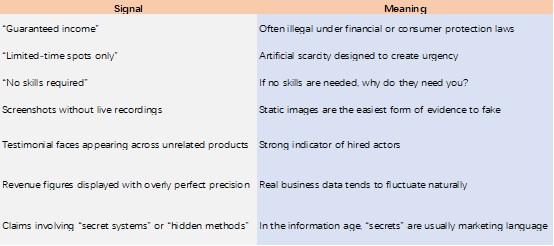
Appendix: Quick Reference Red Flag Checklist
FAQs
1. Are all passive income courses scams?
No. Some educators genuinely teach useful skills related to ecommerce, affiliate marketing, software development, investing, or content creation. However, legitimate programs usually avoid unrealistic guarantees, disclose risks clearly, and focus on long-term skill building rather than rapid wealth promises.
2. Is renting luxury cars or homes for social media content illegal?
Not necessarily. Renting luxury assets for photography or video production is legal in many countries. The legal and ethical issue arises when creators falsely present rented assets as personally owned in order to deceive consumers into purchasing courses, investments, or business opportunities.
3. Why are fake screenshots so convincing to many people?
Most consumers are unfamiliar with how ecommerce dashboards, analytics tools, or payment systems actually work. Social media also encourages fast emotional reactions rather than careful verification, making visual “proof” highly persuasive even when fabricated.
4. Can fake online testimonials lead to legal consequences?
Yes. In the United States, the FTC considers deceptive endorsements, undisclosed sponsorships, fabricated reviews, and misleading testimonials to be violations of consumer protection law. Companies and individuals can face fines, lawsuits, injunctions, or permanent business bans.
5. Why do many online gurus focus on “mindset” instead of operational details?
Operational details expose inconsistencies. Vague motivational language allows marketers to avoid answering practical questions about profit margins, advertising costs, refunds, taxes, fulfillment problems, and customer acquisition expenses.
6. Are fake followers and engagement still common in 2026?
Yes. Despite increased platform moderation, markets for fake followers, engagement pods, artificial comments, and bot-driven interactions still exist across multiple social platforms.
7. Why do some intelligent people still fall for these systems?
These schemes often target emotional vulnerabilities rather than intelligence. Financial stress, career dissatisfaction, economic uncertainty, and social comparison can make people more receptive to simplified success narratives.
8. Is passive income completely unrealistic?
No. Passive income can exist, but it usually requires substantial upfront effort, capital, technical skill, audience building, or long-term system development. Truly sustainable passive income is rarely fast or effortless.
References
1. Federal Trade Commission. (2025). FTC action against Click Profit and deceptive AI ecommerce claims. U.S. Federal Trade Commission. Retrieved from https://www.ftc.gov/
2. Federal Trade Commission. (2025). FTC v. FBA Machine / Passive Scaling permanent injunction. U.S. Federal Trade Commission. Retrieved from https://www.ftc.gov/
3. Federal Trade Commission. (2025). Paddle.com settlement involving deceptive payment processing practices. U.S. Federal Trade Commission. Retrieved from https://www.ftc.gov/
4. Inside Edition. (2024). Investigation into fake Fiverr testimonial videos. Inside Edition. Retrieved from https://www.insideedition.com/
5. Spocket. (2024). How fake Shopify screenshots and ecommerce dashboards are manipulated. Spocket Blog. Retrieved from https://www.spocket.co/
6. TikTok Creator Reports. (2024). Airbnb host exposes influencer using rented mansion as personal property. Retrieved from https://www.tiktok.com/
About the Author
Selma Idrissi
Selma Idrissi is an investigative writer covering platform economies, freelance marketplaces, creator culture, and digital labor systems. Her work examines how online platforms shape incentives, visibility, pricing, and worker behavior in increasingly algorithm-driven economies. She frequently writes about freelance platform algorithms, online success narratives, monetized personal branding, and the hidden labor structures behind seemingly automated online businesses. Selma’s reporting combines digital culture analysis with practical observations from the evolving gig economy.
Editorial Transparency Statement
This article was produced using publicly accessible information, including U.S. Federal Trade Commission litigation records, publicly reported investigations, platform policy documents, media reporting, and verifiable industry analysis.
The article does not accept sponsored placements, affiliate compensation, or promotional payments from any business, course provider, influencer, or platform discussed in the text.
Examples and case studies were selected for educational and analytical purposes only. Some personal names may have been changed or anonymized to protect individual privacy.
The goal of this publication is to improve consumer awareness, encourage critical thinking, and promote evidence-based evaluation of online business claims.
Disclaimer
This article is intended solely for informational and educational purposes and should not be interpreted as financial, legal, tax, investment, or professional business advice.
Readers should independently verify claims, conduct due diligence, and consult qualified professionals before making financial decisions, purchasing business programs, or investing in online income opportunities.
Although every effort has been made to ensure factual accuracy at the time of publication, laws, regulations, platform policies, and business practices may change over time. The publisher and author assume no liability for financial losses, business outcomes, or decisions made based on the information contained in this article.